
Book Review: "Reveries of the Solitary Walker" by Jean-Jacques Rousseau
5/5 - a lot more enjoyable this time around...

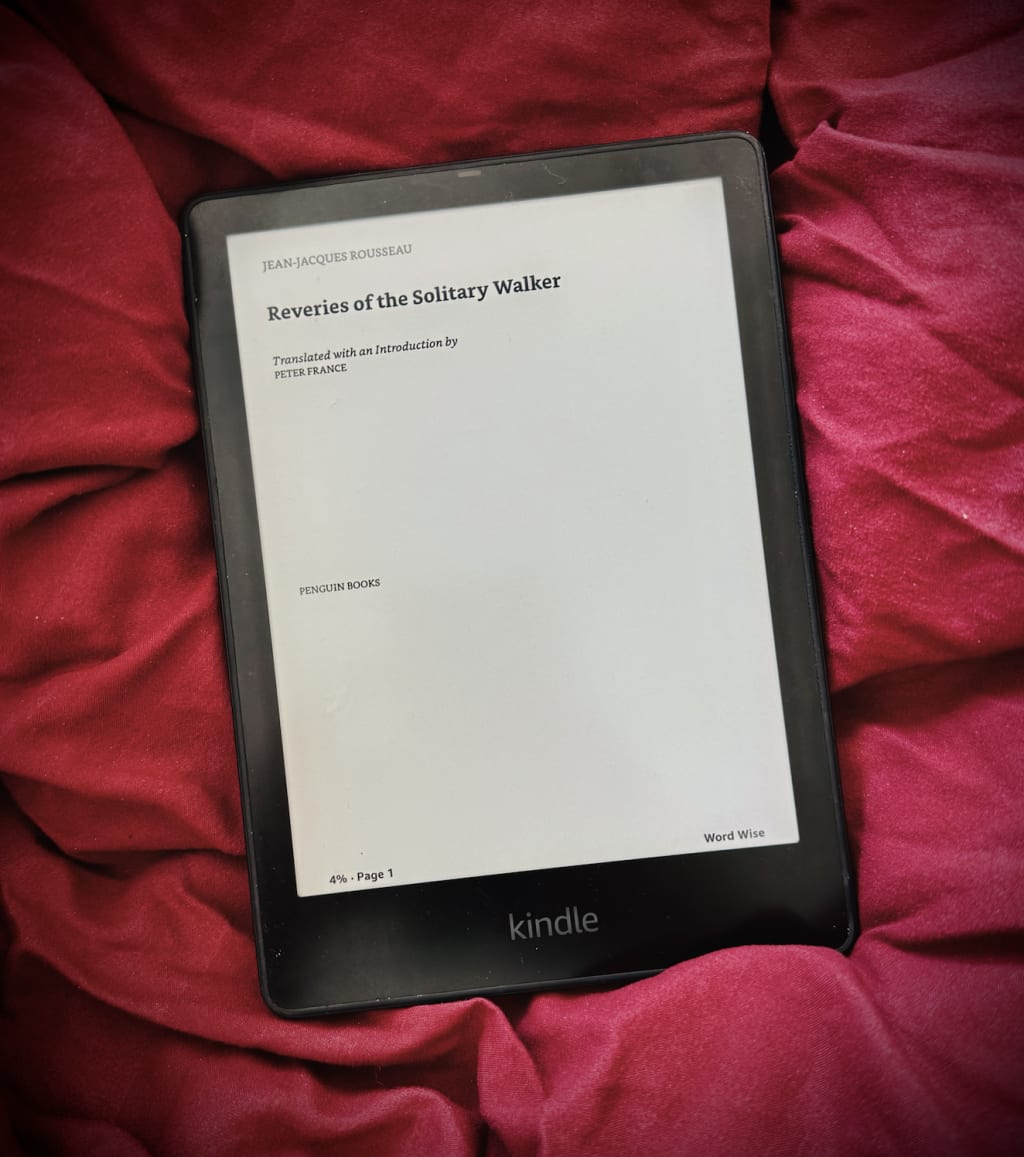
The last time I dipped into Jean-Jacques Rousseau's Reveries of the Solitary Walker I was in university. I have to admit, I didn't actually find too much enjoyment in it and that was probably because I was reading it during some examination period so I was likely stressed out. Recently, I found a copy for free on Kindle (or at least discounted, I don't remember) and I decided to give it another go. Four years' ago I did read The Confessions by Rousseau and if you want to read my ramblings about why it's important, then click here. Otherwise, let's continue...
Rousseau begins the book as a confessional, declaring himself “alone on earth, with no brother, neighbor, or friend.” He recalls how society, once welcoming, has turned against him: former allies now reject him, his reputation blackened, every attempt at reconciliation denied to him. This alienation is not a mere inconvenience but a physical exile from human fellowship.
He describes feeling persecuted, stalked by gossip, and stripped of trust in mankind. The First Walk dramatises his acceptance of this fate. Rather than rail against society, he vows to find refuge in solitude. The natural world and his inner life, unlike people, will not betray him.
Yet the tone is bittersweet: he admits to longing for affection but has learned that dependence on others leads only to suffering. The walk frames his writing as both necessity and therapy - it is a way of conversing with himself since human conversation has been denied. I honestly feel this so deeply. I however, dislike talking too much to other people. It really hits home about how much people don't care for each other and how much they likely, never have. Rousseau's wild ideas caused his books to be burned and his legitimacy to be questioned and so, persecuted, he walked away from society.
He also elevates walking into a ritual. Wandering through groves, along riversides, and down Parisian paths, he insists walking sharpens his awareness of self. The rhythm of footsteps and the openness of nature induce a contemplative state, somewhere between wakefulness and dream. In this “half-dreaming” condition, thought flows more freely than in formal study or conversation.
He calls each walk a kind of essay in motion, a journal of the soul recorded as it drifts. Unlike his earlier works, these reflections are gentle and introspective, unshaped by political agenda. The act of walking becomes a way of recovering balance: not complete stillness, which makes him sink into depression, nor excessive activity, which agitates him, but a steady, bodily rhythm that nurtures reverie. I may not be someone who enjoys aimless walks because I don't see the point in them and they really do nothing for me, but I do like reading about people who take them and get lost in the depths of their own thoughts.
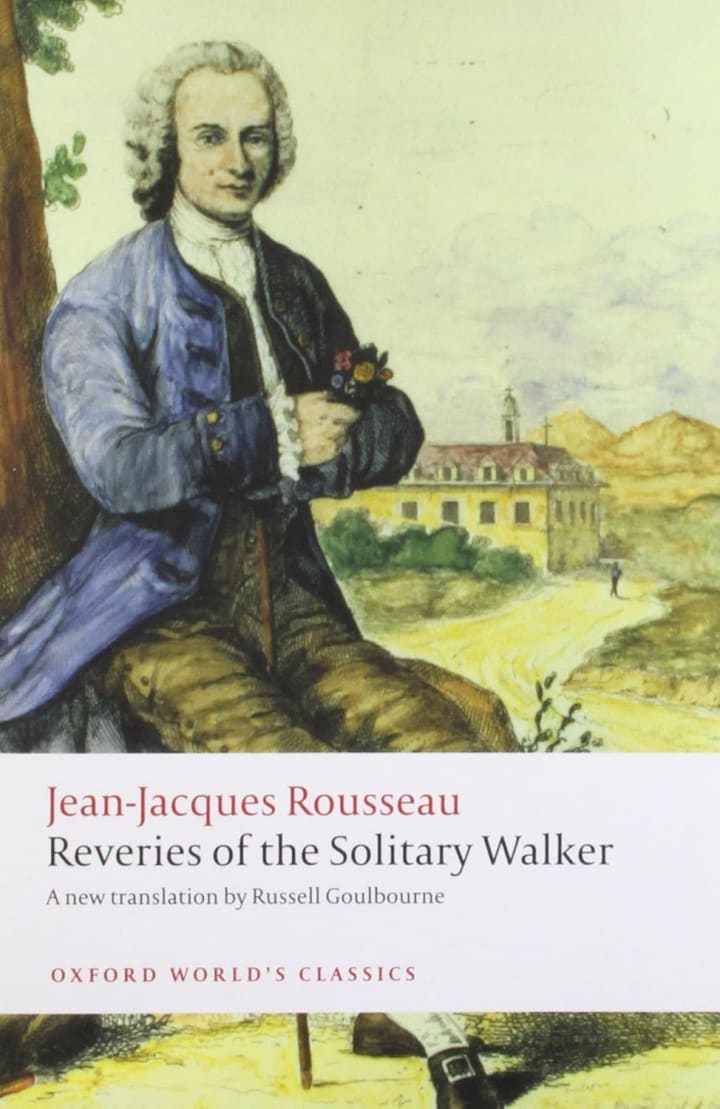
One of Rousseau’s most famous reveries recalls his stay on the Île de Saint-Pierre in Lake Bienne, Switzerland. Here he experienced an almost idyllic solitude: tending to gardens, studying plants, caring for rabbits, rowing across the lake, and losing himself in long, meditative strolls. He describes the pure, wordless joy of floating in a boat, letting the current drift him as he gazed at the sky and listened to ripples.
The memory becomes a symbol of what solitude can offer: peace untainted by ambition or rivalry, a harmony between body and world. He compares the rhythm of island life to the rhythm of his walks, an ideal tempo for reverie, neither too hurried nor too idle. The episode becomes Rousseau’s proof that serenity is possible in this life, though fragile and rare. I think that finding that serenity in modern life is even more rare. We go nowadays from screen to screen and the whole world believes they know who we are based on roughly 2% of the information posted to the internet. It's like there's no room for just having peace and not giving a damn about anyone's opinions. Rousseau was really hitting some nail on the head with this one.
Another one of Rousseau’s deepest philosophical thoughts is his meditation on self-love (amour de soi) versus vanity (amour-propre). Society, he argues, corrupts natural self-love by tying it to comparison and status - which is more true today than even in Rousseau's own time. Think about how social media produces 'rage bait' to pit people against each other. If you can't see that it is the exact same thing on a larger scale then I have news for you buddy.
Pride and envy are born when we measure ourselves against others’ judgments. In solitude, freed from the gaze of rivals, he can return to a purer self-esteem: respecting himself for virtue rather than reputation. He pledges to devote his last years not to pleasing others or chasing fame, but to cultivating an inner moral life. His exile thus becomes a philosophical choice: solitude strips away false pride, leaving only authentic self-respect. This I have to say is something that many people realise when quitting toxic social media applications such as Instagram today. Especially for women in the modern era, comparison is the one thing that people love to hound them with. Rousseau again, makes an excellent point about regaining self-respect and virtue by leaving places which commit you to wounding and shallow comparisons based on slight pieces of information that are more than often made-up for the sake of the comparison itself.
Rousseau wrestles with loneliness but insists that solitude is preferable to toxic company. He recalls moments when malicious people took pleasure in his downfall, and he concludes that to remain among them would degrade him. To protect his integrity, he embraces solitude, even if it is painful. He presents this not as escapism but as survival: it is better to live without society than to be corrupted by it. His solitude thus becomes heroic in tone as he is choosing honesty with himself over complicity in cruelty. This choice reflects the broader philosophy of authenticity: better to be true and alone than false and celebrated.
This is probably my favourite philosophy of the whole book but is also lacking a hell of a lot in our own world today. Rousseau makes an excellent comparison between the self and society and how, well, society is basically run on those who believe that their opinions are worth more than they are. It also feeds into the theory that a lot more people are below average intelligence than we care to think. They work together. Those who are at the lower end of the intellect scale have the loudest and often, the most inarticulate opinions. They fail to see both sides, they often aren't very literate and more than that, they are brainwashed easily by a corrupt society whilst simultaneously believing they are part fo the 1% when it comes to intellect.
My finest example would be male podcasters whose entire personality is 'tradition' in gender roles and the 'greatness' of the western world to compensate for a considerable lack of likability. I could put all of my money on the fact that you reader, having made it this far into a long review, have probably read more words in one sitting than all of these men have combined in their lifetimes.
The book’s last section is left unfinished, breaking off mid-thought. Rousseau’s reflections simply stop, as if the reverie dissolved into silence. This incompleteness carries symbolic weight: life itself is an unfinished reverie, ending without a final, controlled conclusion. We walk off into the distance. Perhaps we are all unfinished walkers.
About the Creator
Annie Kapur
I am:
🙋🏽♀️ Annie
📚 Avid Reader
📝 Reviewer and Commentator
🎓 Post-Grad Millennial (M.A)
***
I have:
📖 300K+ reads on Vocal
🫶🏼 Love for reading & research
🦋/X @AnnieWithBooks
***
🏡 UK
Keep reading
More stories from Annie Kapur and writers in Geeks and other communities.
Book Review: "The Collected Dorothy Parker" by Dorothy Parker
I'm not a big Dorothy Parker reader and have only read a tiny bit in my time. I am by no means a fan. I'm going to be very honest with you here. There was a deal on the online used bookstore and so, I needed a good, cheap book to add to the deal so I could get one of my books for free. I'm looking at doing the same thing but I'm not sure which book I want for free. Anyways, Dorothy Parker's stories have been more entertaining than her poetry (which I'm more on the fence about). So here we go: a review of The Collected Dorothy Parker. And let's keep it to the good stuff, shall we?
By Annie Kapur6 months ago in Geeks
History of The Three Stooges (Part I: The Beginnings and Columbia Pictures - 1920s-1936)
I have been itching to write about The Three Stooges on Vocal for close to two years, but I couldn't figure out how to do it. I wanted to do it by third Stooge, but that's a bit complicated. I know this much. I was about eight or nine years old when I first saw The Three Stooges. I remember one of my local channels had the Stooges on for hours, and I tried my damnedest to be up for those shorts. I remember that the Family Channel actually had an hour of the Stooges on from 11PM to midnight, and it was the entire library on during that time.
By Clyde E. Dawkins4 days ago in Geeks
Did an Israeli Missile Strike the North Korean Embassy in Tehran?
Introduction The escalating conflict between Iran, Israel, and the United States has generated intense global attention and a flood of breaking news reports. Amid the chaos of missile strikes, air raids, and political accusations, one dramatic claim began circulating online: that an Israeli missile had struck or destroyed the North Korean embassy in Tehran. The report quickly spread across social media platforms, raising questions about whether a diplomatic facility belonging to North Korea had been caught in the crossfire of the widening Middle Eastern conflict.
By shaoor afridi5 days ago in Geeks


Comments (2)
I am a walker, and I have his "Confessions" and this book on standby.
Another excellent and interesting review, I have so much on my Kindle, but it is great for train journeys. Thanks again Annie