
Book Review: "Question 7" by Richard Flanagan
5/5 - a memoir, a history, a travel narrative, an essay... all in one...

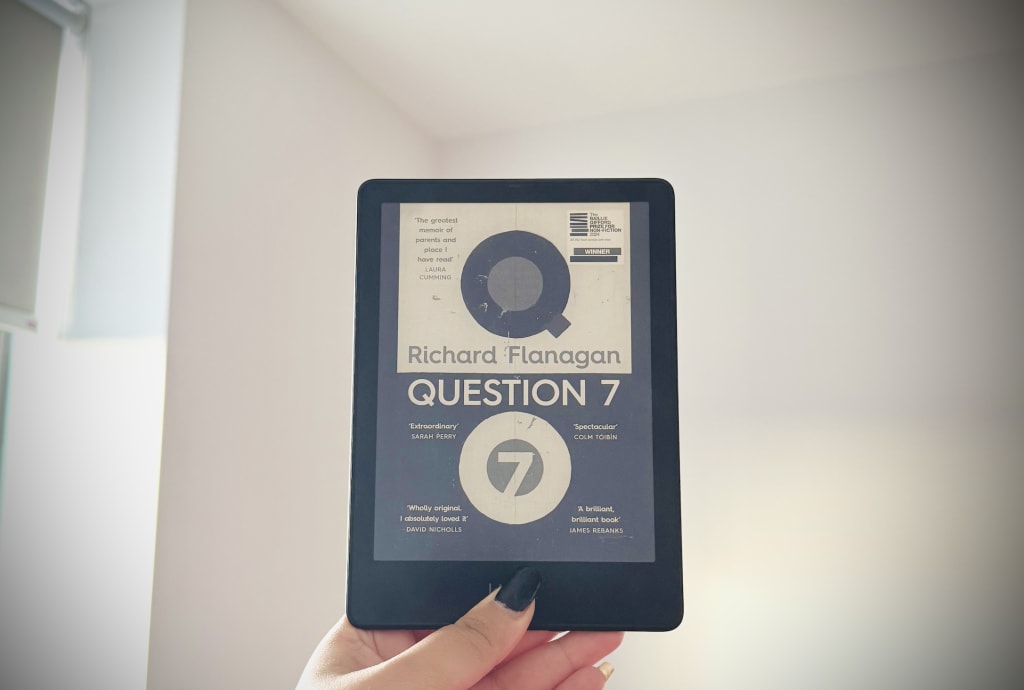
Richard Flanagan is not really an author I choose to read often but I'm definitely glad I picked this one up. Question 7 was not a book I had heard a lot about but it was always popping up on recommendations lists on Amazon. Since reading it, I have seen some mighty prose written, some great side stories investigated, some incredible histories looked into and more. I'm going to say this: if you like straight-forward memoirs then this probably isn't for you - Flanagan blends the imperfection of history with his own and his family's. I thought it was such a great book. A genuinely experimental achievement.
First of all, this book is not just a memoir, it is also a travel narrative, a philosophical investigation and a piece of nonfiction history. He visits the POW camp in Omaha, Japan to see where his father was once kept and looks at the way in which the slave labour camps were often hidden from the general Japanese even though they were, in fact, very real. When he tries to understand what his father went through from other people, we find that not a lot of the other people hadd even heard of the slave labour camp and there's hardly any documentation supporting its existence. The frustration and the reckoning with history is definitely something I adored about the way the book opens. It definitely presents history as being filled with holes - some things are accidentally left out and some are purposefully left out.
Surviving the Japanese POW camp seemed impossible to me, but the way in which Flanagan's father did survive was basically because a huge few bombs were dropped on Japan killing hundreds of thousands of people. It is a weird twist of fate and honestly, I genuinely dislike reading things about the Japanese bombings because it is so upsetting. But it really adds another layer of 'weird history' to the narrative. The author visits the question of the fact he is alive because of mass civilian death and this definitely starts digging into his identity. But, when it comes to the war - the question of whether the bombs were the thing to end the war is a huge question that is left unanswered even if some people believe it.
Another part of the book deals with the affair that HG Wells had with a woman named Rebecca West and deals with the way in which one thing can inexplicably lead to something even worse. One event leads to another but the link is often strange. HG Wells' writing of The World Set Free leads to some nuclear research later on and obviously, this plants the seeds for some very real destructive influence. The fact that Wells wrote The World Set Free under the passionate influence of Rebecca West, does this mean that the love itself was wrong? There is a strange question of this which underlines the novel.

Woven into the narrative is Flanagan's homeland of Tasmania, Australia. The genocides of the people, the loss of major wildlife, the history of a place which I have to say in conventional world history, is often forgotten. Tasmania becomes both home and haunted territory, emblematic of human violence and environmental negligence. The writer often feels this underlying sense of shame and a bit of trauma too about the way in which Tasmania has not only been treated but how it has treated itself.
One of the things I loved about this book though is his meeting with Mr Sato where he tries to find out why good people do evil things because it is expected of them at the time. It definitely makes us question the horrors of history and those who took part in small roles, often for self-preservation out of fear of something worse happening to them. I often think about this when it comes to something like the rules of tyrants. Often surrounded with 'yes men', how many of them actually believed what they were saying and which of them were simply trying to stay alive?
All in all, I thought this book was fantastic. Again, it is not your usual memoir and deals with how histories often weave themselves into each other. It is a place where the past, present and future coexist and one cannot exist without the other two. I hope you consider this book as I have. It is brilliantly written.
About the Creator
Annie Kapur
I am:
🙋🏽♀️ Annie
📚 Avid Reader
📝 Reviewer and Commentator
🎓 Post-Grad Millennial (M.A)
***
I have:
📖 280K+ reads on Vocal
🫶🏼 Love for reading & research
🦋/X @AnnieWithBooks
***
🏡 UK
Keep reading
More stories from Annie Kapur and writers in Geeks and other communities.
Book Review: "A Very Short Introduction to Heidegger" by Michael Inwood
As you know even though I've been to the library I can't seem to stay away from a good Kindle book as well. Back when I was in university, there was a bookshop on campus that sold a whole collection of these books and I never bought them because they were so short that I really couldn't get my money's worth. Anyways, enough history - I finally managed to get a couple of them for cheap on Kindle. This one is on the philosopher Martin Heidegger and apart from the obvious (the fact that he was an avid supporter of the Nazi Party), it also covers what he did in terms of the subject he was a part of.
By Annie Kapur7 months ago in Geeks
The Rachels - 2025
Much to my surprise, I have kept a list of the films I‘ve seen this year. I daresay it isn’t complete. There will be films that snuck in on a late night in front of the TV that I would’ve forgotten to note. Or others, that I went to watch at the cinema, but then had a red wine and promptly forgotten about. But it’s not a bad approximation of the films I’ve seen this year. In total, there are 53 films listed, so an average of one a week and one for good luck.
By Rachel Robbins26 days ago in Geeks



Comments (1)
This book smacks of all my passions, family memoirs, history, and spiritual cores. Thank you for bringing it to my attention.