
Book Review: "A Very Short Introduction to Heidegger" by Michael Inwood
4/5 - Inwood is a better writer than the man he is writing about, for sure...

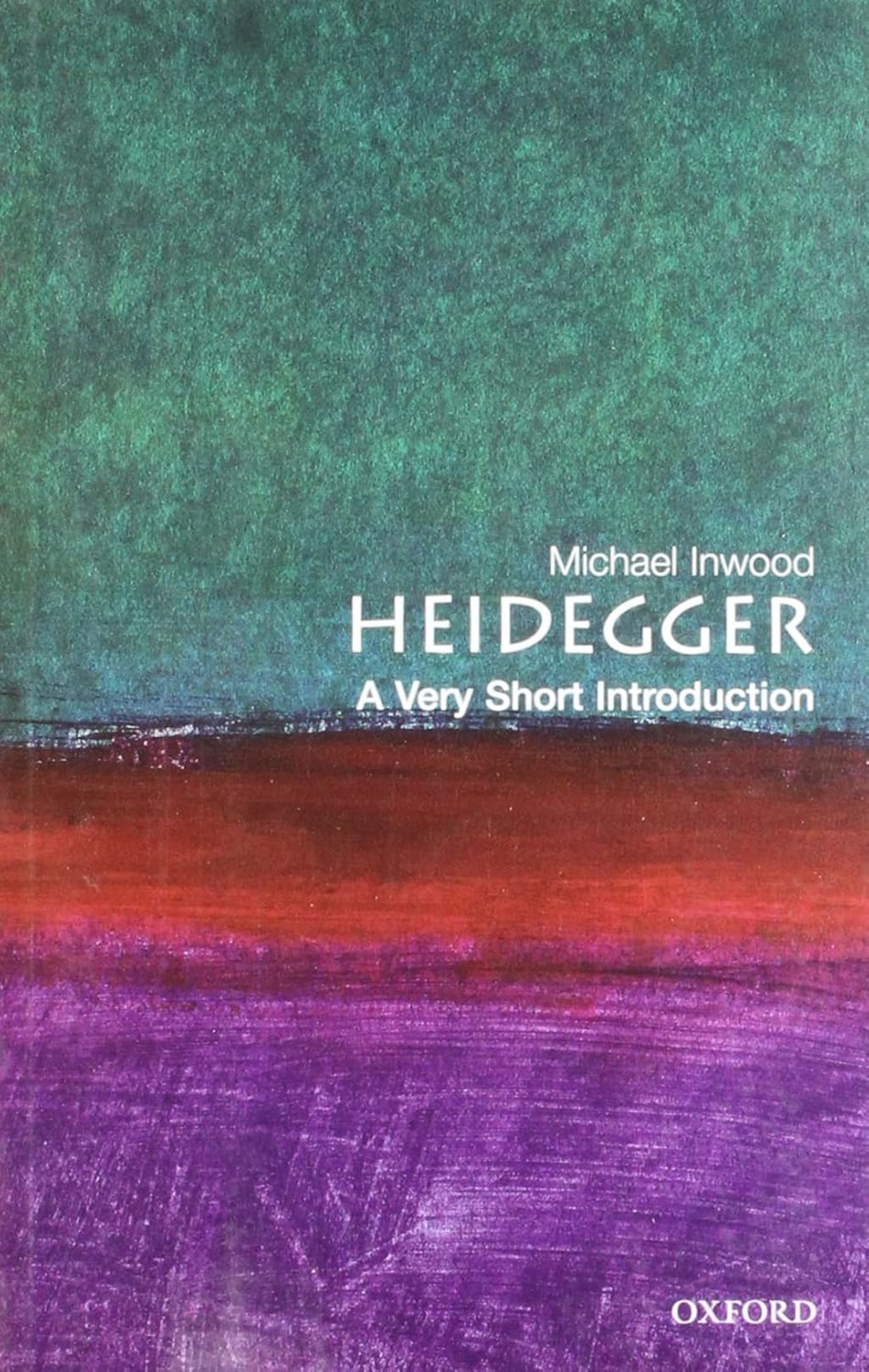
As you know even though I've been to the library I can't seem to stay away from a good Kindle book as well. Back when I was in university, there was a bookshop on campus that sold a whole collection of these books and I never bought them because they were so short that I really couldn't get my money's worth. Anyways, enough history - I finally managed to get a couple of them for cheap on Kindle. This one is on the philosopher Martin Heidegger and apart from the obvious (the fact that he was an avid supporter of the Nazi Party), it also covers what he did in terms of the subject he was a part of.
I think I can speak for everyone when I say that Heidegger is purposefully obscure and a terrible writer, though he does make some interesting points. However, I don't think personally, I can get past the whole Nazi thing because it just seems very weird for a guy who initially left the priesthood to go and face another ideology. Not just that, one that is clearly more dangerous than say, just being a calm little Christian. It was this active anti-Semitism that I think people don't tend to read Being and Time nearly as much as they probably used to.
The author goes through the essential ideas of the philosopher in simple terms and even though I did a little bit of this guy at university, I feel like this author definitely clears it up a whole lot more than whatever I was taught (sorry to my professors). Concepts like authenticity, guilt, angst, and care are investigated. Life's authenticity is about confronting mortality and so, something like angst reveals the 'nothingness' about life. I know, it's difficult and sounds almost pointless but it's nice to understand a few things rather than just sitting there thinking about what the whole thing is about.
The author also goes through how Heidegger reconceptualises time. Is it linear? No. Instead it is a series of temporal ecstasies in which the past, present and future are simultaneous (I think). Our awareness of death and dying gives time this special power of knowing it is finite. And so, only when we acknowledge that this is finite, only when we know time will eventually run out for us, we will live authentically. This seems overly simplistic and also seems a bit too 'live, laugh, love' to be Heidegger but it is definitely the honest truth on what this whole thing is about.
The next thing I understood of the author was that he was trying to tell me something about truth being revealed through the language of poetry but honestly, even though it was explained well by Inwood - I don't think Heidegger's essays explain this well at all. It goes back to his obscurity issue. I think we can all see that the idea is there, but when the philosopher goes off expanding it, it becomes lost. However, Inwood comes to our rescue on this one in which he actually explains the shift in Heidegger's focus across essays in which he becomes more and more involved in how art discloses our truths to us.
Inwood definitely doesn't turn away from perhaps the most obvious thing about Heidegger which is the fact that he was a Nazi. Heidegger's critiques of modernity in the 1930s definitely support the fact that he was destined for Nazism and terribly so. In this period, Inwood explains that Heidegger turned towards Nazism as he did towards nationalism, rejecting rationality for something else entirely. Again, it is odd for a man who turned down the priesthood to go towards Nazism, but definitely not unheard of. Some people just need an ideology and he fell into the wrong one.
I won't lie, Heidegger has some good ideas but all of them seem a little obvious or a little out there, there's really no in between. It's Heidegger's own writing I've always found unreadable. It has become the standard kind of jargon-filled excrement that litters the philosophical world and, as a philosopher he was perhaps more mediocre than a lot of people like to think. Be that as it may, Inwood's book is brilliant. He breaks down everything and fits it all into a short introductory text. I would say that out of the two, Inwood is the better writer by a long-shot.
About the Creator
Annie Kapur
I am:
🙋🏽♀️ Annie
📚 Avid Reader
📝 Reviewer and Commentator
🎓 Post-Grad Millennial (M.A)
***
I have:
📖 280K+ reads on Vocal
🫶🏼 Love for reading & research
🦋/X @AnnieWithBooks
***
🏡 UK
Keep reading
More stories from Annie Kapur and writers in Geeks and other communities.
Book Review: "Happy" by Derren Brown
I've only recently finished this and honestly, I was surprised. I've read books by Derren Brown in the past but none were like this one and it definitely made me realise that perhaps I was wrong to put it off for so long. It's June 2025 and I've been thinking about this book for a while. I mean I did finish reading it a couple of days before writing this review and I was wondering where I stood on the whole thing. I can confirm that I did very much enjoy it, however for the topic it was about, sometimes it did feel like the author was dragging out some of the points beyond where they needed to be. Let's take a look...
By Annie Kapur7 months ago in Geeks
Marvel Zombie
The last entry into our 2025 superhero projects catalogue is Marvel Zombies. This was a show that was anticipated by absolutely no one and it disappeared from the public consciousness as quickly as it was released. There was nothing special about the project that made it a must see, or a must remember. In fact if anything it's a must forget.
By Alexandrea Callaghan26 days ago in Geeks
Emma Watson, Sir Lenny Henry and Sir Elton John lead British Diversity Awards
The prizes will be handed out at a glittering ceremony in London on March 25 2026 and Harry Potter actress/activist Watson will compete with Henry and John for the top gong of Media Personality of the Year with the musician competing alongside his husband David Furnish.
By Dena Falken Esq6 days ago in Geeks



Comments (3)
Oh wow, from priesthood to nazism? Wow, that's shocking! Loved your review!
He was a turd of a human being for supporting the goosesteppers - at the same time as having a Jewish mistress (Hannah Arendt, also a student) - and he got off easy when the war ended. But he also gave us the idea of deconstructionism, and was a brilliant thinker. I thank you for this. I had one book in this series on archeology and was impressed they crammed so much between two covers.
I only know Heidegger from "The Philosophers Song" thank you for this interesting article