
Book Review: "On Tangled Paths" by Theodor Fontane
5/5 - the avoidance of cliché, the betterment of character...

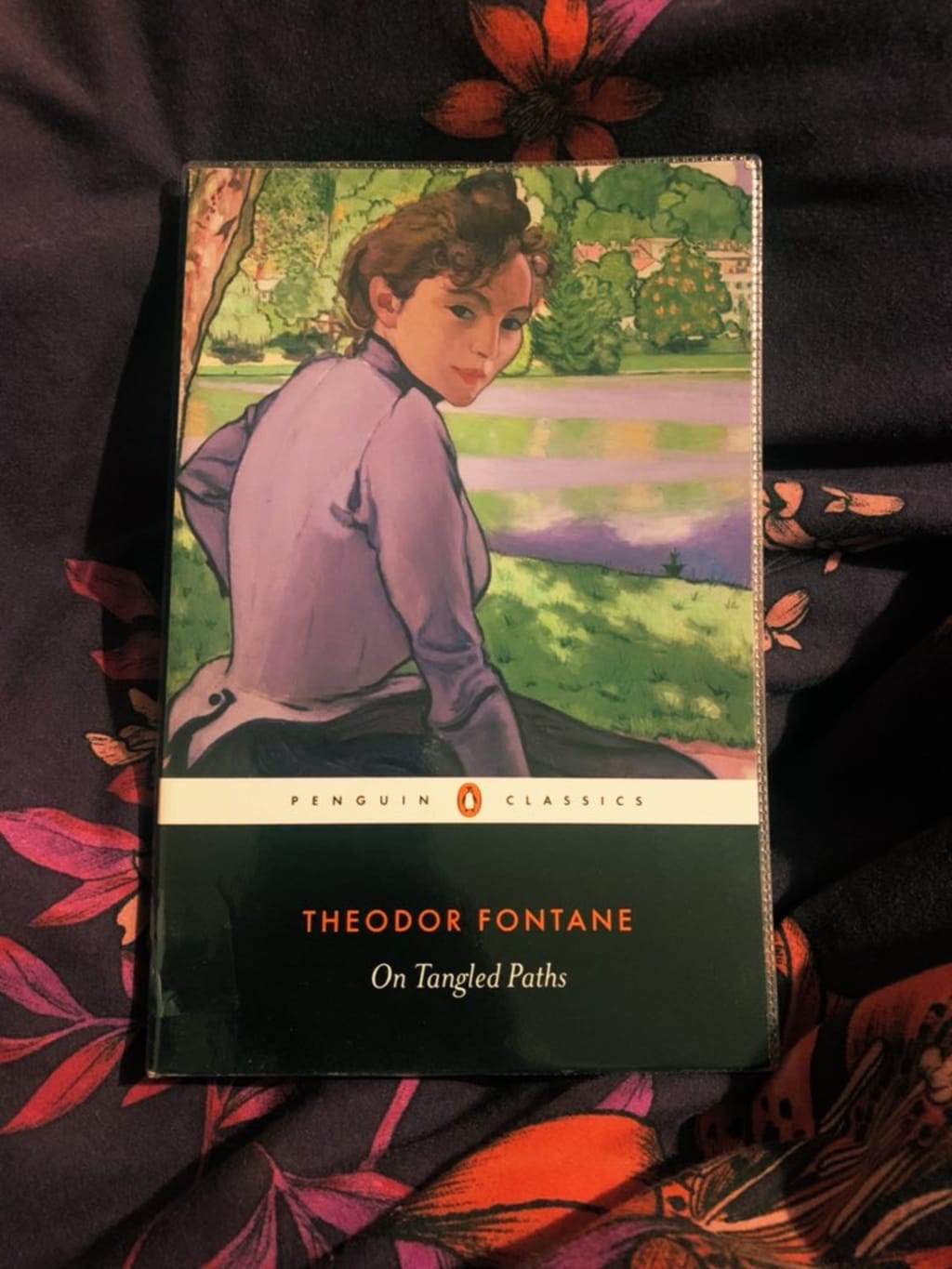
Theodor Fontane has been a difficult one to place because I haven't read him in a while now. His character of Effi Briest seems to be an individual but, in comparison to something like Anna Karenina, Effi Breist seems to fall into some of the common clichés of a male author writing a female character, something that Anna Karenina does not. That is simply what turned me off reading Theodor Fontane for a bit and when I said that to someone, they recommended I read On Tangled Paths, since the female character is somewhat better in this one and I'd like her a lot more. Why? there are less male writing clichés. I gave it a go and for me, it gets the thumbs up for less cliché-ridden character.
Her name is Lene. Lene is a seamstress and she is in love with an aristocrat named Botho. I think that the important thing here is to remember that Theodor Fontane gives us a beginning to a book almost every single time, but rarely drops us in at the beginning of the story. There is always something that has already happened and I think with the story of Lene and Botho, it works better than it does with his other, more famous text. I think that this is primarily because of the nature of the characters in the book - they are so different and so, there is always a suspicion from the reader about the 'how' of the story. It is something that Theodor Fontane alludes to, but does not gives us as an explicit part of the narrative. The love is therefore, somewhat unstable - the strange reason for the love being something that the reader cannot really wrap their head around happening in real life and yet, it has actually happened. It doesn't end up in the same position, but it happens all the same. Lene is therefore the character of tragedy and though the tragedy isn't intense, it does an awesome job of stirring interest in the reader from beginning to end.
The character of Lene is juxtaposed to the character of Botho as well, something I like to see in a story centred on love and free will. Where Lene can be said to be something strong because of her background in the working class, Botho is somewhat dull and a bit stupid. He doesn't have any willpower, he doesn't have any resolution and his aristocratic nature is somewhat pretentiously silly. He is almost like a caricature of the young men of the upper class being able to do absolutely nothing for themselves. Kind of like an overgrown child but yet, he is also likable. The cliché thing to do would be to make him wholly unlikable and yet, Fontane reverses this and makes the reader enjoy his existence and nature. It is very clever and yet, it is also very readable. It doesn't leave the reader thinking 'a-ha.' But instead leaves the reader with a sense of sorrow for the character, like we are supposed to pity him in a way.
Between these characters and the minor ones, such as Gideon Franke, I think that Theodor Fontane produced a great and yet short book that displays the true pessimism of socially unacceptable love. It is a really harsh look at the psychological brutality of love when it isn't accepted by the higher classes and yet, there is something that pains you as the reader when you too must fight for Lene and Botho. Out of everything though, I also think that it is Fontane's ability to create such vivid characters that makes this book incredible.
About the Creator
Annie Kapur
I am:
🙋🏽♀️ Annie
📚 Avid Reader
📝 Reviewer and Commentator
🎓 Post-Grad Millennial (M.A)
***
I have:
📖 280K+ reads on Vocal
🫶🏼 Love for reading & research
🦋/X @AnnieWithBooks
***
🏡 UK
Keep reading
More stories from Annie Kapur and writers in Geeks and other communities.
Book Review: "Edward IV: The Summer King" by A.J Pollard
As you probably already know (and I have said this so many times now it is really becoming tedious even for me), I am reading one book about every single king and queen of England from Edward the Confessor all the way to our own times. So far, I have read a book by Edward the Confessor, William I, William II, Henry I, Stephen, Matilda, Henry II, Richard I, John, Henry III, Edward I, Edward II, Edward III, Richard II, Henry IV, Henry V, Henry VI and now, finally I am reading a book about Edward IV entitled Edward IV: The Summer King by A.J Pollard. Edward IV is a king I know a fair bit about having studied the Tudors and the Wars of the Roses ad nauseam at schools in the past.
By Annie Kapur4 years ago in Geeks
Affection and Healing for Yourself
During the night of the last quarter moon, I gathered my ritual supplies. I carefully handled the chunk of black tourmaline that would protect me from your overall negative and narcissistic energy. I carefully walked the house with my stick of selenite in hand, asking the universe to cleanse our working space.
By Alisha Wilkins ✒️🦋🖋️7 days ago in Fiction




Comments
There are no comments for this story
Be the first to respond and start the conversation.