
Book Review: "Monsters: A Fan's Dilemma" by Claire Dederer
3.5/5 - Respect the art, not the artist...

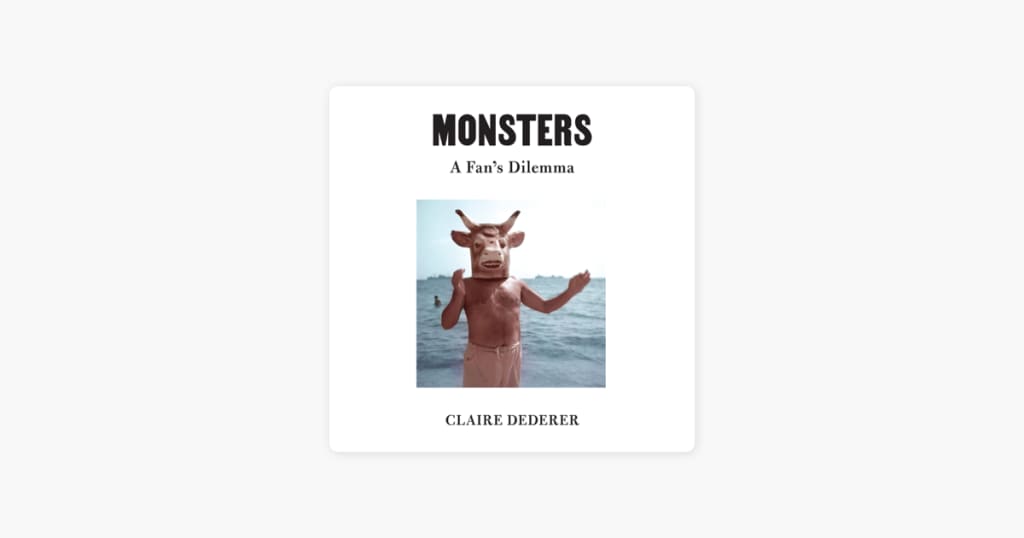
I think that the argument in this book has been asked by many of us over the course of our lives and, in some respects, we have been shying away from saying what we really think about the whole ordeal in favour of presenting virtue and dishing out our own protest spirits - it is, however, an act of narcissism all the same. Of course you don't have to tell people what kind of media you do and do not consume. I went through entire years of knowing people who barely knew anything about me. Why? It wasn't important.
Anyways, Monsters is a book that gives us the ultimate million-dollar question: If they are presumed to be a bad person, can I still consume their media without being a bad person? And the answer in this book is a sort-of-yes. It is hard to say whether it is really a 'yes' because, for the first few chapters of the book, you really get critical and analytical - but it descends into anecdotes and a he-said-she-said later on that is far less readable.
Chapters that amazed me were ones that I found myself sort-of-agreeing with (the term 'sort-of' will be used intermittently throughout the review). This included a chapter on Woody Allen where the author discusses his past mishaps, his terrible reputation as a human being and his questionable relationships. But then, the author also discusses how good it feels to watch something like Manhattan - which I have to admit, it is a good feeling. When I think about the films of Woody Allen, like the author, I feel like I have to look over the life of the artist in order to enjoy them. Midnight in Paris for example, is a brilliant movie and so artistic. The author discusses the need to forget about the artist themselves as human beings in order to consume this media. But, the author also tells us why that doesn't particularly make us bad people ourselves.
First and foremost, there is virtue presentation. It is a form of narcissism to say 'I don't consume 'X' because it was made by 'Y' and 'Y' is a terrible person.' The only reason someone would not consume 'X' is because they want to say it to someone in order to make themselves feel better and more virtuous. This is an argument presented in the book that I feel I have to agree with for as much as I don't like terrible human beings, I also don't like people who have done nothing to be congratulated about presenting themselves as virtuous. Our culture today is so focused on the presentation of ourselves that often we actually forget that there were actual people hurt in the Roman Polanski affair, or the R.Kelly imprisonment, the Woody Allen 'relationships' and the list goes on. Instead, the want to present the self as virtuous in protesting against these folks by not consuming their media seems to be far more important to the consumer than anything else.
The second question posed by this book is: Is it wrong to like media created by bad people? The answer that the book poses is a 'sort-of -no'. This is because the media being consumed is consumed as art, in which for a space of time, we are not focused on the artist and their lives. The whole point of the art is that the artist themselves should not be important for that time - whether it be 2 hours or 3 minutes. The answer that I pose is a definite no because I believe that nearly all art has been created by someone who had a fault within them. If that isn't the case then we wouldn't be sitting around re-watching Iron Man would we?
I think that the downfall of this book has to be near the middle and later on since the book itself goes from a more critical read littered with short anecdotes to an anecdote-heavy read where the reader who wants to read about these philosophical questions ultimately loses interest in what the author has to say. It has a great concept and I would love to see it delved into more, especially the argument to do with virtue signalling in the 21st century. But alas, the book turned into something of a tabloid where the author became more obsessed with talking about herself than the topic at hand.

Though some of the chapters also deal with women, I think this book is far too good at depicting the monstrous men of art including Hemingway, Polanski, Woody Allen, Miles Davis, Pablo Picasso and more. I give it the rating I do since obviously, the chapter on Woody Allen is my favourite. I agree wholeheartedly with the author on this one: I despise the man himself, but those are some really good movies.
About the Creator
Annie Kapur
I am:
🙋🏽♀️ Annie
📚 Avid Reader
📝 Reviewer and Commentator
🎓 Post-Grad Millennial (M.A)
***
I have:
📖 280K+ reads on Vocal
🫶🏼 Love for reading & research
🦋/X @AnnieWithBooks
***
🏡 UK
Keep reading
More stories from Annie Kapur and writers in Geeks and other communities.
Book Review: "The Trouble with Happiness" by Tove Ditlevsen
The great thing about being able to read Tove Ditlevsen is being able to identify the prime causes for concern in human interaction whilst alongside it, ignoring red flags in your own life. The observations made within this text of short fiction may start off as small annoyances, little mistakes and boundaries unset - but they evolve into abuses, ignorances and intolerances for behaviour.
By Annie Kapur2 years ago in Geeks
Marvel Zombie
The last entry into our 2025 superhero projects catalogue is Marvel Zombies. This was a show that was anticipated by absolutely no one and it disappeared from the public consciousness as quickly as it was released. There was nothing special about the project that made it a must see, or a must remember. In fact if anything it's a must forget.
By Alexandrea Callaghan25 days ago in Geeks
Why The Last Holiday Still Resonates Even 20 Years Later
Plot Summary Georgia Byrd, a kindhearted but shy department store employee, discovers she has a terminal illness. Faced with her mortality, she decides to abandon her mundane life and take a lavish vacation to Europe, determined to live life to the fullest before her passing. Along the way, Georgia embraces adventure, discovers her own courage, and forms unexpected friendships that change her outlook. Amid luxury hotels, fine dining, and breathtaking scenery, she also encounters romance and laughter, learning to cherish every moment. The Last Holiday is a heartfelt story about finding the true joy of life and self-discovery.
By TheScreenAnalyst6 days ago in Geeks



Comments (1)
I had the same dilemma a few years ago: there was a Woody Allen film festival here and the theatres were packed. But some people were very critical of the programmers for hosting the event. The problem with art is that it is made by human beings. I studied literature, and I realized very early on that there are few saints in the pantheon. Always consider the black and the white in all of us. It is what makes us human.