
Book Review: "Modern Man in Search of a Soul" by Carl Jung
4/5 - this book presents the best definition of a 'soul' that I have seen in a long time...

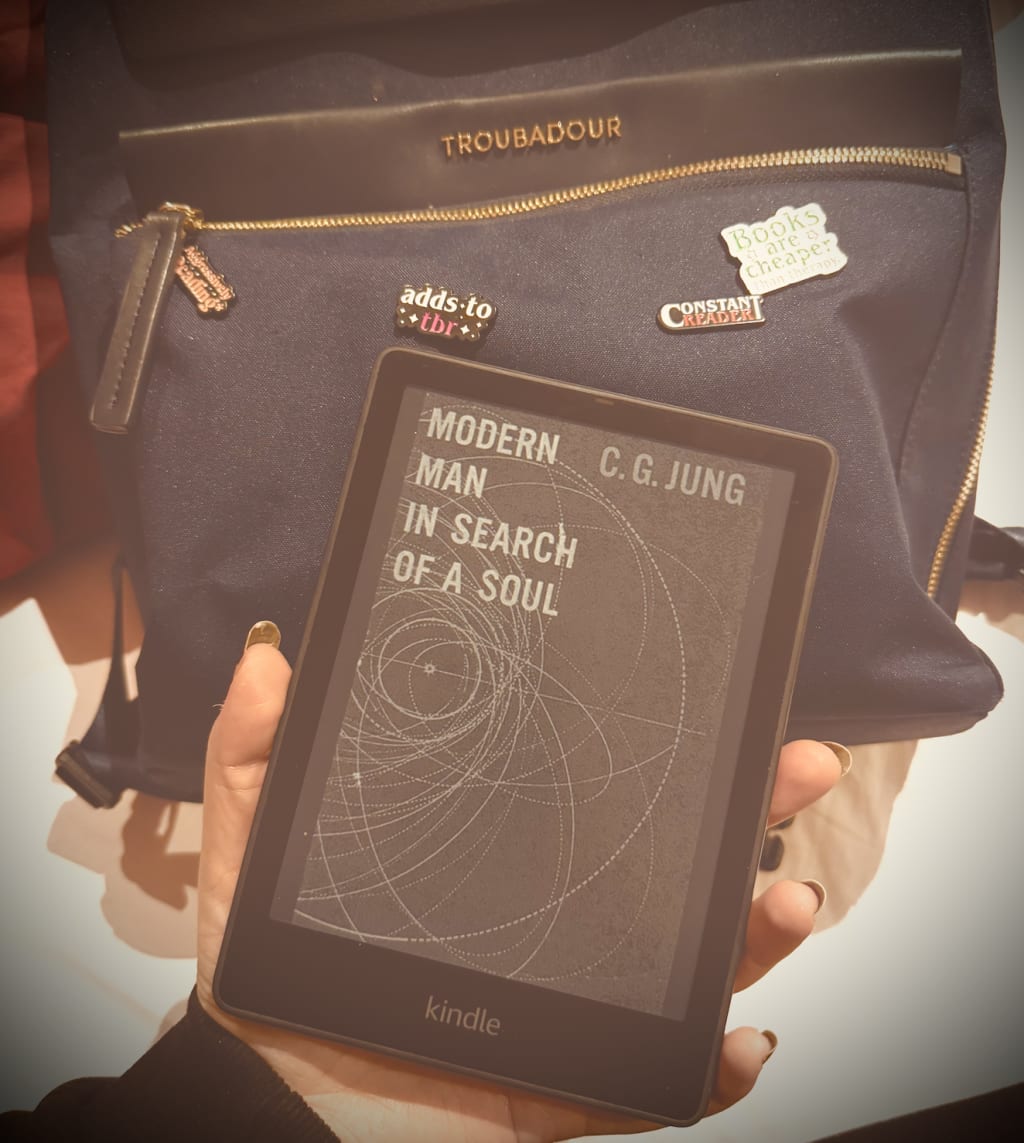
What happens when we strip human life of meaning? Well, according to Jung, everything begins to go wrong for us. From the moment we started to have control over nature, we start to descend in meaning and value. Rationalism may have brought us comfort in understanding, but it has also brought us less meaning in our soul. I'm not going to lie, if a book doesn't define what a 'soul' or a 'spirit' is, then I have no interest in the argument. The issue is that Jung takes us on a journey in which we start to understand what the soul is - or at least, what it is meant to consist of. So even though I don't agree with all of it, I understand where he is coming from when he talks about the subject of a 'soul'. Science can provide us with understanding but cannot answer the larger, more existential questions regarding ourselves.
One thing we must understand here is that Jung states that Freud's analysis is good, but also limited in its approach. Yes Freud's uncovering of the subconscious and unconcious mind is very progressive for the area of study, but to limit the analyses to sexuality and repression is a limitation that Jung feels he cannot ignore. Jung argues that Freud's approach flattens the complexity of the human psyche and ignores its symbolic, spiritual, and creative dimensions. Jung himself would like to expand the analysis beyond pathology and so, make the understanding of the 'psyche' part and parcel to this approach to understanding the 'soul'. This is perhaps the closest actual definition of the 'soul' that I could find in the book and I am mildly surprised by it. Most people who attempt to define the soul make it a separate entity of its own, whereas Jung wants it entirely integrated and codependent on the psyche.
Psychological health, Jung argues, depends on individuation: the lifelong process of integrating unconscious contents into conscious awareness. Rather than striving for normality or conformity, individuation requires confronting inner contradictions, shadows, and unresolved tensions. A meaningful life emerges not from perfection but from wholeness. I think this seems almost obvious today and is written into every single 'wellness' teacher's handbook. However, at the time it would have been quite revolutionary and Jung, unlike the wellness industry, tries to root his research in the health of the individual's soul and psyche. There's something much more connected to the id, ego and superego here that many people today would like to admit. It's not all about neurology and dopamine - it is also about our actual personalities.
Jung takes the concept of 'religion' and looks at the idea of cultish mindsets as parts of our sense of belonging. The necessity to belong may not be simply a religious one at all, it could be replaced by political ideology, or even the opinions we hold about art. These beliefs, Jung states, create a shared language for inner-experiences - but he does seem to lean heavily into the argument for holding a religious belief over any other. I have to say that I do not agree that religion is important when it comes to living your life. It can be helpful for some, and it definitely helps some people (who may attend these religious institutions) to socialise with others - I don't think it is helpful for everyone. For some people, like myself, it was a constant hinderance that I ultimately had to let go.
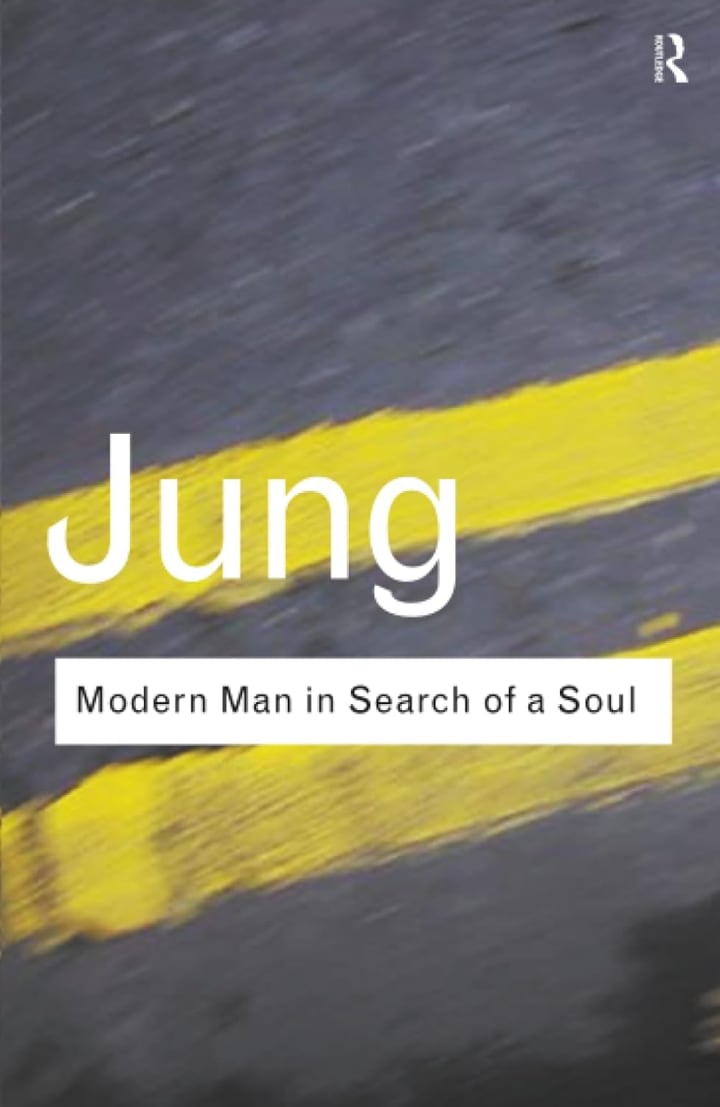
One aspect of the book I did agree with was the concept of the 'shadow' in which people have a capability for cruelty and violence. Instead of projecting this shadow on to others, Jung argues that we should confront our shadows ourselves. This will help us to stop demonising others for holding some of the aspects that we ourselves know we could commit to. Jung warns that collective shadow projection contributes to war, persecution, and mass hysteria. We should not cling to the illusion that we have the moral highground or that we are morally pure in comparison to others. This is basically the entirety of social media - everyone projecting their shadows on to each other.
The idea of the soul generally is a lifelong task to work at, according to this book. Jung makes the point that the soul is never really seen in isolation, it is an abstract idea that represents the jigsaw of the human psyche. There are many things that go into it and yet, there is a fullness, or a wholeness that is the general output. I may not agree with everything but at least I understand where he's coming from. Many people who speak on the topic of a soul can't actually define what they mean by it.
About the Creator
Annie Kapur
I am:
🙋🏽♀️ Annie
📚 Avid Reader
📝 Reviewer and Commentator
🎓 Post-Grad Millennial (M.A)
***
I have:
📖 280K+ reads on Vocal
🫶🏼 Love for reading & research
🦋/X @AnnieWithBooks
***
🏡 UK
Keep reading
More stories from Annie Kapur and writers in Geeks and other communities.
Book Review: "The Road Less Travelled" by M. Scott Peck
This book sort of details the same ideas The Marshmallow Test states but with a spiritual flair to it. Whenever someone mentions the 'human spirit' I usually ask for a definition as you'll probably see in that, they can't actually define what it is. With all the 'spiritual' stuff and the illogical thinking which roots itself in clearly, some sort of religious lexicon, I definitely went into the book telling myself I probably wouldn't be agreeing with many of the points put forward and thus, was cynical about the 'spirit' perspective that the book was pushing. However, it did make some interesting arguments regarding everything from delayed gratification to how incredibly important parenting is.
By Annie Kapur7 days ago in Geeks
No Other Choice (2025)
It is only February, so other films may well surpass “No Other Choice”, but I think this is the best film I’ve seen so far this year. And that surprises me, because, it is a subtitled film and while I am pretentious enough to choose to watch foreign-language films, I was also very tired and that was an extra commitment from me. But more importantly, let me warn you, this film is gruesome and violent. There were times I had to turn away from the screen to avoid the worst of it (including some self-inflicted dentistry).
By Rachel Robbins2 days ago in Geeks
Disney’s Next Era: A Fan-Centered, Creator-Driven Vision for the Company That Once Imagined the Future.
Disney is at a crossroads. Not in the dramatic “end of an era” way people say every few years, but in a quieter, more important way. Disney has more money, more platforms, and more fandom franchises than ever before, and yet something feels off.
By Jenna Deedy5 days ago in Geeks
If You Write A Book, Don’t Tell Anyone
There are days when I’m grateful Amazon doesn’t tell me specifically who has bought my book and who hasn’t. If they did, I would be heartbroken when I read the list and noticed all the important names in my life were not on my list of customers.
By Ellen Frances7 days ago in Writers



Comments
There are no comments for this story
Be the first to respond and start the conversation.