
Book Review: "Liquidation" by Imre Kertész
4/5 - confusing, challenging but well worth the read...

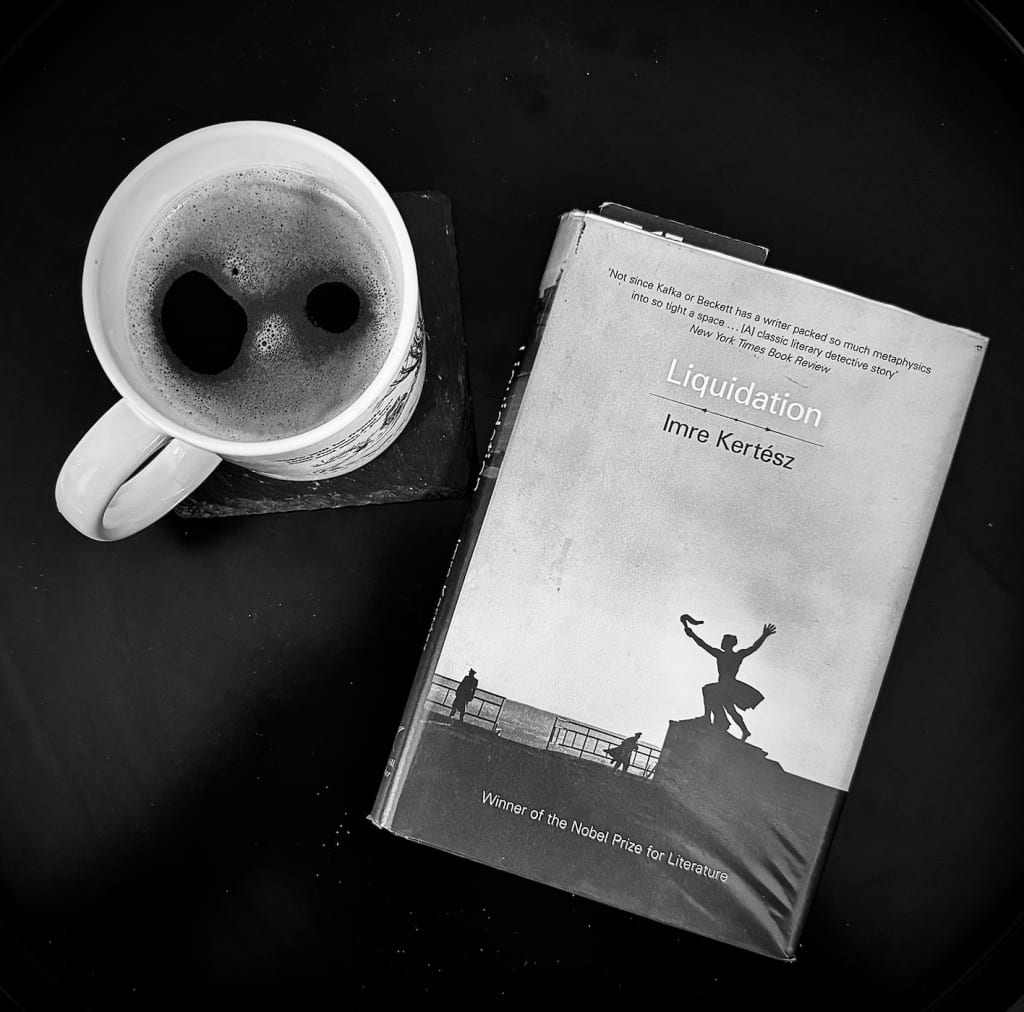
Yes, I've been back to the library and this time (because they haven't actually done my reservations yet so I'm sad) I have tried to go for a theme. The theme this time was black and white book covers. I know it sounds silly but I really had no other idea. I have currently also been shopping for used books. I love looking for books that other people have read and enjoyed (sometimes they have even annotations and drawings inside which makes it all the more interesting). It's April 2025 and I'm sitting around drinking coffee and listening to podcasts. I've finished Liquidation and all I can say is: what the f-?
A person known only as B. has committed suicide. We learn he was once interred in a Nazi concentration camp and the more we learn about the night he died, the weirder it becomes. His death shocks his circle of friends and colleagues, especially Kingbitter, a former editor and close friend. B.’s decision to end his life is layered with philosophical weight and existential despair. It is quite upsetting seeing as he already survived something more painful than death. The historical trauma, it is thought, finally caught up with him. I love this frame for the whole story. The whole story is weighted upon this one suicide. Everything we learn is therefore linked to this singular act. Though it is strange and existential - I still enjoyed it.
Kingbitter becomes obsessed with a manuscript that B. apparently left behind which is a novel called Liquidation - a fictionalised account of the inner circle of friends they both have. It fortells about their moral failures and movements whilst also presenting them with a philosophical journey. The quest to find the manuscript becomes a weird emotional transformation for Kingbitter. As Kingbitter needs to confront his own compromises under Communism and so, we have a systemic annihilation of meaning after the Holocaust presented by the spread of the Communist regime and its censorship. It's heavy, yes, but it also has characters who represent very particular ideas. Kingbitter is basically this protagonist who must deal with the historical trauma whilst also dealing with the horrors of the time.
The novel also explores the lives of several people close to B. such as: his former lover Judit, his ex-wife, his friends etc. all of whom struggle with personal failures, fractured identities, and spiritual fatigue. I quite like those sections that are written like a play script because you really do hear the voices of these people. It makes the sounds of their voices and their existentialism come alive. Their relationships, like the society they inhabit, are hollow and performative, shaped by decades of fear, censorship, and betrayal. This is where you have to think about those sections written like play scripts - are we really seeing who they are or are we seeing who they'd like to be? Are we seeing something they are only revealed to the reader as being? I feel like I'm being conned out of a character at the same time as feeling like I'm outside of this social circle. Christ, alive.
The ethical failure of the intelligentsia is a huge theme which I think is also applicable to today's culture. Many of the characters are part of the intelligent class but have compromised their true beliefs for the sake of Nazism and Communism. They have masked themselves, censored themselves and wanted to fit in so badly to a community of wrongs that eventually, they find themselves spiritually and morally bankrupt. If the novel exists it will reveal all the truths of these characters - it is a direct representation of absolute truth and also a mirror of the moral cowardice of the characters themselves. But the manuscript may also represent B.’s final verdict on literature’s futility, a text so honest and bleak it destroys rather than redeems. It's all very Nietzsche - where God and ideology die, but in its place is nothingness.
All in all as the narrative loops through perspectives, memories, and conversations, echoing the cyclical nature of trauma and philosophical inquiry - the characters are revealed as what they really are, but also there is a question of whether B. could actually survive. There's a scene with Kingbitter and a police officer where another character asks Kingbitter why he lied about the night of B.'s suicide and you can tell at that singular moment that B. could have never survived to tell his own tale.
***
Thanks for reading!
Perhaps take some time to enter my unofficial poetry competition! Money can be won! (Plus, I like reading poetry!)
About the Creator
Annie Kapur
I am:
🙋🏽♀️ Annie
📚 Avid Reader
📝 Reviewer and Commentator
🎓 Post-Grad Millennial (M.A)
***
I have:
📖 280K+ reads on Vocal
🫶🏼 Love for reading & research
🦋/X @AnnieWithBooks
***
🏡 UK
Reader insights
Outstanding
Excellent work. Looking forward to reading more!
Top insights
Compelling and original writing
Creative use of language & vocab
Easy to read and follow
Well-structured & engaging content
Expert insights and opinions
Arguments were carefully researched and presented
Heartfelt and relatable
The story invoked strong personal emotions
Masterful proofreading
Zero grammar & spelling mistakes
On-point and relevant
Writing reflected the title & theme
Keep reading
More stories from Annie Kapur and writers in Geeks and other communities.
Book Review: "In Memory of Memory" by Maria Stepanova
"The woven fabric of language decomposes instantly, never to be felt again between the fingers: "I would never say 'lovely', it sounds so common" Gayla admonished me once. And there were other prohibited words I can't recall, her talk of one's people, gossip about old friends, neighbours, little reports from a lonely and self-consuming life." - In Memory of Memory by Maria Stepanova
By Annie Kapur8 months ago in Geeks
Marvel Zombie
The last entry into our 2025 superhero projects catalogue is Marvel Zombies. This was a show that was anticipated by absolutely no one and it disappeared from the public consciousness as quickly as it was released. There was nothing special about the project that made it a must see, or a must remember. In fact if anything it's a must forget.
By Alexandrea Callaghan25 days ago in Geeks
The 48 Laws of Power
The 48 Laws of Power by Robert Greene is one of the most talked-about and controversial books on power, influence, and human behavior. First published in 1998, the book has gained a massive following among readers interested in psychology, leadership, strategy, and personal success. Loved by some and criticized by others, this book leaves a strong impression and sparks deep discussion about how power works in the real world.
By John Smith7 days ago in Geeks


Comments (2)
I really enjoyed reading your take. The black-and-white cover theme is actually a clever way to choose books, especially when you're waiting on reservations. S. Hossain seems to like your work<LOL!
This sounds like a very interesting book. I have read stories with similar themes before but they often fail to catch my mind, however, I want to give this one a shot because, from your description, it sounds like a good book to read.