
Book Review: "Fugue for a Darkening Island" by Christopher Priest
4/5 - Christopher Priest's dystopian novel is perhaps almost as good as his other books... almost...

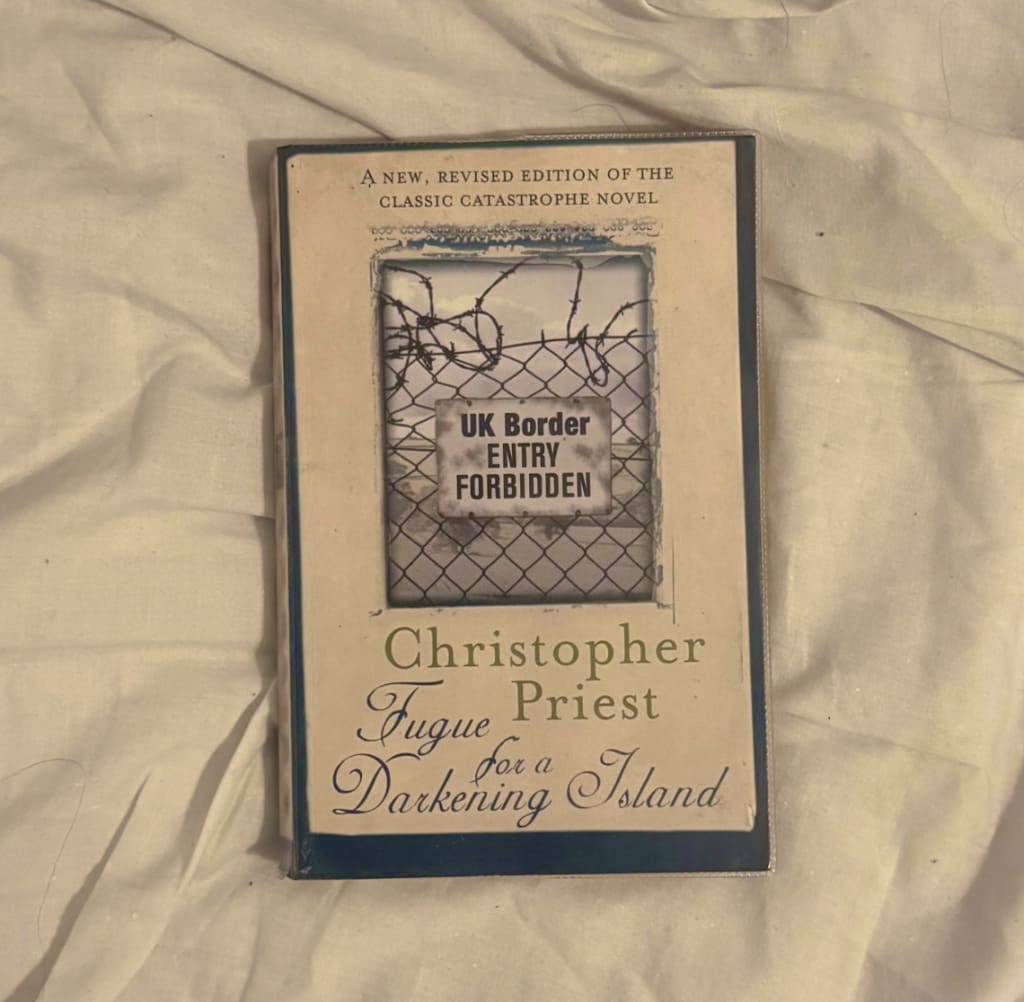
As you know, I've been living in Nottingham for about six months now and as you also know, I am not sure I like it very much. So far, it has proven to be very small, not very city-like and a little slow for me, who is more adapted to being in Birmingham. It is February and I have been taken sick from work for mental health reasons (yes, it is that far into the gutter) and so, I decided to make myself feel a bit better by getting a library card and hanging around some books. No, the library in Nottingham is nothing compared to the one in Birmingham - but it is still something to get me out of my apartment. I brought home six new books and one of them was by Christopher Priest, writer of The Prestige (the book and the film are actually quite different).
This book is a dystopian novel that presents an alternate history of Britain. Set in a near-future version of the country, the novel envisions a political and societal collapse following an unprecedented influx of refugees. This premise is based on an imagined global catastrophe—an African nuclear war—that forces a massive number of displaced people, referred to as “Afrims” (African Immigrants), to seek asylum in Britain. Priest uses this scenario to explore issues of nationalism, xenophobia, political radicalisation, and the fragility of Western democracy. The Britain depicted in the novel has descended into civil conflict, and its institutions are either crumbling or have already collapsed. This is a great premise for the book but perhaps it is a bit of a shame about the writing. From the outset, the writing is bland and flavourless, but Priest tries to justify it with his morally ambiguous main character.

Alan Whitman is a university lecturer turned survivalist. His character arc is marked by a descent from a privileged, middle-class intellectual into a man struggling to navigate a violent and lawless world. Initially, Alan is complacent and politically disengaged, failing to see the warning signs of Britain’s impending collapse. However, as society disintegrates, his personal life unravels, and he is forced to make increasingly desperate choices. His relationship with his wife and daughter deteriorates, and he becomes embroiled in brutal conflicts. Alan serves as both a critique of British liberal complacency and an unsettling reflection of how ordinary individuals can be radicalised or dehumanised in times of crisis. I enjoyed exploring the life of this character but I do have to say that he can be exasperating at times - his privilege often making the reader angry and frustrated with his lack of self-awareness.
One of the most striking aspects of the novel is its fragmented narrative structure. The story does not follow a straightforward chronological order but is instead presented as a series of disjointed, overlapping episodes. These scenes oscillate between different moments in time—before, during, and after the collapse of Britain. This approach reflects the protagonist’s increasingly fractured mental state and highlights the chaotic, uncertain nature of a society in decline. The use of multiple perspectives and temporal shifts forces the reader to actively piece together the sequence of events, mirroring the confusion and disarray experienced by the characters. Christopher Priest is known for his great designs of novel structures and so, this shouldn't be surprising. I will have to say that this one is a little bit overdone, as if the structure did not add too much to the story, though it was fun to get stuck into.

All in all, despite being written in 1972, Fugue for a Darkening Island remains strikingly relevant in contemporary discussions about immigration, nationalism, and political extremism. The novel serves as a warning about the dangers of division, the fragility of democracy, and the moral compromises individuals make in survival situations. Though it is not a perfect novel, it definitely has its advantages and is perhaps more of a fun book to read than its dystopian counterparts. However, I think that there is a certain level of frustration that comes with the protagonist that cannot be ignored and, for that reason I will have to take a mark away. I am awfully sorry about it but it's true.
About the Creator
Annie Kapur
I am:
🙋🏽♀️ Annie
📚 Avid Reader
📝 Reviewer and Commentator
🎓 Post-Grad Millennial (M.A)
***
I have:
📖 280K+ reads on Vocal
🫶🏼 Love for reading & research
🦋/X @AnnieWithBooks
***
🏡 UK
Keep reading
More stories from Annie Kapur and writers in Geeks and other communities.
"A Thousand Dreadful Things"
Background and Context: Ah, here we are again. Yes, there are still many to come - I haven't even begun to check the notebooks I had at university where I scribbled down essay ideas. Here's some context you weren't aware of: I didn't just do this for Shakespeare, but for every one of my modules and the reason I did it is because I was scared of not being able to make up my mind when the time came to write it. A week or so before starting to write the essays, I would read and deduce what I wanted to do. This may have been a long while ago, but it has really been fun actually writing the stuff I never got to write at university. Yes, it takes a while and I work on some concurrently, but eventually it looks pretty good.
By Annie Kapur10 months ago in Geeks
The Rachels - 2025
Much to my surprise, I have kept a list of the films I‘ve seen this year. I daresay it isn’t complete. There will be films that snuck in on a late night in front of the TV that I would’ve forgotten to note. Or others, that I went to watch at the cinema, but then had a red wine and promptly forgotten about. But it’s not a bad approximation of the films I’ve seen this year. In total, there are 53 films listed, so an average of one a week and one for good luck.
By Rachel Robbins27 days ago in Geeks



Comments (1)
Amazing Review