
Book Review: "Dancing by the Light of the Moon" by Gyles Brandreth
5/5 - a book about one of the great joys of my life: poetry

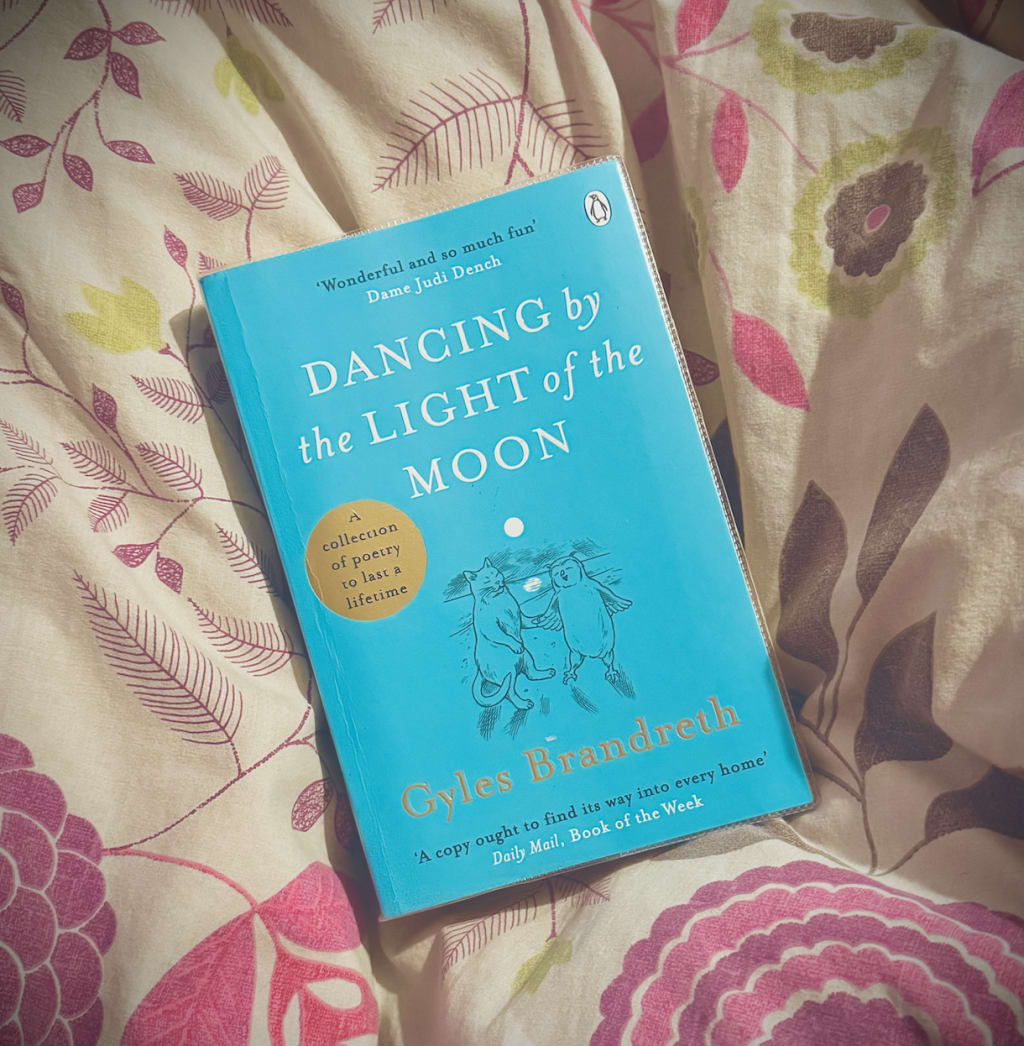
I love poetry and I love trying to memorise my favourite poems. Ever since I was a young girl, I've loved memorising poems like The Raven by Edgar Allan Poe (which I managed to do when I was about 13 years' old) and of course, the famed Vincent Malloy by Tim Burton (if you haven't seen it already I would say definitely go and watch it). Poetry can convey so much in a short space of time, and some of my favourite poets include Lord Byron, Percy Shelley and of course, John Keats. I'm a big fan of Romanticism as you can see, but when it comes to Gyles Brandreth - he has allowed me to explore these favourites whilst also presenting me with nostalgia for lost poets I haven't revisited. But best of all, I have discovered new poets I have not read before.
Dancing by the Light of the Moon is named after Gyles Brandreth's favourite childhood poem The Owl and the Pussycat by Edward Lear. He takes us through the process and reasoning behind memorising poetry and wrongly seems to assume that this was only an activity enjoyed by the older (Boomer) generation. Needless to say, the Millennials have memorised our fair share. But, he takes us through not just the reasons surrounding memorising poetry (and how it can be good for your health), but he helps with the process if you're really struggling to do it. Throughout this, he litters the reader with some of his most beloved poems from youth and beyond. Poetry, to Brandreth, is much more than just a formulation of words on a page, but they are the epitome of art - the very words of the soul. In one section, he lists in order of time what different poets think about poetry and its meanings. This is a quotation by Simon Armitage on the subject, quoted and boxed within the book:
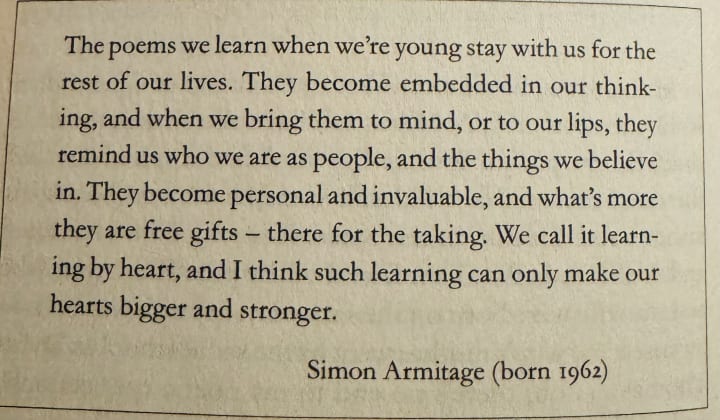
I read a lot of Simon Armitage's poetry when I was in school, not because we were studying it, but because I really enjoyed his work. I remember that there was a poem about going at your wrists in a bathtub with a razor, and for the life of me I can't remember the name of the poem - but I can recall several lines from it off by heart. I think if you're going to quote any modern poet about the way poetry has an impact on our lives and our minds, then it has to be something by Simon Armitage.
Learning poetry, Brandreth states, can be simple if we start small. He gives us a few examples, some poems that are short because perhaps they are formulated that way (i.e a haiku), and some poems that are short because that's just the way they are in order to have maximum impact. He uses Tom Stoppard's poem as a key example. Now, I knew that Stoppard was funny but frankly this is hilarious:
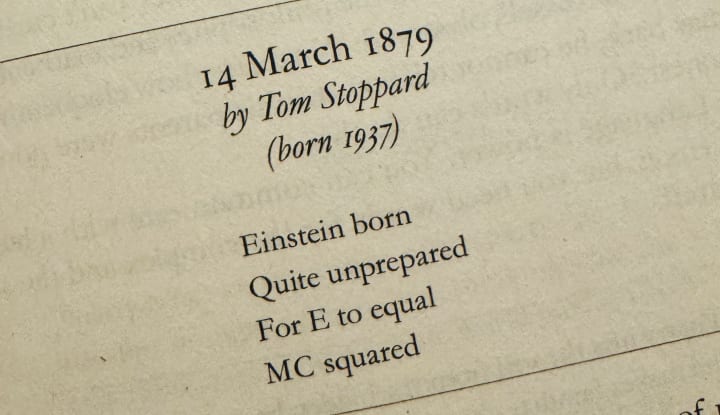
(Also, yes I got a little upset at the fact that Tom Stoppard is now dead and therefore, any updated version of this book might have to fix that 'born 1937' part. But for now, let's pretend he's still alive. It's nicer that way).
One of the chapters I really enjoyed was called The Upstart Crow and of course, it is about William Shakespeare and his greatest speeches. All written in perfect iambic pentameter, we get a flavour of all those brilliant uses of language from Richard III and Othello, from Henry V and obviously, Hamlet. When we come to As You Like It, Brandreth makes his point by taking us through his own version of the seven stages of life mentioned in the speech 'All the world's a stage...' featuring yes, poetry. The next chapter is dedicated to poems from each stage of life, featuring writers like Sylvia Plath, Langston Hughes and even Cecil Day-Lewis. It really was a fantastic (and highly addictive) section of the book.
If we are going to talk about Shakespeare in this text though, we're going to have to talk about the fact that I quite literally could not stop laughing at this poem by Wendy Cope. I ended up reading it several times because it is just so brilliant. It's written in sonnet form (part of the section on sonnets in the book). I hope you can see the humour in it and if you read it aloud, it becomes even funnier:

There were several poems in this anthology I was surprised to see, Kubla Khan was one of them because it's just so different from say, Shakespeare at School. However, there is a poem in this anthology called Matilda that I had to read a few times to make sure I had read it correctly. It's about a little girl who lies about a fire and lies about a lot of things otherwise. When her aunt (whom she lives with) goes out to the theatre leaving the girl alone, the house burns down with her inside because when it caught fire, nobody believed her. I was quite shocked at that one.
But if you do happen to like dark poetry then one of my personal favourite poems, the dark and humorous Vincent Malloy by Tim Burton also features within. An absolute classic of a poem, learn more about it by watching the video:
Another one of my favourite chapters is entitled Funeral Blues (after the famed poem usually read at funerals). Of course, these are poems 'at the end' in which death is a certain part of life. Death be Not Proud by John Donne and Song by Christina Rossetti feature as some of the poems within as Brandreth takes us through what poetry to do with death really looks like. It's not all doom and gloom, a lot of it has to do with acceptance as well. What would the chapter be though, without one of the greatest poems ever written about death? Of course that is Do Not Go Gentle into that Good Night by Dylan Thomas.
Byron's poetry features frequently. In poetry to do with love he appears with When We Two Parted and in the 'A to Z of poets' he is 'B' with She Walks in Beauty. Yes, they are obvious choices but I like the fact he's being included. With poems like If by Rudyard Kipling, Dulce et Decorum Est by Wilfred Owen and Annabel Lee by Edgar Allan Poe, this book is brimming with absolute classics. He even addresses the idea of classics earlier in the book with a poem dedicated to the ones written for children. I genuinely cannot help sharing all of these gems with you:
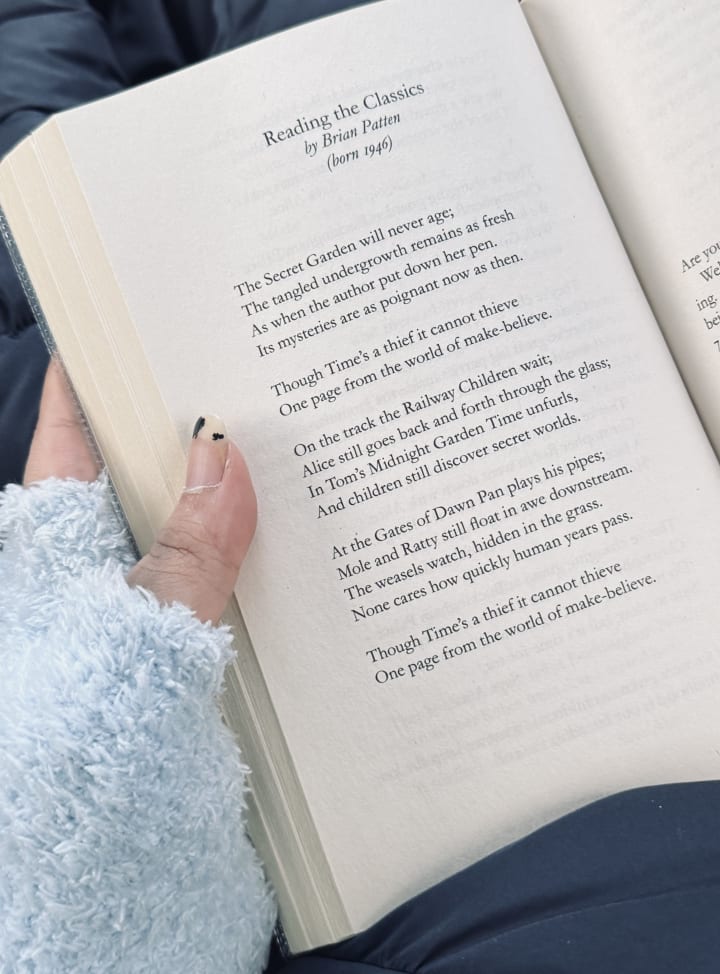
But I can honestly say that the closing poems are quite correct to see us out nicely. Brandreth, before his final chapter and exit from the poetic stage, leaves us with John Dryden's short, but powerful words:

This has been an absolute joy to read.
I hope you too, pick up this book whenever you get the chance.
About the Creator
Annie Kapur
I am:
🙋🏽♀️ Annie
📚 Avid Reader
📝 Reviewer and Commentator
🎓 Post-Grad Millennial (M.A)
***
I have:
📖 280K+ reads on Vocal
🫶🏼 Love for reading & research
🦋/X @AnnieWithBooks
***
🏡 UK
Keep reading
More stories from Annie Kapur and writers in Geeks and other communities.
Book Review: "Violence and the Sacred" by René Girard
The claim that we desire things because others desire them is quite confidently the basis of many psychology books and many claims made about modern culture - especially concerning consumerism. Rather than wanting objects for their intrinsic value, humans imitate the desires of others, especially those they perceive as rivals or models. In his book All Desire is a Desire for Being, the author makes this bold claim backed up with ideas and facts to illustrate them. In my review of the book last year, I saw that Girard's maxims were anthologised as something called mimesis and that 'desire' was actually imitation. (I even depicted this through a clip from The Simpsons tagged in the review itself). But how does this then transfer to the idea of human sacrifice, religion and man's natural propensity for violence?
By Annie Kapur2 days ago in Geeks
Lauren Sánchez Bezos Kicks Off Paris Couture Week in a Blood-Red Suit
Mrs. Bezos has brought her glamazon wardrobe to Paris for Haute Couture Week. Lauren Sánchez Bezos made a splash in blood red today as she arrived, hand in hand with husband Jeff Bezos, at Schiaparelli’s Spring or Summer 2026 runway show.
By Dena Falken Esq5 days ago in Geeks



Comments (2)
I love this! And... "The time has come," the Critic said, "to talk of many things: The way funny poetry acts... And whether we should read those things..." (Lear, please forgive me) And you might be interested in this book: https://www.davidorr.com/books/beautiful-pointless-a-guide-to-modern-poetry/
Not a fan of Brandreth as a person, but this looks very good, and love the examples you include