
Book Review: "Chasing the Scream" by Johann Hari
5/5 - a book that opens your eyes to the reality concerning the war on drugs...

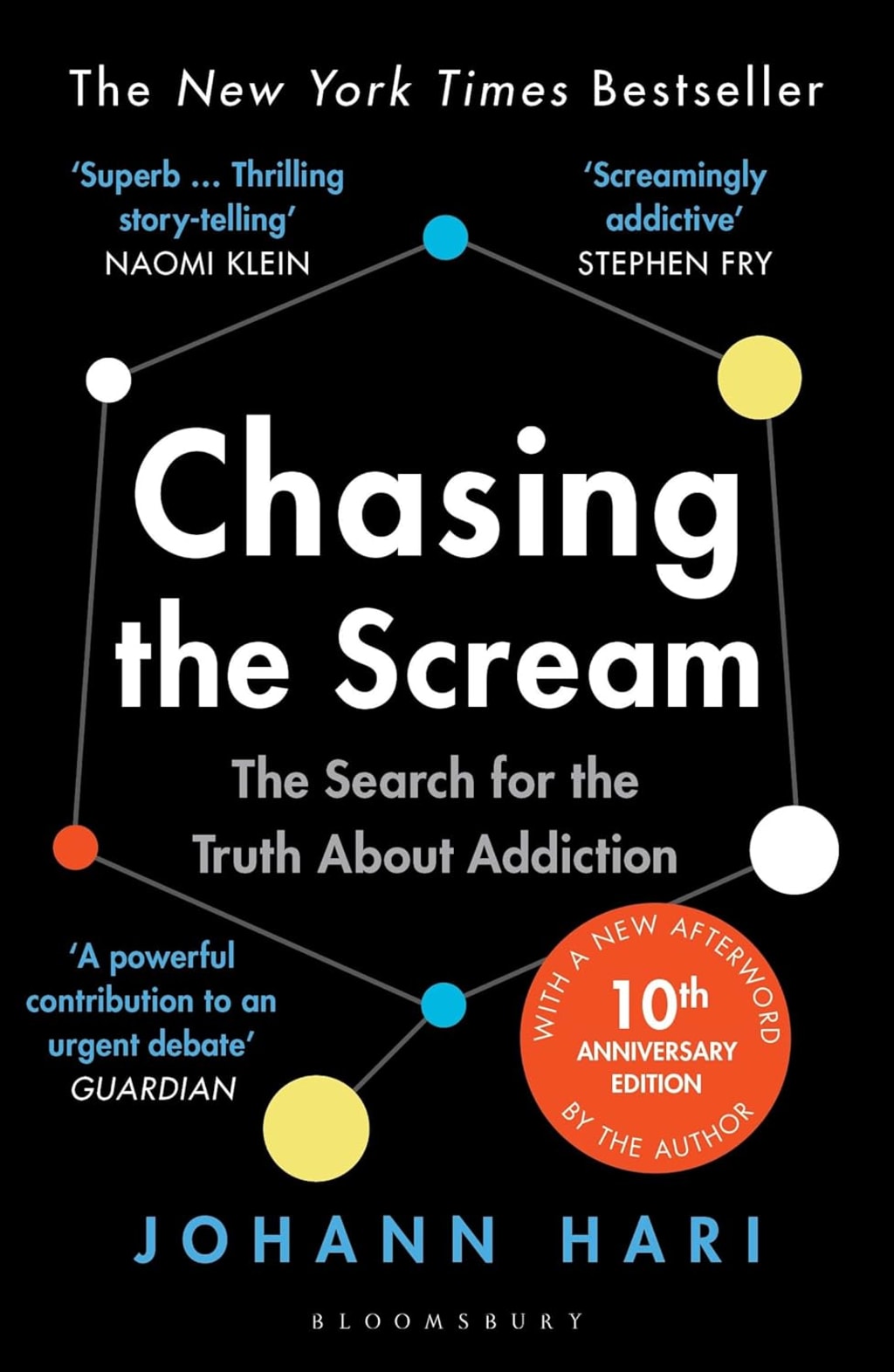
I think I was put off from reading Johann Hari because of the plagiarism thing that apparently happened (though I don't trust the news because everyone's talking rubbish anyway) but I think that because of the fact his book was used for the basis of a movie I enjoyed in the past, I wanted to read this for ages. I've had it for a long time and only recently given it a chance, though I regret not reading it earlier. I did really enjoy it and it took a great hold on me as it went through the life and death of my favourite female singer ever: Billie Holiday.
Hari begins by examining the origins of the global war on drugs, tracing its roots back to the early 20th century. He introduces Harry Anslinger, the first commissioner of the Federal Bureau of Narcotics in the United States, as a central figure in the story. Anslinger’s campaign against substances like heroin, cocaine, and marijuana was driven by racial prejudice, moral panic, and political opportunism. Hari explains how Anslinger’s efforts framed addiction as a criminal issue rather than a public health challenge, laying the foundation for decades of punitive policies worldwide. I've learnt about Anslinger in the past but not in this much detail. It was quite compelling to read this as a piece of true crime narration as opposed to a textbook structure (which is where I read the story in the past).
The book investigates the devastating consequences of drug criminalisation, focusing on its impact on individuals and communities. Hari provides evidence of how punitive laws have disproportionately targeted marginalised groups, exacerbating social inequalities. He explores how the criminalisation of drug use has led to mass incarceration, particularly in countries like the United States, and fuelled violent black markets controlled by organised crime. Hari argues that this approach has failed to reduce drug use or address the root causes of addiction. Well, I'm glad we have established the fact that incarceration does not, in fact, help anything when it comes to addiction and possibly, due to stress, makes things a lot worse than they need to be.
Throughout the book, Hari weaves in deeply personal stories of individuals affected by addiction and the drug war. He profiles addicts, law enforcement officials, and families caught in the crossfire, humanising the statistics and policies. These stories, such as those of Billie Holiday (persecuted by Anslinger for her drug use) and Chino Hardin (a former drug dealer turned activist), reveal the complex realities of lives shaped by the war on drugs and highlight the resilience of those striving for change. This was perhaps my personal favourite part of the book due to the intensity of the story of Billie Holiday. It was so sad revisiting the way she grew up and became a singer because I had previously read that story in a novel called Lady Sings the Blues which was by Holiday herself.
The book provides a detailed analysis of the economics of the global drug trade, explaining how prohibition fuels violence and corruption. Hari visits regions such as Ciudad Juárez in Mexico, where drug cartels thrive in the absence of legal markets. He shows how the enormous profits generated by the black market incentivise organised crime and undermine governments, perpetuating cycles of violence and instability. Hari argues that legalisation and regulation could weaken cartels by removing their primary source of income.
I like the fact that Hari tries to get his information first hand rather than simply relying on stories and evidence given by other people. He starts to build this image of people being addicted to drugs and it not entirely being their own fault, but through a mixture of economic factors and the only emotional way out that is accessible being drugs - it seems more inevitable than anything else. If you want to know more about this then I suggest that you check out a book called The Social Distance Between Us by Darren McGarvey which covers this in one or two of the chapters - especially regarding the poor.
Hari highlights the human cost of prohibition by profiling individuals who have suffered under punitive drug laws. He tells the story of Maria, a mother in Juárez who lost her son to cartel violence, and Bud Osborn, a Canadian activist who fought for safe injection sites in Vancouver. These accounts illustrate the real-world consequences of policies that prioritise punishment over compassion, revealing the systemic failure to protect vulnerable populations. Profiling has never worked and I was interested to learn how this was done by design by people like Anslinger in order to criminalise not the dealers, but the takers.
All in all, Hari concludes with a powerful call to end the war on drugs, framing it as a moral and practical imperative. He urges readers to challenge the stigma surrounding addiction and advocate for policies that prioritise humanity and evidence over ideology. Hari’s final message is one of hope, suggesting that change is possible if society embraces empathy and rejects the punitive approach that has failed so many for so long.
About the Creator
Annie Kapur
I am:
🙋🏽♀️ Annie
📚 Avid Reader
📝 Reviewer and Commentator
🎓 Post-Grad Millennial (M.A)
***
I have:
📖 280K+ reads on Vocal
🫶🏼 Love for reading & research
🦋/X @AnnieWithBooks
***
🏡 UK
Keep reading
More stories from Annie Kapur and writers in Geeks and other communities.
The Grapes of Wrath by John Steinbeck
The Grapes of Wrath, published in 1939, is one of John Steinbeck's most acclaimed novels. Steinbeck, deeply influenced by the socio-economic hardships of the Great Depression, undertook a gruelling research journey across the United States, particularly California, to understand the plight of migrant workers.
By Annie Kapurabout a year ago in Geeks
The Rachels - 2025
Much to my surprise, I have kept a list of the films I‘ve seen this year. I daresay it isn’t complete. There will be films that snuck in on a late night in front of the TV that I would’ve forgotten to note. Or others, that I went to watch at the cinema, but then had a red wine and promptly forgotten about. But it’s not a bad approximation of the films I’ve seen this year. In total, there are 53 films listed, so an average of one a week and one for good luck.
By Rachel Robbins25 days ago in Geeks
Tamer Hassan
Tamer Hassan is a name that carries weight in British film, television, and even popular culture beyond the screen. Known for his tough-guy roles and unmistakable presence, Hassan has built a career that reflects resilience, reinvention, and a deep connection to family. In recent years, public curiosity around him has also grown because of his daughter, Belle Hassan, who rose to fame on Love Island. This combination of cinematic grit and reality TV visibility has introduced Tamer Hassan to a whole new generation of audiences. Early Life and Path to Acting Before becoming a familiar face in crime dramas and action films, Tamer Hassan lived a life far removed from movie sets. Born in London, he grew up in a working-class environment where discipline and survival were everyday lessons. In his early adulthood, Hassan was involved in professional boxing and worked as a bouncer, experiences that later influenced the authenticity he brought to his on-screen roles. Unlike many actors who follow a traditional drama school route, Hassan’s entry into acting was unconventional. His natural intensity, real-life toughness, and commanding voice caught the attention of casting directors looking for realism rather than polish. This background helped him stand out in an industry often saturated with similar profiles. Career Highlights and Acting Style Tamer Hassan is best known for portraying hardened characters—gangsters, enforcers, and morally complex figures who live on the edge. Films such as Layer Cake, The Business, Kick-Ass, and Batman Begins allowed him to showcase his ability to bring depth to characters that could otherwise feel one-dimensional. His performances often balance menace with vulnerability, making his roles memorable even when screen time is limited. On television, Hassan has appeared in popular British series including EastEnders, Silent Witness, and Game of Thrones. These roles further cemented his reputation as a reliable character actor who elevates every project he joins. Rather than chasing leading-man status, Hassan has built a steady career by embracing roles that feel authentic to his life experience. Life Beyond the Camera While his on-screen persona is often intimidating, those close to him describe a different side of Tamer Hassan. Family plays a central role in his life, and this became especially visible when his daughter entered the public eye. Many viewers who searched online for “belle hassan dad” or “who is belle’s dad Love Island” were surprised to discover the connection between the reality TV contestant and the seasoned actor. This curiosity wasn’t just gossip-driven. It reflected genuine interest in how two people from the same family could navigate fame in such different ways—one through gritty cinema and the other through modern reality television. Belle Hassan and Public Curiosity Belle Hassan appeared on Love Island in 2019 and quickly became known for her strong personality and emotional honesty. As her popularity grew, so did questions like “who is Belle from Love Island’s dad” and “who is Belle Hassan dad”. The answer consistently led back to Tamer Hassan. Unlike some celebrity parents who actively leverage their status, Hassan remained largely in the background during Belle’s time on the show. This approach earned respect from fans who appreciated that Belle’s journey felt independent rather than manufactured. Searches such as “Love Island Belle dad” or “belles dad Love Island” often revealed interviews where Hassan expressed pride in his daughter while emphasizing that her success was her own. A Father-Daughter Dynamic in the Public Eye The relationship between Tamer Hassan and his daughter added an interesting layer to public discussions. People asking “who is Belle’s dad from Love Island” often expected a flashy celebrity figure, but instead found a grounded actor who values privacy and hard work. Hassan has spoken openly about wanting to protect his children from the harsher sides of fame while still supporting their ambitions. This balance resonated with many parents watching from the sidelines, especially those navigating social media-driven celebrity culture. In that sense, Hassan’s role as a father became just as compelling as his roles on screen. Legacy and Cultural Impact Tamer Hassan’s career is a reminder that success in entertainment doesn’t follow a single path. His journey from boxing gyms and nightclubs to major film sets reflects determination and adaptability. At the same time, his association with Love Island through Belle Hassan has expanded his relevance beyond traditional film audiences. For some, he is the actor known for intense performances; for others, he is simply the answer to “who is Belle from Love Island dad.” Both identities coexist, and together they paint a fuller picture of a man who has lived multiple lives within one. Final Thoughts Tamer Hassan stands as a unique figure in British popular culture. His work ethic, authenticity, and commitment to family have shaped a career that continues to evolve. Whether recognized for his film roles or through questions about who is Belle Hassan dad, Hassan remains a compelling example of how personal history and professional life can intersect without losing integrity.
By Saboor Brohi 4 days ago in Geeks


Comments
There are no comments for this story
Be the first to respond and start the conversation.