
Book Review: "Arguably" by Christopher Hitchens
4/5 - how to be the very best contrarian you can be...

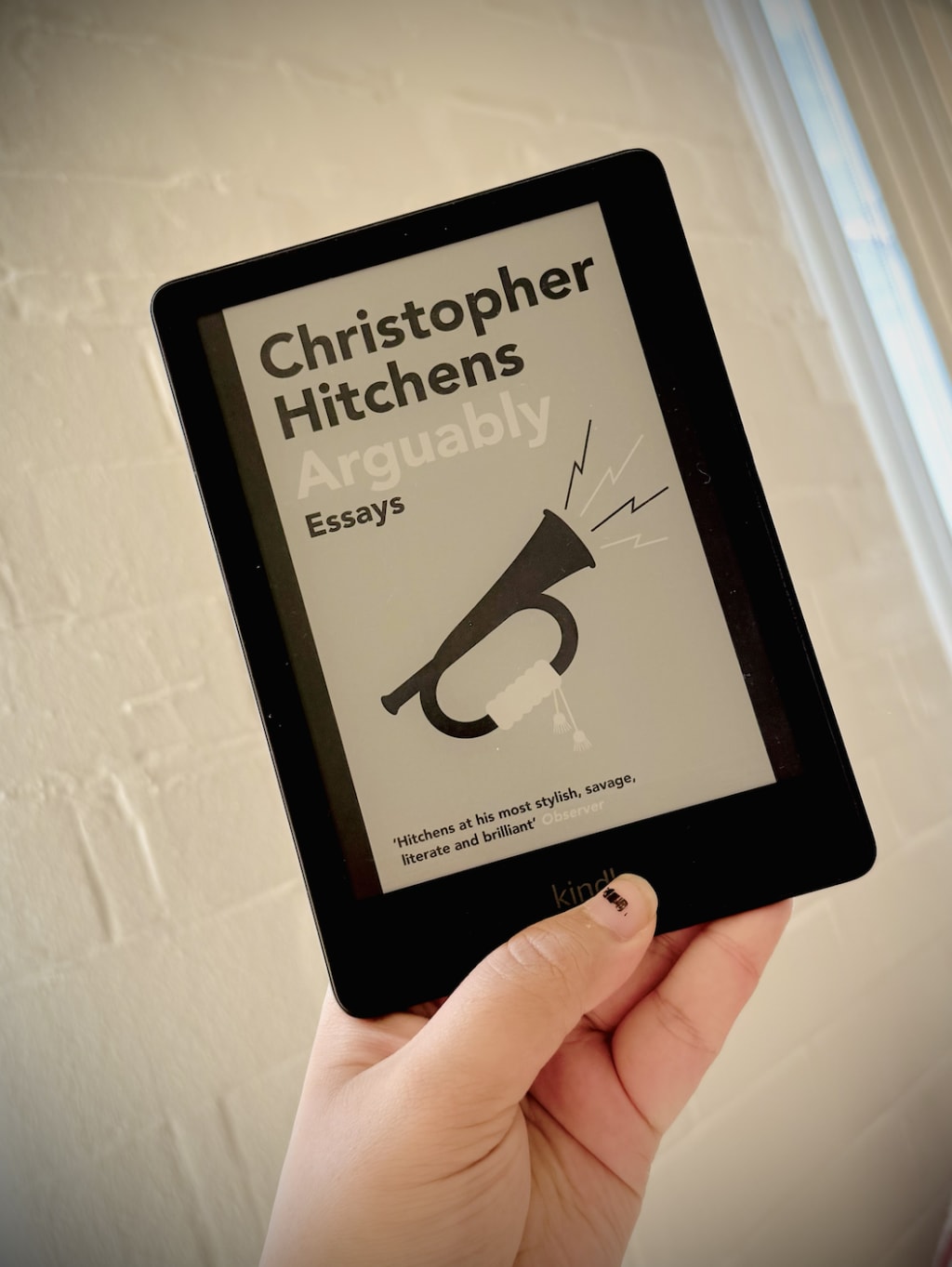
Ah yes, we are back to reading Christopher Hitchens and I can say it is for some profound reason, or I can just be honest. I'm going to choose to be honest: a lot of his essay anthologies are available on Kindle Unlimited. Hitchens was a very prolific philosopher, often writing books atop of books about his theories and what he believes humanity should be doing to progress. I'm going to be honest with you again: I don't agree with everything he says but definitely most things. He is perhaps one of my favourite philosophers ever. His books are often based within logic and reasoning, looking at how and why we think and behave the way we do including obviously, his disdain towards religious institutions.
In this article I'm not going to go through individual essays, but ideas I found being presented over and over again. I want to break these down and find out what Hitchens has said about them and where. So strap in for another long book review where I go insane over details and ideas once again.
Dissent
Christopher Hitchens writes about the moral obligation of dissent. In essays like "The Vietnam Syndrome," he examines how challenging prevailing narrative can reveal uncomfortable truths. In "Why Women Aren't Funny," Hitchens invites readers to wrestle with controversial ideas rather than silence them. No, I don't think that Hitchens is being a woman-hater with that last one. Instead he invites us to talk about ideas that are perhaps banished from the public space by the dominant rhetoric. This is something I enjoy.
His essay on Salman Rushdie, "Assassins of the Mind," exemplifies this by defending Rushdie's right to free speech in the face of fatwas and death threats. He definitely sees the media as the enemy of truth (which is something that he unusually has in common with opposing religious philosopher, Dr Jordan Peterson).
In "Trial of the Will," he dissects the public and political cowardice in dealing with Saddam Hussein, arguing that appeasement often masquerades as prudence. (I'm sorry, but I kept reading that last sentence I wrote because I really like how I wrote it). Dissent, for Hitchens, is a stand for intellectual integrity against the pull of groupthink.
Religion
Would it really be a Christopher Hitchens book without some critique on religion? No, I don't think so. Hitchens continues his fierce criticism of organised religion in essays like "The Great Agnostic," where he evaluates Thomas Paine’s 'The Age of Reason'. I read 'The Age of Reason' when I was doing my undergraduate degree and I think after reading this by Hitchens, it has opened my mind a lot more about its ideas. For example: Hitchens admires Paine's ability to regard reason as the opposite to the foundations created for irrational religious belief. He does a similar thing in "God of Our Fathers" where he talks about how strange it is that there is so much religious language that mythologises the USA even though it was founded upon secular ideals.
Hitchens takes on religion’s role in history, as in "Iran’s Waiting Game," critiquing the theocratic elements that drive Iranian politics. I have already encountered how much Hitchens has to say about Iran and the regime it was under post-1970s, but I think it is always important to see his fierceness against the autocracy in that part of the world - an autocracy based solely on religious ideals. This can be seen in tandem with "Unspoken Truths" which revisits the abuse scandals in the Catholic Church, arguing that religious institutions often protect their power at the expense of justice. If you've read God Is Not Great then I think you'll find these ideas very familiar indeed.

Literature
You know how much I enjoy reading how Hitchens writes about literature? A lot. You can definitely see how his philosophical and political ideas and beliefs have been shaped by his reading on people who especially, lived under certain societies. Previously, in Hitch-22 we saw that he appreciates writers like Azar Nafisi, who is probably one of the most bad-ass writers to ever live to be honest. Her autobiographical novel Reading Lolita in Tehran speaks for itself. If that isn't dissent then I don't know what is.
In essays like "The Medals of His Defeats," Hitchens writes with reverence about George Orwell’s moral clarity and precision. Orwell represents for Hitchens a rare fusion of literary excellence and ethical courage. After reading Clive James' essay The All of Orwell, I can honestly say that I prefer Hitchens' account of Orwell's ability to convey ideas seeing as Hitchens is slightly more articulate.
In "Prisoner of Shelves," Hitchens explores the allure of Nabokov’s language, marveling at how form and intellect combine in works like Lolita. I think he really hits the nail on the head when it comes to Nabokov. Again, a bit better and more articulate on particular ideas than Clive James' essay on Nabokov where he basically complains about his translation of Eugene Onegin - somehow that turns out to be a weird dissection of Nabokov's character that doesn't make sense.
Meanwhile, in "Bellow's World," Hitchens admires Saul Bellow’s ability to capture the intellectual striving of post-war American men. It's funny because I bought Herzog by Saul Bellow because of this essay. Many people cite it as being the best novel Bellow has ever written. But if I were looking at my reading on perhaps my favourite novel by him through the Hitchens lens, I can definitely see the dislocated American man in Ravelstein.
The Enlightenment
Hitchens talking about the enlightenment is perhaps one of the best things you could ever read/listen to that's if you've ever heard his lectures. In "Jefferson and the Quran," he explores how Enlightenment thinkers valued knowledge across cultures, even Islamic texts, without subscribing to religious orthodoxy. This is probably in my opinion, the best way of looking at religion - as a flexible philosophy instead of an orthodox way of life. Hitchens reveres Voltaire, Paine, and Hume, repeatedly invoking their legacy in essays like "Mind the Gaps," which critiques the teaching of intelligent design in schools.
He seems to suggest that moving away from Enlightenment principles (which is seemingly what our century has been doing for the past perhaps, 15 years' or so) leads to the breakdown of society. We collectively lose the ability to say 'I don't agree with this' and thus, make headway into the black hole of Communism. In "Words' Worth," a tribute to the English language and its literary tradition. He, as I hope we all do, upholds clarity and intellectual rigour as essential Enlightenment virtues. He sees these values as constantly under attack but ultimately indispensable to human flourishing. After his death though, I would hate to think that he would be ashamed of how low we have drowned and how polarised we have become that now, we even treat our politics as religious values.
Contrarians
I think we all know that contrarian thinkers is one of Hitchens' favourite topics. Not only when it comes to Salman Rushdie, Azar Nafisi and others who have criticised horrific regimes and orthodoxies. He appreciates people like Solzhenitsyn and in other essays, Pasternak and more - who went as far as they could into the realm of critical thinking against the regimes that would not allow them to do so.
In "The Man Who Was Thursday," he revisits G.K. Chesterton, acknowledging his bigotry but praising his imaginative flair. I wouldn't really call Chesterton a 'contrarian' myself but I am all open to reading about him. "A Man of Permanent Contradictions" examines Graham Greene’s Catholic guilt and political ambivalence with empathy. Graham Greene is such an interesting character and so, the more you read about him, the deeper this point gets. In "Martin Amis's Morality," Hitchens credits his friend for tackling uncomfortable truths about Islamism and the legacy of Stalin. Even when he disagrees with his subjects, Hitchens respects their willingness to challenge orthodoxy.
Conclusion
You've probably read enough of this and therefore, I'll end it with this note. This might not be as great as his other books, but it is definitely worth a read to understand his arguments about how to be a person who properly rocks the political boat.
***
Enter my unofficial poetry challenge and don't forget to drop your link in the comments!
About the Creator
Annie Kapur
I am:
🙋🏽♀️ Annie
📚 Avid Reader
📝 Reviewer and Commentator
🎓 Post-Grad Millennial (M.A)
***
I have:
📖 280K+ reads on Vocal
🫶🏼 Love for reading & research
🦋/X @AnnieWithBooks
***
🏡 UK
Keep reading
More stories from Annie Kapur and writers in Geeks and other communities.
Book Review: "Our London Lives" by Christine Dwyer Hickey
Have you ever gone to the library and gone: yeah I'm just going to pick up this giant book because I know exactly when I'm going to read it. Well, that's exactly what I did. Our London Lives is an immersive experience of time and love over the big city. More than often, I think that there are modern writers (especially in the 21st century) that can't really capture the essence of London. However, Christine Dwyer Hickey seems to do it perfectly. There's an atmosphere that is almost unforgettable and a writing style that is constantly tinged with longing. I wasn't surprised I liked this one: it has human connection over the course of forty years intermixed with the changing landscape and lives of the characters. It was beautiful.
By Annie Kapur8 months ago in Geeks
The Rachels - 2025
Much to my surprise, I have kept a list of the films I‘ve seen this year. I daresay it isn’t complete. There will be films that snuck in on a late night in front of the TV that I would’ve forgotten to note. Or others, that I went to watch at the cinema, but then had a red wine and promptly forgotten about. But it’s not a bad approximation of the films I’ve seen this year. In total, there are 53 films listed, so an average of one a week and one for good luck.
By Rachel Robbins26 days ago in Geeks
The Conspiracists Is Less About Secrets and More About Us
Conspiracy theories used to live on the fringes. Today, they thrive in comment sections, podcasts, and algorithm-fed echo chambers. The Conspiracists steps directly into this cultural minefield—not to mock it, glorify it, or neatly explain it away, but to sit uncomfortably inside it. What emerges is a film that feels eerily familiar, disturbingly intimate, and surprisingly human.
By David Cook3 days ago in Geeks


Comments
There are no comments for this story
Be the first to respond and start the conversation.