
Book Review: "A Supposedly Fun Thing I'll Never Do Again" by David Foster Wallace
4/5 - ...possibly the best piece of work by this author that I have read so far...

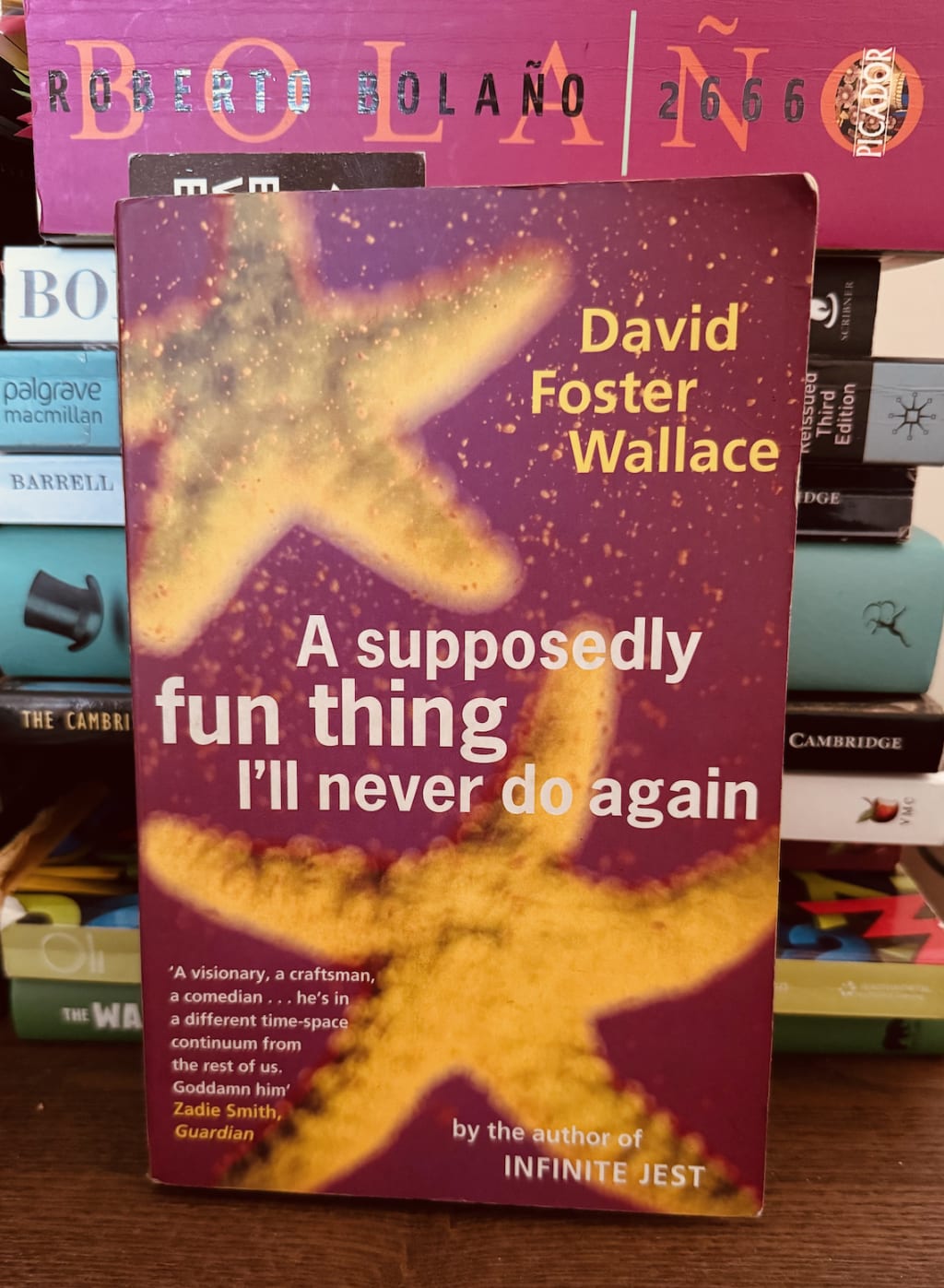
I honestly thought David Foster Wallace was an author I was never going to read again (that was a joke). Way way back, I read The Pale King and gave my first impressions on it in a strangely worded article where I was a bit overtly confused about why this was meant to be regarded the way it was. I enjoyed it enough but there was always a part of me that thought I was supposed to be enjoying it. Anyways, The Pale King has kept me on the fence. At least it was a better experience than I had when reading Infinite Jest a couple of years before that - that was not a great experience. So, let's have a look at the 'even better than The Pale King' experience I had of reading A Supposedly Fun Thing I'll Never Do Again. As you can tell, there's something more to this...
This is a collection of seven essays by David Foster Wallace, first published in 1997. Originally appearing in various magazines such as Harper’s, The New York Observer, and Premiere, these essays explore topics ranging from state fairs and professional tennis to the philosophy of television and the existential horrors of luxury cruises. Wallace blends reportage, personal reflection, and linguistic playfulness to craft an insightful critique of modern American culture. The title essay, which details Wallace’s experiences on a week-long Caribbean cruise, has become one of his most celebrated works, exemplifying his ability to dissect the absurdities of consumerist escapism. This is probably his more articulate work as well.
At its core, A Supposedly Fun Thing I’ll Never Do Again is an examination of pleasure, entertainment, and the underlying dissatisfaction embedded in modern American life. Wallace repeatedly returns to the idea that the pursuit of happiness, particularly through passive entertainment, often leads to an eerie sense of emptiness rather than fulfilment. He critiques the relentless pursuit of comfort, the infantilisation of consumers, and the false promise of escapism, whether through television, sport, or leisure travel. The essays also explore themes of loneliness, self-awareness, and the paradoxical nature of American excess. I think this is probably needed more than ever since we have so much passive entertainment nowadays. Many of the critiques he makes, I understand would have sounded a bit weird coming out when they did, but now you sort of think 'wow, he was kind of right about the emptiness of culture and infantilisation of consumers...'
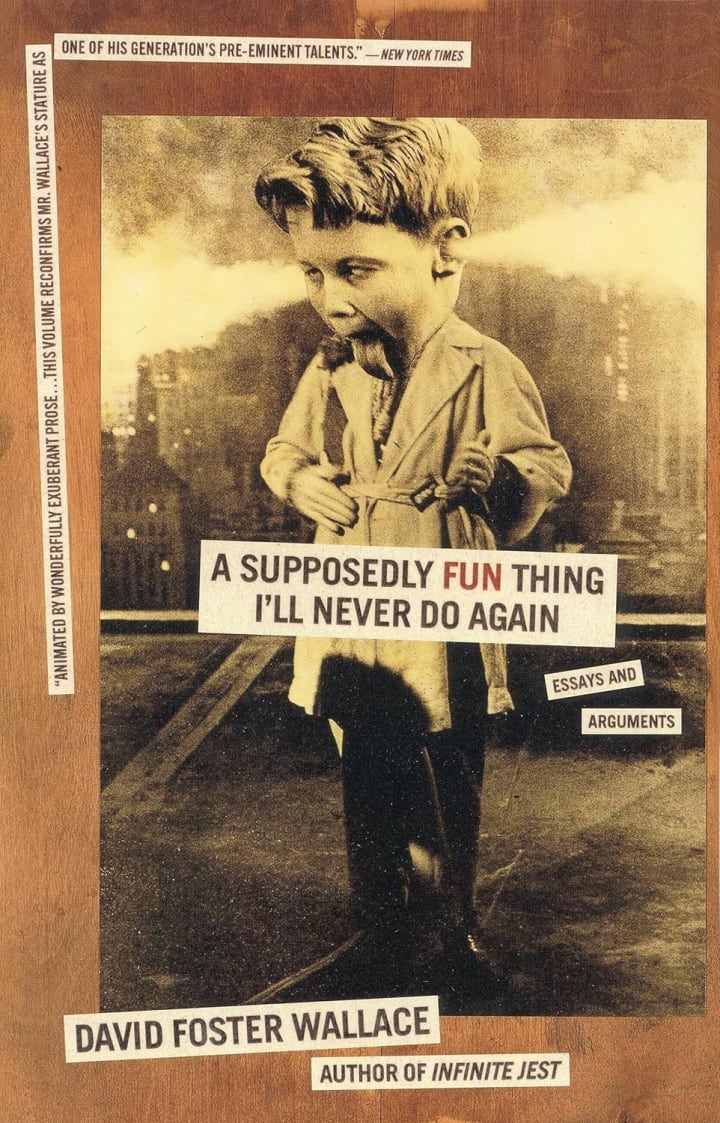
The titular essay, originally published as Shipping Out in Harper’s, recounts Wallace’s week aboard a luxury Caribbean cruise ship. Ostensibly a travel piece, the essay spirals into a deeply philosophical meditation on the nature of pleasure and its inherent contradictions. Wallace is both fascinated and horrified by the artificial happiness imposed upon passengers, from the forced joviality of staff to the relentless bombardment of hedonistic distractions. The ship, with its obsessive cleanliness, orchestrated leisure, and relentless catering to guests' every whim, becomes a metaphor for the American tendency to equate comfort with happiness, a tendency that Wallace finds simultaneously seductive and deeply alienating. There's two thoughts here: one is that who the hell does this on a cruise? The next is that perhaps he is correct.
While the cruise essay is the collection’s centrepiece, the other six essays provide equally rich explorations of contemporary American life. E Unibus Pluram: Television and U.S. Fiction examines how television has shaped American culture and literature, particularly in its relationship with irony. Wallace argues that TV’s saturation of irony has led to a cultural paralysis, where genuine emotional engagement is increasingly difficult. Getting Away from Already Being Pretty Much Away from It All documents his visit to the Illinois State Fair, using it as a lens to explore regional identity and the unglamorous side of American entertainment. Other essays, such as Tennis, Trigonometry, Tornadoes, reflect on Wallace’s personal experiences with competitive sport, blending memoir with philosophical inquiry.
All in all, the author's essays continue to resonate because they articulate a fundamental anxiety about modern existence: the fear that we are being entertained into oblivion. His work serves as both a critique and a confession, acknowledging the seduction of comfort while exposing its underlying emptiness. And honestly, who can blame him? He was witnessing the beginning that may have felt like 'oh it's just TV, or (insert other random luxury/entertainment from the 90s here) it's been around a long time now...' It may have felt like it didn't matter but dear god, how the world exploded.
About the Creator
Annie Kapur
I am:
🙋🏽♀️ Annie
📚 Avid Reader
📝 Reviewer and Commentator
🎓 Post-Grad Millennial (M.A)
***
I have:
📖 280K+ reads on Vocal
🫶🏼 Love for reading & research
🦋/X @AnnieWithBooks
***
🏡 UK
Keep reading
More stories from Annie Kapur and writers in Geeks and other communities.
The Bard and the Troubadour
Background and Context: I am back again with all these random notes from university (a long way back now) being turned into essays finally. You might ask me why I'm doing it now and really it's because I've been looking at them lying around for a long time now. There's many in my bank at this point and I like to think writing them now is doing them a little bit more justice than writing them back then with my less apt writing skills. However, there's always room for improvement. If you go on to my page and have a click around, you should be able to find a whole host of essays.
By Annie Kapur10 months ago in Geeks
The Rachels - 2025
Much to my surprise, I have kept a list of the films I‘ve seen this year. I daresay it isn’t complete. There will be films that snuck in on a late night in front of the TV that I would’ve forgotten to note. Or others, that I went to watch at the cinema, but then had a red wine and promptly forgotten about. But it’s not a bad approximation of the films I’ve seen this year. In total, there are 53 films listed, so an average of one a week and one for good luck.
By Rachel Robbins25 days ago in Geeks
Grant Gustin's Chances Of Returning As The DC Universe's Flash Have Just Increased After New Update
The Flash has yet to be cast for the new DC Universe, and after a new update, the rumors of Grant Gustin's return as Barry Allen in the new franchise have gained strength once again. Gustin made history by playing Barry for The Flash's nine seasons. The actor also starred in multiple Arrowverse crossovers, becoming one of the franchise's fan-favorites.
By Dena Falken Esq5 days ago in Geeks



Comments (2)
Fabulous story ♦️🖌️📕🏆♦️
Great Your all story 👌