
Book Review: "A Jest of God" by Margaret Laurence
5/5 - a breath of female liberation...

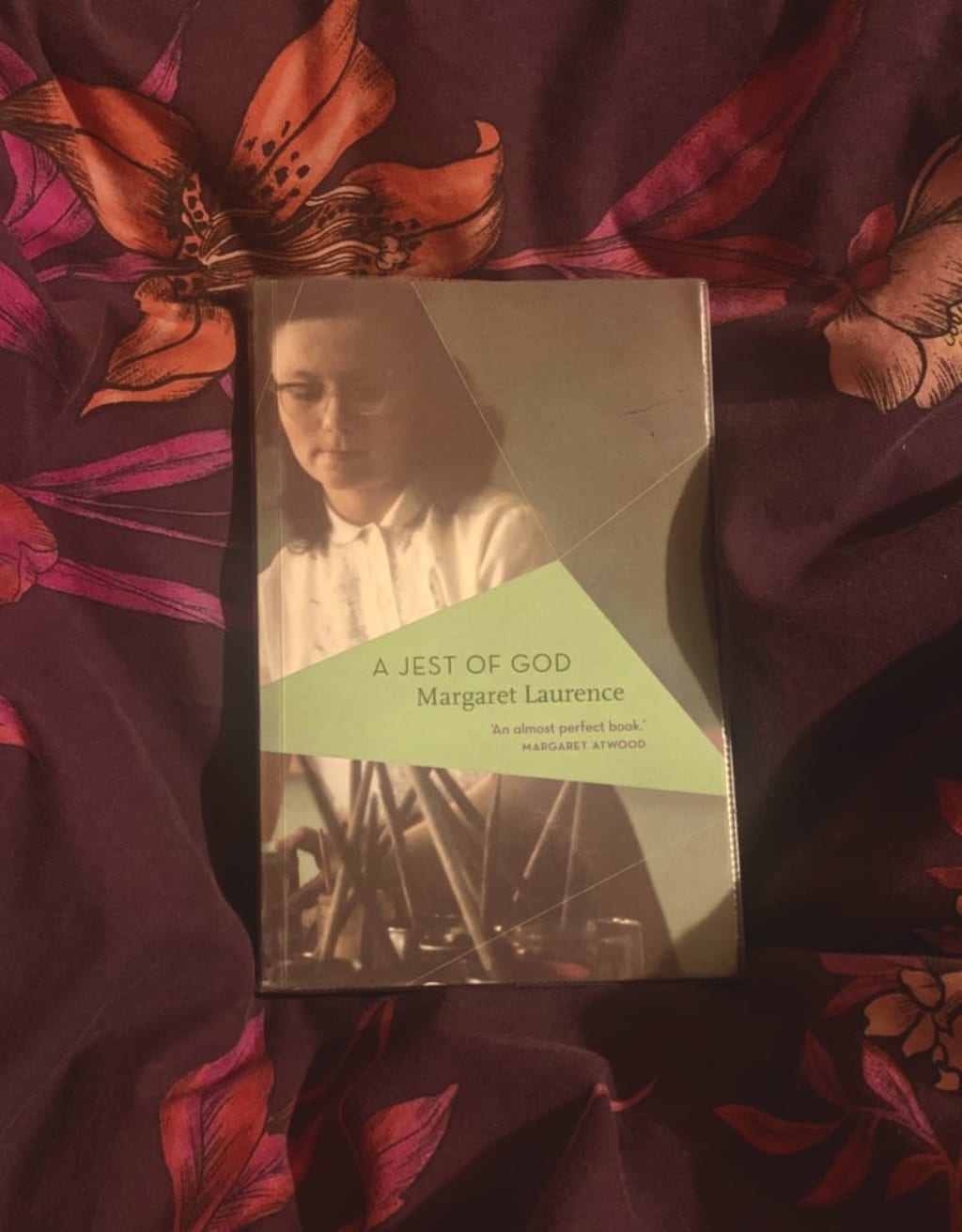
Romantic main plots are never a good idea for a novel because romance should always act as a subplot at most - as a main plot it ends up being shallow and the amount you can do with it is incredibly limited. Romantic subplots can really enhance a storyline such as in novels like In Search of Lost Time by Marcel Proust, Frankenstein by Mary Shelley and of course, the book we are looking at right now: A Jest of God by Margaret Laurence. My edition has an afterword by he author of The Handmaid's Tale, Margaret Atwood who explains why this novel is pretty perfect when it looks at the unfulfilled experience of womanhood and to be perfectly honest, this novel reminded me somewhat of the book The Post-Office Girl by Stefan Zweig. Needless to say, I really enjoyed it.
Rachel Cameron is a woman who looks after her invalid mother and has hardly come into contact with another human being. She has this strange surviving spirit about her where she wants freedom and love, purpose and to be liberated from her assumed position as care-giver and maternal being to other people in her life. This really does sound like the beginnings of Stefan Zweig's The Post-Office Girl or even Shirley Jackson's The Haunting of Hill House. The common theme is that these women are longing for something else rather than just looking after other people, they finally want to put their own happiness first rather than being accused of selfishness by others if they do. These accusations were almost always reserved for women who went out looking for their own happiness.
When we meet Rachel, she is to us a simple spinster - a school teacher in her thirties who has no lover and no real purpose apart from looking after other people. In her mind though, she is anything but just a simple spinster. Instead, she is a dreamer and a rebel, someone who is very clearly trapped by their own position without a pheasible way out. There are many things that we can say about this and the first and foremost one is that in our own day and age of female liberation, we cannot help but feel empathy towards Rachel and feel angry for the people who are responsible for keeping her locked into a position she very clearly does not want to be in.
As we get further and further into the book, Rachel's personality begins to come out of her own mind a little bit more. Her want to escape becomes more palpable and we begin to understand why she kept this hidden for so long - because of the reactions of other characters. The way she deals with love, death, rejection and solitude is simply incredible and is a great inspiration to women like myself who enjoy their solitude and do not understand it when others don't enjoy it. She seems to be this complex character further on in the novel and as the reader already knows this, the other characters are starting to realise it. The romantic subplot is merely there to help her understand herself and the ideas within her to stop her fearing solitude. A respect for herself develops from this and she begins to acknowledge what she must do if she is to move forward with her dreams of liberation.
In conclusion, I think that there is a lot more I want to read by this author now that I have met this complex character of Rachel Cameron. I think that there is a lot more I want to explore about the respect for solitude and why, out of everything, we must love ourselves first and foremost. It is a romance of the self, not a romance of others.
About the Creator
Annie Kapur
I am:
🙋🏽♀️ Annie
📚 Avid Reader
📝 Reviewer and Commentator
🎓 Post-Grad Millennial (M.A)
***
I have:
📖 280K+ reads on Vocal
🫶🏼 Love for reading & research
🦋/X @AnnieWithBooks
***
🏡 UK
Keep reading
More stories from Annie Kapur and writers in Geeks and other communities.
Book Review: "Darling" by Mercedes M. Yardley
Thank you to NetGalley for my copy of this book. If I have said it once, I have said it a million times - if you want to create a good horror novel with some serious fright, you have to have a simple storyline with very few characters. Why? This allows for the expansion of atmosphere, a better control of pace and a more intense amount of fright along with a nice heavy-hitting denouement due to the rush of the climax. Apart from that, you will need good character development and fleshed-out themes and symbols, these are secondary in order to help the reader make more sense of the story. What you don't want under any circumstance ever is thousands of useless characters scattering around the story making it more complicated than it has to be. Why? The reader can't get lost in the terror and nightmare of the narrative. The more you keep introducing characters and places, the less chance you have of letting your reader breathe in the atmosphere and key scenes. Unfortunately, this is exactly what happened with this book: Darling by Mercedes M. Yardley.
By Annie Kapur4 years ago in Geeks
The Rachels - 2025
Much to my surprise, I have kept a list of the films I‘ve seen this year. I daresay it isn’t complete. There will be films that snuck in on a late night in front of the TV that I would’ve forgotten to note. Or others, that I went to watch at the cinema, but then had a red wine and promptly forgotten about. But it’s not a bad approximation of the films I’ve seen this year. In total, there are 53 films listed, so an average of one a week and one for good luck.
By Rachel Robbins25 days ago in Geeks



Comments
There are no comments for this story
Be the first to respond and start the conversation.