
Alma Pöysti Wins Best European Actress at the Septimius Awards 2025 in Amsterdam
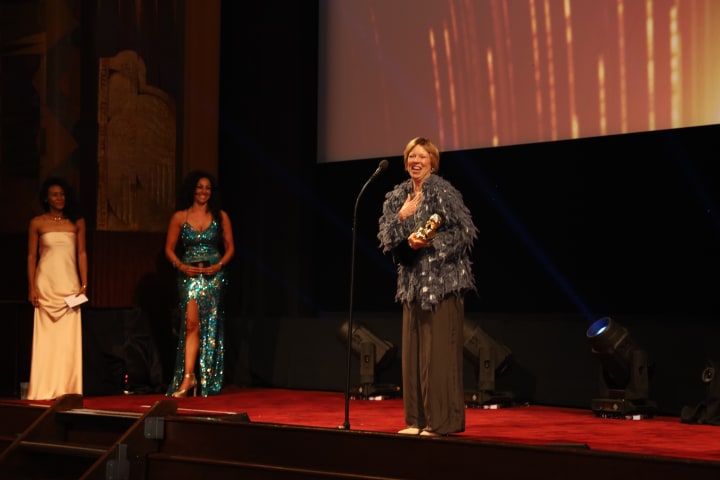
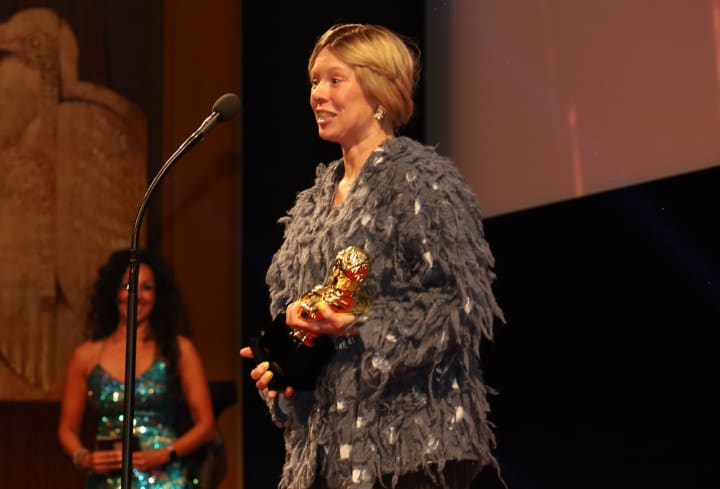
Alma Pöysti Wins Best European Actress at the Septimius Awards 2025 in Theater Tuschinski in Amsterdam

Alma Pöysti's triumph as Best European Actress for her performance in Orenda at the 2025 Septimius Awards is a milestone moment - not just for her, but for the kind of emotional clarity and risk that European cinema so often aspires to deliver. In a field crowded with powerful performances, Pöysti stood out for her ability to be both intensely personal and hauntingly universal, drawing viewers inside Orenda in a way that stays with you long after the film ends.

Pöysti, a Finland-Swedish actor, has been steadily building a reputation for roles that demand subtlety, physical presence, and off-screen complexity. But in Orenda, her performance seems to crystallize everything she has done so far: the roles that asked her to make silence speak, to carry internal conflict without melodrama, to be both fragile and unyielding. Orenda doesn't offer easy resolutions; it prefers to dwell in the space between choices not taken, in the tension between past and future. And it's in that tension that Pöysti truly shines.
Her character in Orenda is caught in multiple currents: emotional, cultural, perhaps political. The film's cinematography often frames her in isolation - scenery, long stretches of space, moments of stillness where the camera lingers. In those scenes, Pöysti doesn't have big speeches. What she has are gestures: the way she breathes, the way she looks away, the way her body moves (or doesn't). Those small details feel lived in; they resist sentimentality. They ground the more lyrical or symbolic scenes in human truth.

That said, Orenda also gives its lead moments of confrontation, of visceral tone, and Pöysti meets them with courage. She doesn't shy away from the darker sides of her character - regret, anger, doubt - but she also allows grace, longing, small joys. It's not only about what her character suffers but how she endures, how she connects, how she reaches - for something beyond the immediate pain. Those moments are what make her performance emotionally rich.
Critically, Pöysti's win is meaningful because it celebrates acting that is interior rather than showy. In an era when so many awards are swayed by spectacle or by performances that break open in grand gestures, Pöysti reminds us of the power of restraint. Orenda may be a visually arresting film; its soundtrack, cinematography, direction all add layers of mood and metaphor. But it's the acting that holds the film together - Pöysti's performance is its emotional anchor.
Her contribution to European film has been growing, and Orenda might become a touchstone for her career - a role people refer back to as one where everything aligned. The recognition by the Septimius Awards amplifies that: a prestigious international stage that values originality, risk, independent vision. Winning Best European Actress puts her among a cohort of actors who are pushing European cinema forward - not just in prestige, but in what stories are told and how.
Beyond Orenda, Pöysti's career and background give her additional resonance. Her multilingual, bicultural roots (Finnish, Swedish) infuse her work with a sensitivity to liminal spaces - between languages, between cultures, between identities. She often plays characters who are negotiating belonging, translation (literal or metaphorical), and the weight of history. In Orenda, that negotiation is central; it's part of the character's struggle, part of her longing. And Pöysti brings authenticity to that space; it doesn't feel like an "acting choice," but like lived experience.
There is also something resonant about this moment in 2025, for European cinema generally. Filmmakers and actors are more aware of global flows - distribution, streaming, cross-border collaborations - and audiences are more open to non-Anglophone stories. But the challenge remains: how to maintain depth, complexity, cultural specificity, without losing emotional immediacy. Pöysti meets that challenge. Her performance is rooted in its setting, its language, but carried by universals: love, regret, fear, hope.
Her support cast and crew in Orenda deserve credit too - director, editors, cinematographer, sound, production design - all contribute to creating spaces in which quiet performances matter. The film gives room - rooms, in fact - for Pöysti to live in the skin of her character. And she takes that space and makes it sing, in its silences and its breaks.
Her triumph at Septimius is likely to open more doors - larger international co-productions, roles that allow her to show different facets, directors who trust her with complexity. It will also be a signal to filmgoers: this is someone whose work is worth noticing, whose choices lean toward challenge, toward meaning. And perhaps for younger actors in Europe who see themselves in her, this is encouragement: that there is space for subtle, difficult, emotionally true performance.
In the end, Alma Pöysti as Best European Actress for Orenda doesn't feel like just the best among peers - it feels like a moment when actor, role, film, context all converge. It's an achievement, yes. But more than that: it's an invitation - to see what cinema can do when it trusts its characters and its viewers, when performance is about inner life as much as outward action. It is a win for Pöysti, but also a win for cinema that knows the power of quiet bravery.
About the Creator
MarqueeNarrative
Marquee Narrative
Keep reading
More stories from MarqueeNarrative and writers in Geeks and other communities.
Luo Bin’s New Dawn (当大事) Wins Best Short Film at the Septimius Awards 2025 and Paralympic Japanese actress Mei Ichinose is nominated for Best Asian Actress for her role in “The Edge”
In a significant moment for Chinese filmmaking, director Luo Bin’s poignant and evocative short film, "New Dawn," was awarded Best Short Film at the prestigious Septimius Awards 2025. The ceremony, held on September 4th at the iconic Tuschinski Theater in Amsterdam, celebrated a diverse range of cinematic talent from across the globe, and Luo’s win stood out as a beacon of hope and recognition for Chinese artists who have long been on the periphery of Western award circuits.
By MarqueeNarrative4 months ago in Geeks
The Rachels - 2025
Much to my surprise, I have kept a list of the films I‘ve seen this year. I daresay it isn’t complete. There will be films that snuck in on a late night in front of the TV that I would’ve forgotten to note. Or others, that I went to watch at the cinema, but then had a red wine and promptly forgotten about. But it’s not a bad approximation of the films I’ve seen this year. In total, there are 53 films listed, so an average of one a week and one for good luck.
By Rachel Robbins16 days ago in Geeks
Spring Fever: A Quiet, Intimate Portrait of Desire, Youth, and Emotional Recklessness
In a television landscape increasingly dominated by high-concept premises, explosive twists, and binge-friendly cliffhangers, Spring Fever stands out by doing something deceptively simple: it observes people. The show does not rush to explain itself or overwhelm viewers with plot mechanics. Instead, it unfolds slowly, allowing emotions to bloom, collide, and unravel in ways that feel uncomfortably real. Spring Fever is less about what happens and more about how it feels when longing, confusion, and self-discovery arrive all at once.
By David Cook4 days ago in Geeks


Comments