
A Filmmaker's Guide to: The Top Down Shot
Film Studies (Pt.117)

In this chapter of ‘the filmmaker’s guide’ we’re actually going to be learning about literature and film together. I understand that many of you are sitting in university during difficult times and finding it increasingly hard to study and I understand that many of you who are not at university or not planning on it are possibly stuck of what to do, need a break or even need to catch up on learning film before you get to the next level. This guide will be brief but will also contain: new vocabulary, concepts and theories, films to watch and we will be exploring something taboo until now in the ‘filmmaker’s guide’ - academia (abyss opens). Each article will explore a different concept of film, philosophy, literature or bibliography/filmography etc. in order to give you something new to learn each time we see each other. You can use some of the words amongst family and friends to sound clever or you can get back to me (email in bio) and tell me how you’re doing. So, strap in and prepare for the filmmaker’s guide to film studies because it is going to be one wild ride.
The Top Down Shot
What is it?
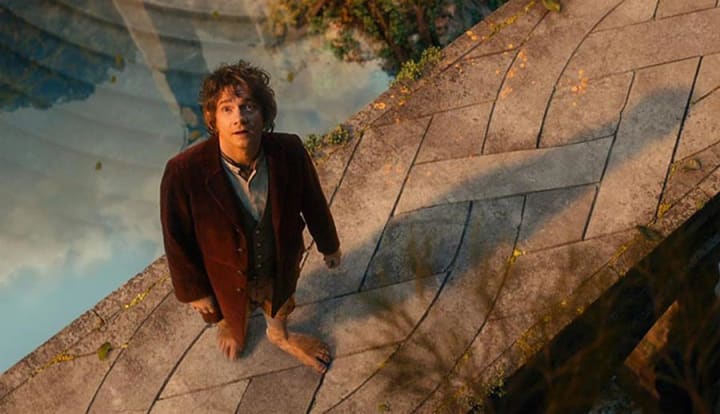
Sometimes known as the 'downward crane' shot, it is where you take your camera parallel to the very top of your characters - it is up to you how far over their heads you are - and tilt the camera downwards in an act of looking down upon the characters at some sort of angle.
How is it used?
It can be used for the various reasons:
Show the perspective of space (as in the still from "The Hobbit" [above])
Show an isolated situation in which dramatic things are taking place
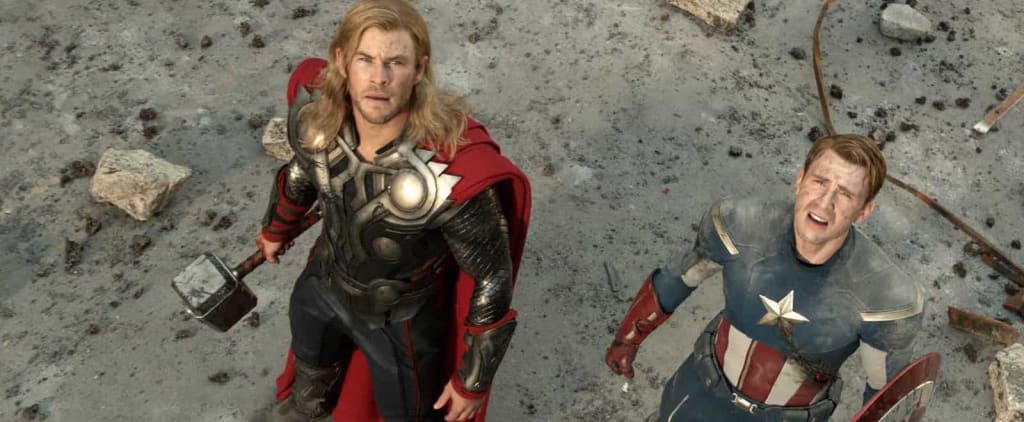
Show the perspective of size (as in the still from "The Avengers" at the beginning of the article)
To give some sort of importance to a particular character
To pan downwards on to a situation to recognise it as being important to the storyline
Case Study: "Inglorious Basterds" (2009)
Within this film, there are many of these 'top-down' shots which obviously give us not only spatial awareness, but show the importance of very particular characters before or within their main climactic arc.
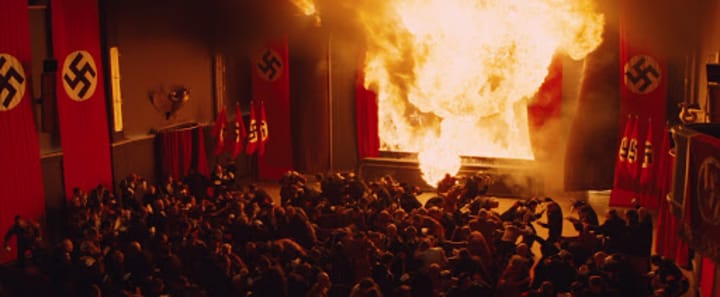
When we look at this still [above] we see that the top-down shot is done from the perspective of the woman who owns the cinema and, when she sets fire to it, we get to see almost a POV of what she is seeing. It gives importance to her character, gives importance to her arc and shows the audience exactly what is going on in every aspect of the scene.
Another way in which we can see the top-down shot is through the close-up. This shows the importance of one particular part of a scene through its harnessing of the character's facial expression in a very important moment of the story. Have a look at the still below:
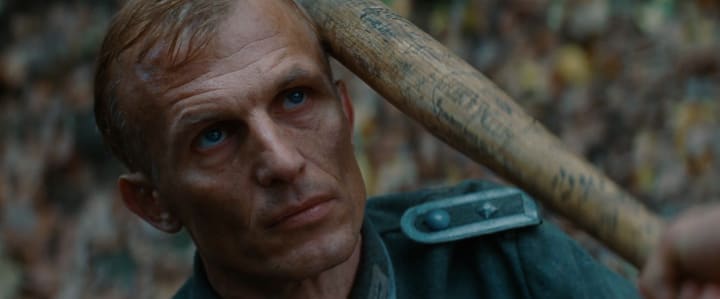
It is very slightly tilted downwards, but it is done to show not perspective, but to have the facial expression of character almost in the middle of the shot whilst also showing us what is about to happen. It is an act of almost looking over the shoulder of another character - we therefore feel more involved with the story.
Conclusion
There are many more that you can find, for example you could study the scene where we have Brad Pitt introducing himself to his soldiers. There is an amazing top-down shot in that scene that seems to represent the importance of these people - leading us on to the entire story of the film. But, the best top-down shots I have seen have always been in the films of Quentin Tarantino. Films such as "Jackie Brown" and even his more recent "Once Upon a Time in Hollywood" have some amazing top-down shots to analyse.
About the Creator
Annie Kapur
I am:
🙋🏽♀️ Annie
📚 Avid Reader
📝 Reviewer and Commentator
🎓 Post-Grad Millennial (M.A)
***
I have:
📖 280K+ reads on Vocal
🫶🏼 Love for reading & research
🦋/X @AnnieWithBooks
***
🏡 UK
Keep reading
More stories from Annie Kapur and writers in Geeks and other communities.
Book Review: "Satan in Goray" by Isaac Bashevis Singer
Isaac Bashevis Singer is probably best known for winning the Nobel Prize for Literature and writing novels such as "Love and Exile", "The Penitent", "The Family Moskat" and "Enemies: A Love Story". But there is another book that I have read by him in my attempt to read his entire bibliography - that novel is called "Satan in Goray". I have to say that this book is like none that I have ever read by him before and has seriously surprised me through its incredibly influential use of religion. Normally the Jewish identity is not as religious as we see it in this novel and honestly, it is a great turn for the author who now, writes a novel about religious hypocrisy and moral panic.
By Annie Kapur5 years ago in Geeks
Silver Screen Magic with Mae West
American actress and singer Mae West became a popular film actress during the Great Depression. She started entertaining in vaudeville, then performed on Broadway, and finally went to Hollywood. She signed up with Paramount Pictures and made her debut in the 1932 film “Night After Night.” She also starred in musicals, comedies, and crime dramas. The American Film Institute named her one of the best classic Hollywood actresses.
By Rasma Raisters3 days ago in Geeks
Playing Death Games to Put Food on the Table
There is something deeply unsettling about watching people risk their lives for money—and yet, we keep watching. From neon-lit arenas to abandoned cities rigged with traps, modern television has turned survival into spectacle. Shows built around “death games” aren’t just about shock value or violence; they are mirrors reflecting economic anxiety, social inequality, and the quiet desperation of everyday life.
By David Cook7 days ago in Geeks



Comments
There are no comments for this story
Be the first to respond and start the conversation.