


In this chapter of ‘the filmmaker’s guide’ we’re actually going to be learning about literature and film together. I understand that many of you are sitting in university during difficult times and finding it increasingly hard to study and I understand that many of you who are not at university or not planning on it are possibly stuck of what to do, need a break or even need to catch up on learning film before you get to the next level. This guide will be brief but will also contain: new vocabulary, concepts and theories, films to watch and we will be exploring something taboo until now in the ‘filmmaker’s guide’ - academia (abyss opens). Each article will explore a different concept of film, philosophy, literature or bibliography/filmography etc. in order to give you something new to learn each time we see each other. You can use some of the words amongst family and friends to sound clever or you can get back to me (email in bio) and tell me how you’re doing. So, strap in and prepare for the filmmaker’s guide to film studies because it is going to be one wild ride.
Punk

What is it?
Normally centred around left-winged politics, 'punk' as a genre focuses on beating, overcoming and holding revolution against a corrupt and dystopian-styled authoritarian government.
In literature, punk has normally been split up into different subdivisions mostly concerning the realm of Sci-Fi and/or Fantasy genres. These include but are probably not limited to the following:
- Atompunk - Space Age related Sci-Fi [for example: 2001: A Space Odyssey by Arthur C. Clarke]
- Cyberpunk - Enhancement of lifestyle due to some sort of digital component [for example: Ready Player One by Ernest Cline]
- Retropunk - A recent historical setting with components of exaggerated digital equipment and/or fantasy qualities [for example: Captain America]
- Steampunk - Sci-Fi influenced by various industrial revolutions over the course of history [for example: Around the World in Eighty Days by Jules Verne]
- Clockpunk - Based in mechanical, pre-modern designs, the aspects of this world work in cogs and reels much like an old clock. [for example: the "Cogheart" series by Peter Bunzl]
- Biopunk - sometimes also known as 'monster punk' it involves the changing in a biological make-up in order to create a monster, either animal or human, playing into the Dr. Jekyll and Mr. Hyde archetype. [For example: The Incredible Hulk]
- Post-Cyberpunk - a mixture between apocalyptic literature and the literature of the cyberpunk movement, it focuses on the decay of civilisation due to technological advances. It was mainly conceived as an idea by critics once they realised that we had probably moved past the cyberpunk age. [for example: Altered Carbon by Richard Morgan]
Other books within various punk movements include the following [but are definitely not limited to them]:
- Do Androids Dream of Electric Sheep? by Phillip K. Dick
- War of the Worlds by H.G Wells
- Ender's Game by Orson Scott Card
- The Man in the High Castle by Phillip K. Dick
- Twenty-Thousand Leagues Under the Sea by Jules Verne
- Oryx and Crake by Margaret Atwood
What about in film?

At the moment, I mean in the last twenty years, film has been pretty obsessed with the punk genre. Everything from adapting works of literature for the screen, to comics and manga to screen and even original works which are definitely worth a watch - well, sometimes. All of which contain either one or various aspects of different subdivisions of what we know as 'punk'. They are normally set against either a dystopian or digital backdrop and have an audience of everyone who wants to see the government get beaten up a few times throughout the next couple of hours.
Let's have a look at some of them that have come out in our own recent times since the start of our beloved century:
- Artemis Fowl
- The New Mutants
- The Book of Eli
- Inception
- Never Let Me Go
- Battle: Los Angeles
- I Am Number Four
- Real Steel
- Source Code
- Super Eight
- X-Men - Days of Future Past
- X-Men - First Class
- Transformers
- Thor: Ragnarok
- Cloud Atlas
- Hunger Games
- Total Recall
- Ender's Game
- Her
- Man of Steel
- Oblivion
- The Wolverine
- World War Z
- Big Hero Six
- Edge of Tomorrow
- Guardians of the Galaxy
- Maze Runner
- Predestination
- Ex Machina
- Jupiter Ascending
- Divergent
- Star Wars: Rogue One
- X-Men - Apocalypse
- Blade Runner 2049
- Ghosts in the Shell
- The First Purge
- Mortal Engines
- Alita: Battle Angel
- Brightburn
- Gemini Man
That's a lot of punk movies. You just have to determine now which 'punk' subdivision you think that each of them fall into and why. Some are easier than others, for example: "Thor: Ragnorok" has the aesthetic of punk to to put it definitively into a subdivision is much harder than you think. However, there may be some that fit more than one subdivision and that is perfectly alright as well.
Coming soon to a punk subdivision near you... Neuropunk
Further Reading:
- Lavigne, C (2012). Cyberpunk Women Feminism &: A Critical Study. USA: McFarland and Company.
- Quiroga, R (2020). NeuroScience Fiction: From "2001: A Space Odyssey" to "Inception," How Neuroscience Is Transforming Sci-Fi into Reality―While Challenging Our Beliefs About the Mind, Machines, and What Makes us Human. USA: Benbella Books Publishing House.
- Unno, H (2018). The Art of Fantasy, Sci-fi and Steampunk. USA: PIE Books Publishing House
About the Creator
Annie Kapur
I am:
🙋🏽♀️ Annie
📚 Avid Reader
📝 Reviewer and Commentator
🎓 Post-Grad Millennial (M.A)
***
I have:
📖 300K+ reads on Vocal
🫶🏼 Love for reading & research
🦋/X @AnnieWithBooks
***
🏡 UK
Keep reading
More stories from Annie Kapur and writers in Geeks and other communities.
A Filmmaker's Guide to: Critiques of Mental Health
In this chapter of ‘the filmmaker’s guide’ we’re actually going to be learning about literature and film together. I understand that many of you are sitting in university during difficult times and finding it increasingly hard to study and I understand that many of you who are not at university or not planning on it are possibly stuck of what to do, need a break or even need to catch up on learning film before you get to the next level. This guide will be brief but will also contain: new vocabulary, concepts and theories, films to watch and we will be exploring something taboo until now in the ‘filmmaker’s guide’ - academia (abyss opens). Each article will explore a different concept of film, philosophy, literature or bibliography/filmography etc. in order to give you something new to learn each time we see each other. You can use some of the words amongst family and friends to sound clever or you can get back to me (email in bio) and tell me how you’re doing. So, strap in and prepare for the filmmaker’s guide to film studies because it is going to be one wild ride.
By Annie Kapur5 years ago in Geeks
Spongebob Review
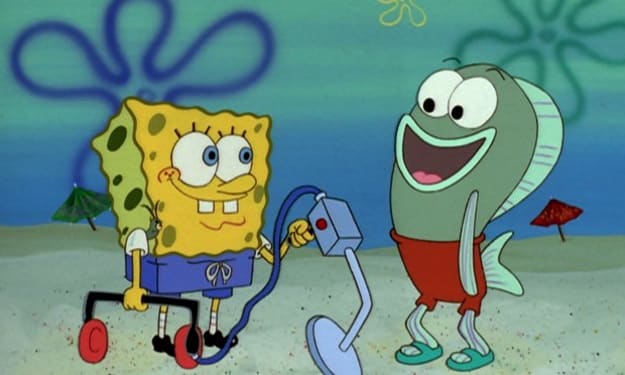
The episode “Walking Small” opens with a sun‑drenched panorama of Goo Lagoon, the golden sand glittering like powdered sugar under a cloudless sky, and the playful chatter of Bikini Bottom’s residents echoing across the waves. From the very first frame, the animation captures the carefree rhythm of a typical day at the beach, yet a subtle tension is already bubbling beneath the surface as Plankton slides into view, his tiny silhouette a dark crescent against the bright horizon. The writers cleverly juxtapose the idyllic setting with Plankton’s scheming grin, foreshadowing the paradoxical lesson that will unfold: the transformation of SpongeBob from his usual bubbly innocence into a surprisingly assertive beach‑goer. The visual palette—turquoise water, amber sun, and the occasional flash of a distant jellyfish—serves as a vivid backdrop for the episode’s central conflict, immersing the audience in a world that feels both familiar and slightly off‑kilter, as if the sand itself is waiting for a ripple that will reshape the familiar rhythm of beach life.
By Forest Green6 days ago in Geeks
Tatt~Master
— Assembly Line Tatt Machine ~ Impressions to Impress — As I begin to understand more about the Tattoo Phenomenon. I've written silly, yet verbatim, dating site anecdotes in 'Frazzled.' So let me ask you: Would you be More attracted to someone slathered with tattoos, or Less?
By Jay Kantor6 days ago in Humor



Comments
There are no comments for this story
Be the first to respond and start the conversation.