
A Filmmaker's Guide to: Extreme Wide Shots
Film Studies (Pt.123)


In this chapter of ‘the filmmaker’s guide’ we’re actually going to be learning about literature and film together. I understand that many of you are sitting in university during difficult times and finding it increasingly hard to study and I understand that many of you who are not at university or not planning on it are possibly stuck of what to do, need a break or even need to catch up on learning film before you get to the next level. This guide will be brief but will also contain: new vocabulary, concepts and theories, films to watch and we will be exploring something taboo until now in the ‘filmmaker’s guide’ - academia (abyss opens). Each article will explore a different concept of film, philosophy, literature or bibliography/filmography etc. in order to give you something new to learn each time we see each other. You can use some of the words amongst family and friends to sound clever or you can get back to me (email in bio) and tell me how you’re doing. So, strap in and prepare for the filmmaker’s guide to film studies because it is going to be one wild ride.
Extreme Wide Shots
What are they?
Well, they are exactly what you think they are. They are wide shots which are taken to the extreme by making the background appear bigger and the foreground appear smaller through the use of perspective. Therefore, something like a mountain range would be perfectly visible and the character would be small in the foreground. The width of the frame and everything in it truly captured for that extra sense of drama and naturalism.
How are they used?
Extreme Wide Shots are used for a number of reasons, here are some main ones you probably want to look into:
- Showing the size of a landscape [especially if it is massive]
- Giving perspective to where something is [check out the example of the mountain range from above, the people are made little in the foreground on purpose]
- Showing where something is [especially if this thing is considered by urban standards to be in the middle of nowhere, we still need to know where that nowhere is in order to understand the movie]
- To add drama [as a lot of movies try to do with their breathtaking landscapes]
Case Study 1: "127 Hours"
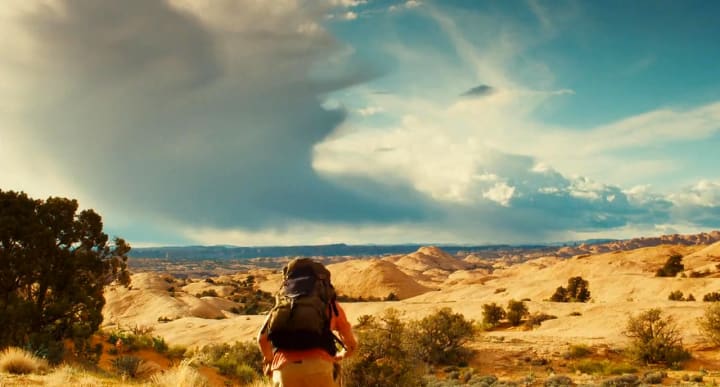
The acting may be terrible, but the extreme wide shots included by Danny Boyle in the film "127 Hours" are breathtaking. Just take a look at this. We can definitely see that there is a skyline, desert regions and various dry plants littered about. What do we get from this? We get the feeling that our character is way away from civilisation and, not only heightening the drama but the tension as well - we have taken the character far away from where we believe humans should be living: cities, countrysides etc. This emptiness and the dead plants is something that worries us as an audience.
Case Study 2: "Lawrence of Arabia"
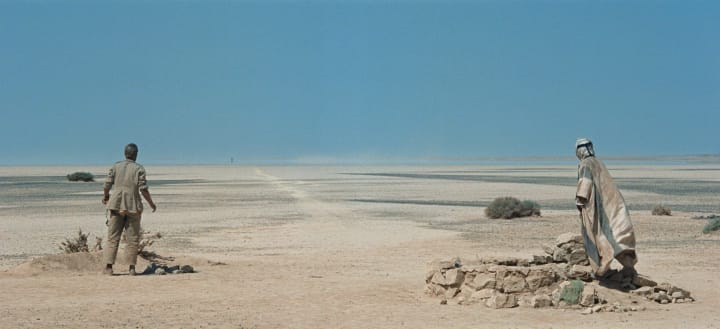
It is impossible, in my opinion, to discuss the extreme wide shot and its use without talking about "Lawrence of Arabia" which is probably the most famous film to use this kind of shot multiple times in the film. If you remember when we covered our topic on epic films, you would have seen me mention the extreme wide shots in this film briefly. The point of these shots is not only to add the breathtaking and sublime effect that the director got right on the head in this film, but also to depict space. As we can see, the characters are completely isolated in this vast space of nothingness, it is a beautiful way of depicting the east and has been used many, many times in other movies since.
Conclusion
As we can see, there are varied uses for the extreme wide shot, obviously it is more effective in areas such as the depiction of space when the character is far removed from things that the modern person should be equipped with. Other films such as Westerns, Adventure Films etc. are possibly just as famous for their inclusion of extreme wide shots purely for perspective and if you want to learn more about this shot then I suggest you check out the movies of epic scale because that is the most popular form of cinema it is used in.
About the Creator
Annie Kapur
I am:
🙋🏽♀️ Annie
📚 Avid Reader
📝 Reviewer and Commentator
🎓 Post-Grad Millennial (M.A)
***
I have:
📖 280K+ reads on Vocal
🫶🏼 Love for reading & research
🦋/X @AnnieWithBooks
***
🏡 UK
Keep reading
More stories from Annie Kapur and writers in Geeks and other communities.
Book Review: "Watching from the Dark" by Gytha Lodge
I like reading twisted thrillers a lot and honestly, this was no exception to that rule. I adored this thriller. The modernity of it, the brilliance of the polished storyline and the back and forth between a long time before the murder to just afterwards. The whole storyline is trying to direct your attention away from what is actually happening and when you think that you have figured it out, it changes the entire story and you go in a different direction. My opinion is to keep an open mind and suspect everyone. I mean you must suspect everyone.
By Annie Kapur5 years ago in Geeks
The Rachels - 2025
Much to my surprise, I have kept a list of the films I‘ve seen this year. I daresay it isn’t complete. There will be films that snuck in on a late night in front of the TV that I would’ve forgotten to note. Or others, that I went to watch at the cinema, but then had a red wine and promptly forgotten about. But it’s not a bad approximation of the films I’ve seen this year. In total, there are 53 films listed, so an average of one a week and one for good luck.
By Rachel Robbins26 days ago in Geeks


Comments
There are no comments for this story
Be the first to respond and start the conversation.