
5 MCU Films That Were Almost Very Different
A few tweaks along the way.


Marvel Studios' Marvel Cinematic Universe is easily the most ambitious franchise of all time. Never before has an interconnected onscreen world of so many different locations and characters been built, and even now, 17 years, five phases, and 37 films in, no other attempt has yet matched the MCU in success and scale.
A lot of this success comes down to careful planning, at least post-phase one following the success of The Avengers, when it became more clear that a once-crazy idea was actually going to work. Despite this, there have still been a few times along the way where plans have had to pivot or change, subject to various factors along the way.
Here's some of the MCU films that almost turned out very differently.
1. The Avengers
By the release of Iron Man 2 in 2010, Marvel Studios had fully committed to a shared universe, building towards an Avengers film in 2012. The plan was to have the newly formed Avengers face off against Loki, the often evil adopted brother of Thor, in a story inspired by the very first Avengers comic book. In order to meet the release date, elements of The Avengers began filming before Thor, the film set to introduce Loki, had even been released.
The success or failure of The Avengers would rely largely on the reception to Thor, which was a major risk as the characters were not widely popular outside of comic circles, and two then relatively unknown actors, Chris Hemsworth and Tom Hiddleston, had been cast in the lead roles of Thor and Loki. In an attempt to lessen this risk, some early drafts of The Avengers script used Captain America villain The Red Skull as the main antagonist. Red Skull was seen as a more familiar, obvious threat, and a proven actor, Hugo Weaving, had already been cast in the role for Captain America: The First Avenger. Early scripts also included The Wasp as part of the team.
This idea was soon taken off the table when Hugo Weaving was resistant to the idea of signing for another film, leaving Marvel Studios' to stick to the original plan. This turned out for the best, as Loki quickly became one of the MCU's most iconic characters. While The Wasp did not appear in the final film, the idea of her as a founding Avenger was alluded to in an episode of What If..?, when a character in a Wasp suit (due to the Ant-Man-esque design, most assume Janet Van Dyne) appeared briefly as a member of Captain Carter's Avengers team.
2. Captain America: Civil War
Following Avengers: Age of Ultron, Robert Downey Jnr's contract with Marvel Studios was set to expire. While Downey was willing to sign on for more films, during negotiations the actor was given a choice to make, and it was one that had a huge impact on the way Phase Three of the MCU unfolded. Downey was given the option to either star in a fourth Iron Man solo film, or co-star in the third Captain America film, which would adapt the iconic Civil War comic event. Making the choice he believed was best for the MCU's ongoing story, Downey opted to star in Civil War.
Had Downey chosen Iron Man 4, Captain America 3 would instead have seen Steve Rogers battling the Serpent Society, a team of snake-themed supervillains in Marvel Comics. In this scenario, it is unknown how Spider-Man and Black Panther would have made their MCU debuts, or whether the Avengers would still have become fractured. As such, we wouldn't only have had a different third Captain America film, but a very different lead-up to Avengers: Infinity War.
At one point, the Serpent Society was slated to play a more significant role in Captain America: Brave New World, but most of the members were cut from the final product.
3. Doctor Strange in the Multiverse of Madness
Everyone knows by now that the Scarlet Witch takes a villainous turn in Doctor Strange in the Multiverse of Madness, but this was not always the case. In one earlier draft of the film, Strange would instead have been facing the villain Nightmare.
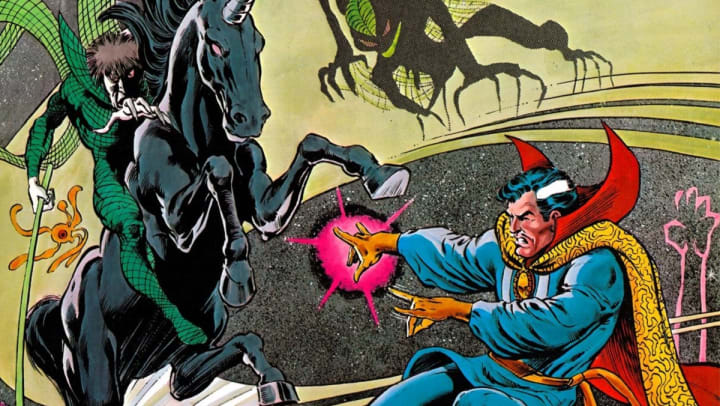
The Scarlet Witch would still have appeared in the film, but as a co-protagonist, having sought sanctuary with Strange at the Sanctum Sanctorum to get help learning to control her powers after the events of WandaVision. Rather than pursuing America Chavez to steal her power as she does in the final film, Wanda would have become a mentor to the girl, cautioning her on the dangers of not being in control of her abilities.
At the conclusion of the film, despite the pleading of her allies, Wanda was to have fled into the Multiverse in the hope of reuniting with her children, accidentally killing Wong as he tried to stop her from doing so. Multiverse of Madness was also initially planned to take place before Spider-Man: No Way Home. Earlier scripts for No Way Home feature America as a supporting character, and it would have been she, not Ned, who located the two alternate Spider-Men.

While the latter change was a result of COVID-related delays, the other changes occurred because Michael Waldron, who wrote the final version of the Multiverse of Madness script, wanted to use the Scarlet Witch as a villain.
4. Black Panther: Wakanda Forever
Following the success of the first Black Panther film in 2018, Marvel Studios and Writer/Director Ryan Coogler quickly began planning for a follow up, with star Chadwick Boseman apparently signed on for at least two sequels as King T'Challa. Tragically, all of Coogler's initial plans had to be scrapped when Boseman passed away from Colon Cancer in 2020.
A sequel, Black Panther: Wakanda Forever, was eventually released in 2022, with T'Challa's grief-stricken younger sister, Princess Shuri, reluctantly taking up the mantle of Black Panther when Wakanda comes under attack by Namor and the underwater Kingdom of Talokan. The film was well received, and even resulted in an Oscar nomination for Angela Basset, yet naturally, we wonder what might have been.
If not for Chadwick Boseman's death, Black Panther 2 would have been a very different film, but two elements of Wakanda Forever would have remained: Namor as the antagonist, and Toussaint/Prince T'Challa, Nakia and T'Challa's son, introduced in Wakanda Forever's post-credits.
According to Coogler, the original plan for the film was a Father-Son story, with T'Challa attempting to make up for missing his son's early years due to being a victim of the Blip. T'Challa would have been taking Toussaint on a traditional Wakandan Pilgrimage, before their trip is derailed by Namor's attack. It's a film many wish they could have seen.
5. Thunderbolts*
MCU scripts usually go through multiple drafts before the final product, and Thunderbolts*, the concluding chapter of Phase Five, is no different. Most fans will now be aware that in the theatrical cut, Antonia Dreykov, aka Taskmaster, is an early casualty, assassinated by Ghost on Valentina's orders. Many fans already predicted this, after noting that Olga Kurylenko, the actress behind the character, was the only Thunderbolt absent from the Avengers: Doomsday cast announcement. However, Taskmaster's death was not always a forgone conclusion.
In earlier drafts of the Thunderbolts* script, Taskmaster survives at least most of the film. And, in what seems a somewhat tragic twist given what we see in the final film, Ghost would have developed a protective, older sister-like bond with Taskmaster, as they both worked to overcome their troubled pasts.
More often than not, changes like these happen for a reason. However, it would still be interesting to see how things would change if any of these alternate MCU projects had made it to the screen.
About the Creator
Kristy Anderson
Passionate About all things Entertainment!
Keep reading
More stories from Kristy Anderson and writers in Geeks and other communities.
Review: Roald Dahl's 'The Witches' at Beaumaris Theatre
The late and beloved Roald Dahl is an eternal icon of children's literature, having easily earned his oft-given title as one of the greatest children's storytellers of the 20th century. Dahl's books, including such classics as Charlie and The Chocalate Factory, Matilda, Fantastic Mr. Fox, and The B.F.G, among many more, have sold over 300 million copies worldwide, with many of them having been adapted into other forms of media, including films, radio dramas, and stage plays.
By Kristy Anderson7 months ago in Geeks



Comments
There are no comments for this story
Be the first to respond and start the conversation.