


Part 53, and we’re still nowhere near done with our lists. If you’ve been here a while then I apologise for all the reading I’ve probably been giving you. But of course, I don’t expect you to read them all—If you take away just one or two books from all of these lists, then that’s good enough for me. But, if you’re reading through them, then I honestly say, from the bottom of my heart—Good luck, because it took me forever. No, seriously. It took me over 10 years to read all these books. Anyways, I feel like the next topic that’s coming up is a pretty important one. Today, we’re discussing the importance of reading from an early age.
There are studies that suggest that the most important time to develop any child’s reading is from the ages of zero to five. I can honestly say that my mother and father did a pretty good job of that, by buying me fairytale books for my birthday when I was younger. For my 5th birthday, I received a book called Fairy Stories, and it was a massive book. Not in thickness; it was just large in size. I was very excited to get started and so, reading it myself meant that my parents had instilled a love of reading in me before I turned 5.
The problem with instilling a love for reading after that age group is that there are distractions that come about. Every generation has its own distractions—for my generation, it was TV and PlayStation, and now, distractions seem to outweigh the reading altogether, with Smart Phones, iPads, all different kinds of game consoles, social media, etc. I feel like getting a child to read, and instilling that love of reading, after the age of five nowadays is harder than it has ever been. Personally, I have witnessed far more children who dislike reading than children who actually enjoy reading, and it makes me upset to think we’re going to have this generation grow into adults who haven’t developed their reading at all. Reading ages are dropping, and this means that if the child doesn’t read then they won’t improve their reading. It’s a mean cycle of not wanting, and then not being able to. But then again, you can’t force a child to read. You can, however, remove the other distractions, or direct the use of the distractions to something involving reading.
I feel like I’m telling you what to do with your children here, and that’s not my intention at all. I’ve found while working as a teacher that children just do not enjoy reading as much as children did, when I was a child. I mean when I was a child, the Harry Potter series was still releasing books, and we all got super excited when a new one came out and everyone in the class had the same book for a while. There isn’t that excitement anymore. I guess it’s an age of children who just don’t like being educated. There’s always one.
Anyways, we’re going to get off that depressing topic, and begin going through our thirty books I’ve read and will recommend to you. I’ll mark my favourites with a (*), and talk about one or two intermittently, if you haven’t had enough of me talking already. So, here we go, numbers 1561-1590…
1561-1570
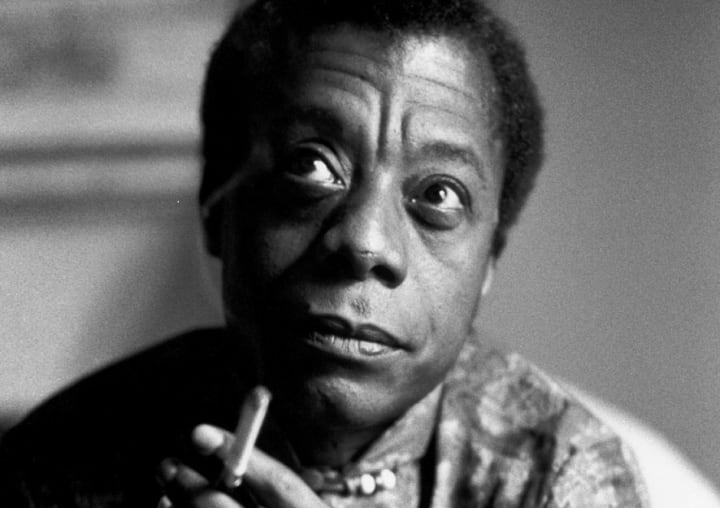
James Baldwin
1561. The Penguin Book of Contemporary Verse*
1562. A Spy in the House of Love by Anais Nin
1563. Marry Me by John Updike
1564. God’s Dice by Martin Amis
1565. Lamb to the Slaughter by Roald Dahl
1566. The Pit and the Pendulum by EA Poe*
1567. The Trial of Oscar Wilde by Richard Ellman*
1568. Sonny’s Blues by James Baldwin*
1569. The Penguin Book of the Sonnet*
1570. Selected Writings of Dr. Johnson
1571-1580

Honore de Balzac
1571. Ten Italian Folktales by Italo Calvino
1572. Childhood by Anthony Burgess
1573. Little Me by Katharine Hepburn
1574. Summer by Albert Camus
1575. The Atheist’s Mass by Honore de Balzac
1576. The Gentle Spirit by Fyodor Dostoevsky
1577. Reflections on the Fall of Rome by Edward Gibbon
1578. The Penguin Book of Irish Verse*
1579. Hegemony or Survival by Noam Chomsky*
I have read a lot of Chomsky in my time, and his far-left views and language analysis never fail to fascinate me. But, the one thing that always catches me by surprise is the fact that he makes easy work of psychological analysis concerning language. Unlike David Crystal, who will talk for the world if you let him (not that it’s bad; I love reading Crystal’s works), Chomsky makes straight to the point analyses, taking you through, but never side-tracking. I feel like Chomsky is one of the easier to read and so, I've recommend you my first Chomsky book here.
1580. The Accidental by Ali Smith
1581-1590

George Eliot
1581. Coningsby by Benjamin Disraeli
1582. Felix Holt by George Eliot
1583. Selected Prose of John Milton
1584. English Mystery Plays
1585. Scenes of a Clerical Life by George Eliot
1586. Three Restoration Comedies
1587. The Man Who Was Thursday by GK Chesterton
1588. My Childhood by Maxim Gorky
1589. Sybil by Benjamin Disraeli
1590. Florence Nightingale by Lytton Strachey
About the Creator
Annie Kapur
I am:
🙋🏽♀️ Annie
📚 Avid Reader
📝 Reviewer and Commentator
🎓 Post-Grad Millennial (M.A)
***
I have:
📖 300K+ reads on Vocal
🫶🏼 Love for reading & research
🦋/X @AnnieWithBooks
***
🏡 UK
Keep reading
More stories from Annie Kapur and writers in Geeks and other communities.
30 Books to Read Before You Die (Pt. 52)
Oh my, we’ve really come a long way haven’t we? Last time, we talked about what we think the Great American Novel is and why America has such a hard time deciding its representative text. Today, we’re going to look at something slightly different but along the same path. Last week, I told you that the novel England considers the “representative” text in most cases is Middlemarch. To some extent, I agree with this—but I want to show you some other novels that could also represent England in a good and overall, very meaningful light.
By Annie Kapur7 years ago in Geeks


Comments
There are no comments for this story
Be the first to respond and start the conversation.