
The Silent Warriors:
A Journey Through Time on the Olympic Rings

In the hushed silence of an Olympic arena, two rings dangle from the ceiling, swaying gently as they await the next athlete to test their mettle. The still rings, as they are aptly named, are deceptively simple in appearance—just two wooden or plastic circles suspended by straps. Yet, for nearly a century, they have been the stage for some of the most breathtaking displays of human strength, precision, and courage. They are the proving ground for those who dare to defy gravity and push the limits of the human body, an arena where history is written with every grip, swing, and hold.
The journey of the rings began in 1924, in the City of Lights, Paris. The Olympics were witnessing a new era, and among the myriad events, the still rings made their debut. It was a time when gymnastics was still in its infancy, and the routines were simple, composed mostly of swinging elements. Yet, even in these early days, the rings captivated audiences with the sheer display of athleticism and control. The athletes swung with grace, their movements fluid and unbroken, a dance between man and gravity. But the true revolution was yet to come, a revolution that would transform the rings into an emblem of unparalleled strength and artistry.
As the decades rolled on, the world of gymnastics evolved, and with it, the difficulty of the routines on the rings. The athletes who took to the stage were no longer content with mere swings; they sought to master the art of stillness, to hold positions that defied the natural inclinations of the human body. The Iron Cross became the symbol of this new era—a position where the gymnast, arms extended straight out to the sides, held their body horizontal. It was a feat that required extraordinary upper body strength and unwavering focus. The Iron Cross was not just a skill; it was a testament to human determination and resilience, a statement of defiance against the limitations of the flesh.
The Iron Cross was soon joined by other iconic elements. The Maltese, a position where the gymnast's body is parallel to the floor with arms extended, emerged as another hallmark of the sport. These static holds were no longer just displays of strength; they were expressions of a deeper struggle, a silent battle fought within the confines of one's own body. The athletes who mastered these moves became legends, their names etched in the annals of Olympic history. They were the silent warriors, battling against the odds, pushing their bodies to the brink, all for the fleeting moment of perfection.
One such warrior was Yukio Endo, a Japanese gymnast who competed in the 1964 Tokyo Olympics. With a calm demeanor and an unyielding spirit, Endo took to the rings with a quiet grace that belied the storm within. As he transitioned into the Iron Cross, the arena fell silent, every eye fixated on the man defying gravity. The strain was visible, the veins in his arms bulging, his muscles quivering under the immense pressure. But Endo held on, his face a mask of serenity. In that moment, he was not just a gymnast; he was a symbol of perseverance, of the human spirit's indomitable will. His performance was a masterpiece, earning him a gold medal and a place in history.
As the years went by, the complexity of the routines continued to grow. The athletes pushed the boundaries of what was possible, incorporating intricate combinations and breathtaking dismounts. The rings became a canvas for the athletes' creativity and innovation. The sport was no longer just about physical prowess; it was about artistry, about telling a story through movement. Every routine was a narrative, a journey of struggle and triumph, of pushing past the pain and fear to find a moment of transcendence.
The journey of the rings reached new heights with the advent of athletes like Yuri Chechi, the "Lord of the Rings." Chechi's mastery of the apparatus was unparalleled, his routines a blend of elegance and power. At the 1996 Atlanta Olympics, he performed a routine that left the audience in awe. Every move was precise, every hold executed with unwavering control. When he transitioned into the Maltese, it was as if time stood still. The audience held their breath, watching as Chechi defied the laws of physics. His dismount was flawless, a perfect landing that brought the crowd to its feet. Chechi had not just performed; he had created a moment of pure, unadulterated beauty, a moment that would be remembered for generations.
The rings, over time, have become a symbol of the Olympic spirit. They are a reminder of the countless hours of training, the sacrifices made, and the unwavering dedication required to reach the pinnacle of the sport. The athletes who compete on the rings are not just gymnasts; they are artists, warriors, and dreamers. They chase perfection, knowing full well the cost, yet they persevere, driven by a passion that burns brighter than any fear.
In recent years, the sport has continued to evolve, with athletes pushing the boundaries even further. The routines have become more complex, the difficulty of the elements reaching new heights. Yet, despite the changes, the essence of the rings remains the same. It is a test of strength, a measure of one's willpower, and a showcase of the beauty that lies in the struggle. The rings are a testament to the resilience of the human spirit, a celebration of what it means to be truly alive.
As the world watches these athletes perform, they see more than just physical feats; they see the embodiment of hope, courage, and the unyielding pursuit of excellence. The rings, with their simple design, hold within them the dreams of every gymnast who has ever taken to the stage. They are a symbol of the heights we can reach when we dare to dream, when we refuse to give up, and when we believe in the power of the human spirit.
In the end, the story of the rings is not just a story of gymnastics; it is a story of humanity. It is a story of the triumph of the human spirit, of the power of dreams, and of the unbreakable will to achieve the impossible. It is a story that continues to inspire, to move, and to remind us of the beauty that lies in the pursuit of greatness. As the athletes continue to soar, to defy gravity, and to create moments of pure magic, the rings will always be there, silent witnesses to the incredible journey of the human spirit.
About the Creator
Keep reading
More stories from Aminu Muhammad and writers in Gamers and other communities.
The Glory and Heartache of the FIFA World Cup
The FIFA World Cup stands as the zenith of football, an extraordinary celebration that transcends sport to become a symbol of hope, passion, and unity. Since its inception in 1930, this quadrennial tournament has been a stage where dreams are realized, heroes are born, and nations unite in pursuit of glory. It is a journey marked by moments of breathtaking beauty, profound heartache, and an unyielding spirit that echoes through generations.
By Aminu Muhammad2 years ago in Gamers
From the Dugout to the Deal Table: Applying Baseball and Football Tactics to Smarter Lending
In professional sports, winning is rarely accidental. Baseball managers and football coaches rely on preparation, analytics, timing, and disciplined execution to outmaneuver opponents. Every decision—whether it’s calling a curveball on a full count or going for it on fourth down—reflects calculated strategy rather than impulse.
By James Cretella6 days ago in Gamers
No Man’s Sky Will Take You to a Universe You Can Explore Forever
Few games capture the sense of wonder and scale like No Man’s Sky. Developed and published by Hello Games, the title continues to redefine what open-world exploration means on Xbox. With constant updates and expansions, No Man’s Sky offers a universe that is as vast as it is unpredictable, inviting players to explore, survive, and create without limits.
By Lukáš Hrdličkaabout 2 hours ago in Gamers
A Historic Declaration
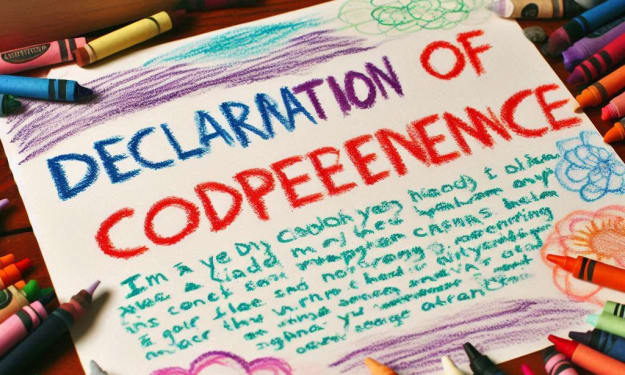
We the People of the Husbands of the United States of America, in Order to form a more perfect Union, and I mean you...with me...establish Justice, insure domestic Tranquility, provide for the common defence, promote the general Welfare, and secure the Blessings of Liberty to ourselves, after Puberty, do ordain and establish this Declaration of Co-Dependence.
By Gerard DiLeo5 days ago in Humans


Comments
There are no comments for this story
Be the first to respond and start the conversation.