
THE POLITICAL AND SOCIAL CLIMATE AROUND THE 1936 BERLIN OLYMPICS
The Rise of Nazi Propaganda and the Global Spotlight on Racial Ideology and Political Tensions.

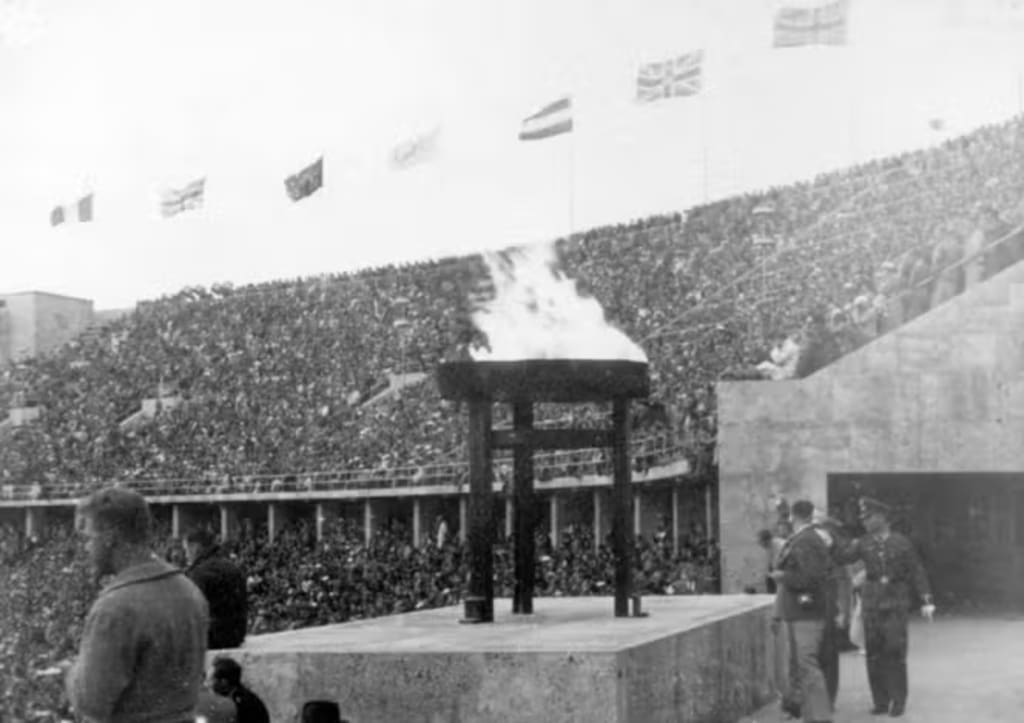
The 1936 Berlin Olympics, officially known as the XI Olympiad, were held in Nazi Germany, under the rule of Adolf Hitler and the Nazi regime. These games were deeply intertwined with the political and social climate of the time, serving as a platform for Nazi propaganda, and representing a critical moment in the lead-up to World War II. The political and social environment surrounding the event reveals much about the manipulation of sports for ideological purposes and the broader global tensions of the era.
(I)Nazi Germany and Propaganda
By 1936, Adolf Hitler had been in power for three years, having become Chancellor of Germany in 1933. His regime was marked by authoritarian control, militarization, and aggressive nationalism. Hitler and the Nazi Party sought to use the 1936 Olympics as a tool to project an image of a strong, unified, and racially superior Germany to the world.
The Nazi ideology emphasized Aryan supremacy, with Hitler’s belief that the German people were part of a "master race" that should dominate the world. As a result, the Olympics were seen as an opportunity to showcase the athletic prowess of the Aryan race and further promote the Nazi racial agenda. The regime also wanted to demonstrate that Germany was a peaceful and welcoming nation, in stark contrast to the growing militarism and anti-Semitism that were defining its policies at home.
To achieve this, the Nazis meticulously staged the Games, designing the Olympic Stadium and surrounding areas to fit their propaganda narrative. The event was carefully choreographed to demonstrate the unity and strength of the Nazi state, with elements such as the iconic torch relay, which symbolized the connection between ancient Greece and Nazi Germany, and the grandiose opening ceremony filled with Nazi symbolism. Hitler’s image was everywhere, but the Games also sought to hide or downplay the country’s rising tensions with other nations.
(II)The Social and Political Context in Germany
Internally, Nazi Germany was undergoing a significant transformation under Hitler’s leadership. The regime implemented sweeping policies to enforce racial purity, including the persecution of Jews, Romani people, and other minorities. The Nuremberg Laws, passed in 1935, formalized the discrimination and disenfranchisement of Jews, stripping them of their civil rights. Many Jewish athletes were excluded from participation in the Olympics, and some were forced into exile.
The Olympics provided a critical opportunity for the Nazis to present a facade of inclusiveness and unity. To avoid international criticism, Hitler allowed non-Aryan athletes to compete, but the Games were still structured to highlight Aryan superiority. Notably, African-American athletes, particularly Jesse Owens, a track and field star from the United States, would later challenge this narrative in a dramatic way.
At the same time, the Nazis had begun to militarize the German youth through organizations like the Hitler Youth, and the 1936 Olympics were used as a showcase for this militarization. Many of the athletes were also expected to embody the physical ideal of the Nazi "warrior"—strong, disciplined, and obedient to the state.
(III)International Reactions and Boycotts
As the Olympics approached, the international community was divided over how to respond to the Nazi regime. Many countries were critical of Nazi policies, especially their anti-Semitism and aggressive nationalism. Calls for a boycott of the Games grew louder, particularly in countries with significant Jewish populations, such as the United States, the United Kingdom, and France. However, the boycott efforts were not widely successful. Some countries, such as the United States, debated whether to participate, but ultimately, the pressure of international competition and prestige led most to attend.
The United States was particularly divided on the issue. While some American athletes, including prominent figures such as Jesse Owens, were vocal about the injustices of the Nazi regime, the U.S. government decided not to pull out of the Games. American sports officials were concerned about the loss of opportunities for their athletes, and there was also a reluctance to make a political stand against Nazi Germany at a time when the Great Depression was still affecting many countries.
(IV)Jesse Owens and the Challenge to Nazi Ideology
One of the most significant and dramatic aspects of the 1936 Berlin Olympics was the performance of Jesse Owens, an African-American track and field athlete. Owens, competing for the United States, won four gold medals in the 100 meters, 200 meters, long jump, and 4x100 meters relay. His success directly challenged Hitler’s racial theories of Aryan supremacy.
Owens’s triumph in front of a hostile crowd, including Hitler, was a public embarrassment to the Nazi regime, which had hoped that the Games would prove the superiority of the Aryan race. Hitler, in fact, famously left the stadium during Owens's victories, although some reports suggest that he later congratulated the American athlete privately. Owens's victories were not only a personal achievement but also a powerful blow to the Nazi racial agenda, highlighting the hypocrisy of the regime’s claims.
(V)The Olympics as a Prelude to Global Conflict
The 1936 Olympics were held during a time of rising tensions in Europe. By the mid-1930s, Hitler had already begun his policy of aggressive expansionism, rearming Germany in violation of the Treaty of Versailles and remilitarizing the Rhineland. The year before the Games, the Nazis had also signed the Anti-Comintern Pact with Japan and Italy, signaling their growing alliance against the Soviet Union and Western democracies. These tensions would soon escalate into the outbreak of World War II in 1939.
The Games, while seen as a symbol of peace and international unity, were an ironic backdrop to the growing political and military tensions in Europe. The Nazi regime used the Olympics to mask the increasing repression at home and its aggressive foreign policies, presenting a sanitized image of Nazi Germany to the world.
End
The 1936 Berlin Olympics were an extraordinary event in both sports and politics. While they were advertised as a symbol of peace and unity, they were, in reality, a calculated effort by the Nazi regime to present itself as a global power, capable of controlling and manipulating the international narrative. The Games exposed the world to the ideological underpinnings of Nazi Germany, including its racial and nationalistic ambitions, and served as a precursor to the global conflict that would soon engulf Europe. For the athletes, particularly Jesse Owens, the Games were a reminder that sport could also serve as a battleground for ideological and racial struggles, with far-reaching consequences both on and off the field.
About the Creator
Badhan Sen
Myself Badhan, I am a professional writer.I like to share some stories with my friends.
Keep reading
More stories from Badhan Sen and writers in Gamers and other communities.
THE ECONOMIC IMPACT OF HOSTING THE WINTER OLYMPICS IN CANADA
Hosting the Winter Olympics is a prestigious honor for any nation, offering an opportunity to showcase its culture, infrastructure, and hospitality to the world. For Canada, the experience of hosting the Winter Olympics, most notably in Vancouver in 2010, provided a significant opportunity for economic growth, global exposure, and long-term investments. However, while hosting the Games presents numerous potential economic benefits, it also comes with challenges. The following explores both the positive and negative economic impacts of hosting the Winter Olympics in Canada.
By Badhan Senabout a year ago in Gamers
Here Again
I know I have been teasing about coming back to content creation and just before, I either get sucked into work or life gets the best of me. 2025 was quite a year and I feel that resonates with everyone. At the begining of the year I got a new vehicle only to lose it about halfway through the year due to an accident. Thankfully no one was injured, and the worst damage done was to my vehicle and my wallet. But I also got a promotion at work, and although it has come with it's challenges I am still powering through it. I also recently lost my mother towards the end of the year and dealt with the emotions that come along with that. So although 2025 was quite rough and I had to really step away and see what was important to me, I believe I have found my way and will be coming back with more content and a new sense of direction. I wanted to create a community where gamers could come together no matter what we played on and honestly there are quite a few ways to complete that goal. I will be streaming four days a week, mostly solo games, and once I complete the story line on Where Winds Meet than that will be the community game as it is not only cross play across systems, but also cross save. I will also introduce PalWorld at some point. For the moment I will be completing out three solo games a week. I will be streaming on Twitch and when able I will upload the video to my Youtube channel. With my schedule, I will only be streaming every other week so as to not burn myself out creativetly. I will also be writing out game reviews as well as game walk throughs on here that will be written through experience of playing. I am also going to use every chance I get to remind people to return to our roots as communities and through these tough times to be a little kinder to one another. I will not entertain or put up with mindless unkindness in my community and those that attempt to do so will not have access to the community that is being built. On that note, I will not turn anyone away that is looking for a helping hand, as I am still growing I am not able to help out financially but I can provide a safe space on Discord and offer a place to play games. I play more than just I will be showcasing on Twitch, and when I am online I am almost always available and up for a game with friends. I have found that since being back in contact with some old friends of mine that I really do wish to come back into the scene and work towards my original goal of working from home. Do not get me wrong, I enjoy what I do for my personal career and I am actually quite fulfilled and rewarded at work. I do see myself being at my "day" job for a good while yet, as soon I wish to start into learning a new field this year. Two of them to be exact, between cyber security and nursing, I wish to further my education so as to further reach my goals. So I appreciate every view, read, comment, and share across my socials. So to wrap things up on this one, every other week I will be streaming on Twitch on Sunday, Monday, Wednesday and Saturday. I look forward to hearing from all of you as well as playing games together!
By Will Besaw5 days ago in Gamers




Comments
There are no comments for this story
Be the first to respond and start the conversation.