
The Legacy of Final Fantasy VII: How a Cyberpunk Fairy Tale Rewrote Gaming History
Why This 1997 Masterpiece Still Dominates the Conversation.


The Immortal Legacy of Final Fantasy VII: How a Pixelated Revolution Became Timeless
The scent of mako reactors still lingers in the collective memory of gamers worldwide. When SquareSoft unleashed Final Fantasy VII upon the PlayStation in 1997, they weren't just releasing another JRPG—they were detonating a cultural bomb whose fallout would permanently alter the gaming landscape. What began as a technical showcase for 3D graphics and CD-ROM storage became something far more profound: the moment video games grew up.
From Chocobos to Cultural Phenomenon
Before Cloud Strife's spiky polygon hair became iconic, Japanese role-playing games existed in a niche realm of turn-based combat and text-heavy storytelling. The sixth installment had already pushed 2D sprites to their absolute limit, but FFVII dared to ask: "What if these characters could breathe?"
The answer came in the form of pre-rendered backgrounds that felt painterly yet alive, cutscenes that rivaled anime films, and a musical score that elevated every emotional beat. Nobuo Uematsu's compositions didn't just accompany the action—they gave Midgar's steel canyons a pulse and the Cosmo Canyon observatory its soul.
Midgar: The Character You Couldn't Play As
No virtual city before or since has carried the oppressive weight of Shinra's metropolis. From the moment the camera pans up from the slums to reveal the plate city looming overhead, FFVII establishes its central dichotomy:
- The "haves" living in arrogant sunlight.
- The "have-nots" choking on their waste.
This wasn't just set dressing—it was worldbuilding as a political statement. The environmental allegory of mako energy exploitation felt radical in an era when most RPGs concerned themselves with generic evil wizards. Avalanche's eco-terrorism missions forced players to grapple with uncomfortable questions:
- When does rebellion become terrorism?
- Can you save the planet without destroying its people?
The Death That Redefined Interactive Storytelling
Aerith Gainsborough's fate remains gaming's most devastating narrative pivot not because of its brutality, but because of its intimacy. Unlike the grandiose sacrifices common in fantasy stories, hers was quiet, sudden, and—crucially—permanent. The genius lay in the gameplay implications:
- All those hours spent leveling her.
- All those materia combinations, rendered meaningless by a single sword stroke.
In that moment, FFVII taught players that no character was safe, that their emotional investments could be weaponized against them. Modern masterpieces like The Last of Us and Red Dead Redemption 2 owe their willingness to traumatize players directly to this watershed sequence.
Sephiroth: The Shadow That Outgrew the Story
What makes gaming's most iconic villain so enduring isn't his silver hair or absurdly long katana—it's the way FFVII withholds him. For the game's first act, Sephiroth exists only in whispers: a photograph here, a bloodstained trail there. By the time Cloud's fractured memories coalesce into the Nibelheim flashback, the player's imagination has already constructed a mythos far more terrifying than any scripted reveal could deliver. His eventual descent into godhood madness works because we've witnessed the human cost of his genesis—the hollowed-out reactors, the ghost towns, the experiments left screaming in tubes.
The Remake's Daring Gambit
When FFVII Remake launched in 2020, it faced an impossible task: how do you recreate a sacred text without desecrating it? The solution was nothing short of genius—by introducing the Whispers as literal manifestations of fan expectation, the game became a meta-commentary on nostalgia itself. That iconic highway escape sequence doesn't just recreate the original's beats; it interrogates our collective memory of them. When Aerith cryptically mentions "boundless terrors" awaiting if fate changes, she's speaking directly to players' fear of losing what made the 1997 version special.
Why the Planet Still Whispers
Nearly three decades later, Final Fantasy VII endures because it represents gaming's first truly multimedia phenomenon. Before The Witcher had Netflix adaptations or Halo had Hollywood blockbusters, this was a story that spilled beyond its medium—into feature films, animated shorts, novels, and a merchandising empire. More importantly, it proved that games could tackle adult themes without sacrificing wonder, that political commentary could coexist with chocobo races.
The remake project's ongoing success—with Rebirth expanding the world beyond Midgar—proves that great storytelling transcends generations. What began as a technical experiment in 1997 has become something far more valuable:
- A testament to gaming's ability to make us care deeply about pixelated people.
- To remember slums we never visited.
To still flinch when we hear a church bell echo across digital ruins.
The Final Fantasy That Never Ended
Other games have better graphics. Others boast more sophisticated combat systems. But none have matched Final Fantasy VII's alchemical fusion of ambition, heart, and sheer audacity. It wasn't just ahead of its time—it created the time we inhabit now, where games are expected to make us feel as much as they make us react. The planet may still be dying in that fictional universe, but its legacy grows stronger with each passing year.
As we await the conclusion of the remake trilogy, one truth becomes self-evident: we're all still chasing that first high, that moment when a game stopped being something we played and became something that played us. The ghosts of Midgar wouldn't have it any other way.

_________________________________________________
Still not over that Aerith scene? Join the club. Subscribe for our upcoming breakdown of Rebirth’s wildest twists. Just don’t blame us when you start hearing the victory fanfare in your dreams.
About the Creator
Geek Peek
Geek Peek is your go-to hub for all things fandom, pop culture, and geek life. From deep dives into beloved universes to hot takes on trending shows, we celebrate the stories that shape our world.
The Family Totem: A Warlock Who is All About Honor Above Glory
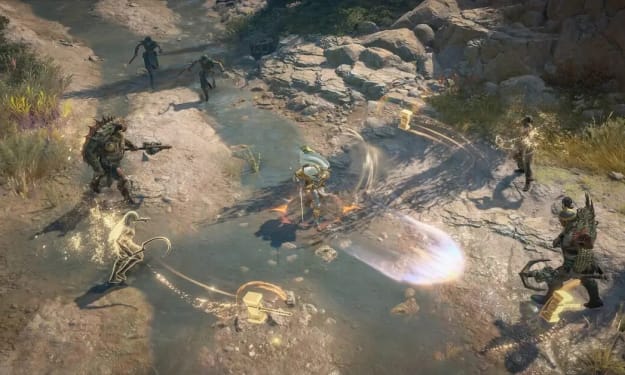
Junpei had told Lord Ona that he would defend the gate, ensuring that no one would enter. Neko lay nearby, purring as usual, but then she woke up, ready for action. He asked the cat to walk over to where the attackers would come through; the cat grudgingly did so. He focused inwardly, becoming inspired and ready for battle. A demon entered the area before the gate; Junpei laughed at the illusion. Three samurai entered the area; he grinned at the challenge. They readied their bows. He had Neko grapple the leg of one of the samurai and concentrated for a moment. The samurai felt the chill of death as his life force ebbed from his chill touch. They charged. He summoned a glowing sword in front of him. The samurai sliced at him. Two of them hit. The glowing sword sliced one down. He himself sliced at another samurai.
By Jamais Jochimabout 16 hours ago in Gamers



Comments (1)
Final Fantasy VII was a game-changer. The 3D graphics and CD-ROM storage were revolutionary at the time. I remember being blown away by the pre-rendered backgrounds and cutscenes. It really made the characters come to life. And the story, with its environmental themes, was deeper than most RPGs. It made me think about the choices we make. What did you think of the game's message?