
So You Want to Play D&D, Part 2
What you should know as a Player going in.


Today on “So You Want to Play D&D” I’m going to talk about being a player. I do have quite a bit of experience playing roleplaying games, and though I spend most of my time behind a screen as a gamemaster, or Dungeon Master (DM) as the game director is known in D&D, I have put quite a few hours into quite a few characters in several different campaigns, from the weekly game I used to play with my coworkers at the games store I worked at, to pick up games at conventions or open play days. So I’m going to lay out for you what I think, as a player and a DM, you should bring to being a player in a D&D game.
Find a Game
Every player is going to need a few things, regardless of the game that you are going to play. The first is a game. Yeah, seems like a no brainer, but it isn’t always easy. Some of us have groups that we have been playing with for years, but even people lucky enough to have a home group might not always play with them. Whether we are separated by distance, or just don’t have the time, occasionally you may need to look outside of your home group for that gaming fix. The good news is that there are options. First, you definitely want to look in your area for an FLGS, or Friendly Local Game Shop, as you’ll see referred to in the community. While they aren’t everywhere (sadly my town doesn’t have one), they are fairly common.
While any games store near you is a great place to potentially find a group, the better ones have in store gaming areas and often host open gaming or demo days which may allow you to jump into a game on the spot. Now sure, this might seem daunting, and I can imagine for most jumping into something like roleplaying with a complete group of strangers can be, well, scary, I can tell you that it is very much worth it. Not only can you get a taste of what it's like, largely for free (I would suggest some basic materials that I’ll get to in a minute), but most DMs who are running games during these events are likely experienced and will be running their game with an educational or tutorial framework. Great place and time to learn how to play, and you might find some new friends and even eventually grow your own home group.
Another place where it is becoming more common to find a game is online. Many people now play D&D remotely, using anything from simple voice and sharing tools like Discord all the way up to fully created and curated virtual table tops (VTTs) like Fantasy Grounds. Finding groups is often done within these programs or social media groups that focus on such programs. A little bit of googling should find the right places to look for a game online in no time.
Make a Player Kit
I’m not going to lie, you can probably show up to most games (at least the first game or a demo game) with nothing, but I wouldn’t recommend it. As a DM I will absolutely give you some note paper, something to write with, a character sheet (if starting fresh) and even some dice. But I can honestly say I don’t want to have to (don’t worry I won’t really judge you if I have to). Look, it’s not school, and roleplaying should definitely be fun, but when I DM I am a lot more happy when people already have the things they will need to play (mainly because I don’t like other people touching my dice, ruining how they roll). Luckily as a player you don’t really need much. I would encourage you to get a pencil (I suggest mechanical) you like, a notebook (any type, any format, I prefer composition/graph), and a set of polyhedral dice, which you can pick up at any games store and even some larger stores like Target or Walmart. For D&D you’ll need a basic set of seven which contains a d4, d6, d8, 2d10, d12, and a d20. For some editions and some other games more than one set might be a good idea, but it isn’t the end of the world if you only have one.
Beyond these, for bonus points I would suggest a character sheet (possibly with an already created character if allowed) and your own copy of the rulebook (or at least the player’s book if it is separate). But if you are just hitting a random game day or demo don’t feel like you have to go this far.
With these tools you should be ready to play. What else could you need?
Time
If you’ve never played D&D before you may not realize what you are about to get into so I feel that I have to tell you, you need time. Most demo games run 2 to 4 hours, and a regular game or one run during an open gaming day might last anywhere from 4 to 8 hours long. Obviously the DM and the players have a say here, and the group should agree when they need to take breaks or when they’ve had enough, but it does take time. I personally have run games for my home group that lasted 10 to 12 hours, but those were rare. So I encourage you to manage expectations here. Don’t plan on getting a game in during your lunch break.
Engagement
Finally, the last thing you really need as a player, and I can’t stress this enough as someone who runs games, is that you need to be engaged. Hopefully this is something you are interested in, otherwise you wouldn’t be looking into it or planning to do it, but it needs to be said. To manage that engagement realize that D&D, and any roleplaying game really, is a form of shared storytelling, so you aren’t going to be talking all the time, and while a good DM works hard to keep everyone and every character involved in the story, there are times when you might be effectively on hold for a moment while another player’s character is in the spotlight. Just realize that going in.
That said, it's very important that you speak up and get involved. If there is something that you want to highlight or something that you want your character to do, make sure to get your DM’s attention. You may still need to wait a moment, but again, this is a shared narrative, so you need to be involved. Roleplaying can be hard, but it is even harder, and you’ll likely feel less satisfied, if you don’t take the initiative.
Part of your engagement should also be a willingness to learn, and to ask questions, particularly if you are playing for the first time, but even long-time gamers should heed this advice as well. No one really expects you to be an expert on the game (and realize the same should hold true for the DM, though they should be more prepared and I’ll talk about that in a later article). But as you play, even when it is not your “turn,” you should be paying attention and trying to understand what is going on. The more you learn, and the more experience you have with the game, the easier it will be. If you have questions don’t be afraid to ask, and you might find that even the DM has to look up a rule or a situation to be sure (though also remember that the DM is running the game, so if they make a call, you should generally accept it).
Bottom Line
So there it is. While there isn’t much to being a player, there are some things you can do to make finding and playing a game of D&D easier, and more fun. So, whatever you find, and however you prepare, just play. Next time I’ll talk about a subject near and dear to my heart, being a Dungeon Master. See you soon.
About the Creator
Keep reading
More stories from Brian Gracey and writers in Gamers and other communities.
So You Want to Play D&D
Dungeons & Dragons. Everyone knows the name, and it’s becoming more popular. Possibly even mainstream. You can even buy one of a few different starter sets at Target. But for some of us, D&D has been a part of our lives for a long time. I personally have been playing some version of D&D, not to mention other tabletop roleplaying games, since the mid 1980’s, and I can say that it has been a trip watching my life long hobby become more and more recognized. So assuming that with my 30ish years of experience I might have some ideas, I thought I’d put this out to help people who might be interested in trying roleplaying out. Today I want to talk about systems (specifically D&D systems).
By Brian Gracey5 years ago in Gamers
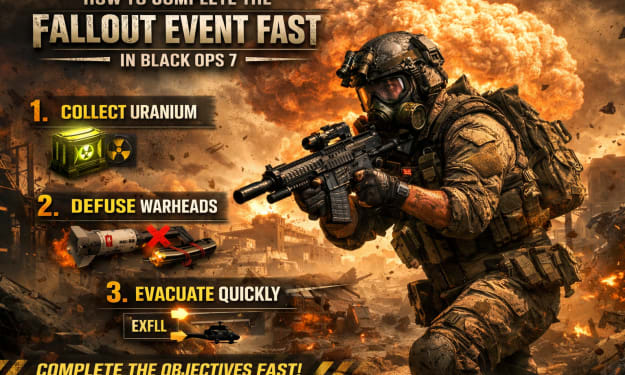
U4gm How to Complete the Fallout Event Fast in Black Ops 7
Call of Duty: Black Ops 7’s latest update has injected the wasteland straight into your favorite shooter. The Fallout crossover event brings themed modes, unique cosmetics, and a fully loaded Event Pass inspired by the iconic post-apocalyptic universe. For players who want to finish the event efficiently, planning your approach is just as important as racking up kills—especially if you’re diving into BO7 Bot Lobbies to accelerate challenges.
By Billo Nali5 days ago in Gamers



Comments
There are no comments for this story
Be the first to respond and start the conversation.