
Playing to Focus: How Video Games Can Sharpen Hands, Steady Minds, and Help Us Handle Chaos
Me, You, and AI Let's Go!


In a world where distractions pile up and pressure builds fast, video games are more than just a way to kill time—they’re becoming tools that help people learn to move with precision and stay centered when everything’s spinning. Recent research has started to show that certain kinds of games can improve hand-eye coordination and even serve as calming anchors when life gets messy. Let’s dig into what science is saying lately—and how to use these findings in real life.

What Recent Studies Say
Serious Games for ADHD: Getting Better at Focus & Movement
A systematic review published in 2025 looked at children with ADHD using “serious games”—games explicitly designed for therapeutic purposes. Out of 35 trials, nearly all (31) showed improvements in attention, impulsivity control, and social skills. What’s interesting is that games involving somatosensory input (games that require physical input, touch, motion) also helped with hand-eye coordination. That means games can do more than just reward you for pressing buttons fast; they can train your body and reflexes. JMIR Games
Mental Health Games for Kids & Teens: Emotional Stability Through Design
A major review by Johns Hopkins (2024) compiled 27 randomized clinical trials involving nearly 3,000 children and adolescents (ages 6-17). These trials tested video games made to help with ADHD, depression, and anxiety. What they found: games designed for ADHD and depression had modest but real benefits—improved ability to sustain attention, reduced sadness. Games meant primarily to treat anxiety showed a weak benefit. Importantly, the ones that worked best were structured (with controlled durations and regular schedules) and had clearly defined therapeutic goals. Hopkins Medicine, ScienceDaily, Mental Health Research

Virtual Reality & Reaction Training: When the Hands and Eyes Sync Up
A recent project (2023) introduced a VR game inspired by the BATAK lightboard (a speed/reaction board) called Virtual Human Benchmark (VHB). It had modes for reacting to lights and repeating visual sequences. Users’ performance in reaction time, speed between targets, and pattern recall improved, showing that immersive, interactive games can train both cognitive and motor abilities. This suggests that when games demand you respond quickly with precision, your hand-eye coordination can sharpen over time. arXiv

Game Addiction vs Game Benefit: Where the Balance Lies
A study from Saudi Arabia (2024) looked at children/adolescents who played video games daily, some for more than 5 hours. It found that high levels of gaming (especially multiplayer) were correlated with higher rates of inattention, anxiety, and depression. While this doesn’t negate the benefits, it shows the importance of moderation: too much unstructured or compulsive play can erode mental health. PubMed

Screen Time, Sleep, and Mental Health: More Than Just Gaming
In 2025, a large U.S. study (over 50,000 kids aged 6-17) found that four or more hours of daily screen time (including video games) was associated with higher risks of anxiety, depression, ADHD symptoms, and behavioral problems. But mediating factors mattered a lot: physical activity, regular sleep schedules, and adequate sleep duration significantly lowered the risk. It’s not that gaming is bad by itself—it’s what else you’re doing (or not doing) that matters. arXiv

How These Findings Apply to You
Putting these studies together reveals some patterns:
Gameplay that challenges perception + movement helps: Game types involving visual tracking, rapid response, or somatosensory feedback (like tapping, motion, or VR input) are especially good for improving hand-eye coordination.
- Designed intent makes a difference: The games made for therapeutic purposes show clearer benefits than casual or purely entertainment-focused ones—especially for ADHD and depression.
- Moderation and structure are key: Limited, regular sessions beat binge gaming. Balanced life habits (sleep, exercise, stress management) amplify the positives.
- Be mindful of addictive use: If gaming starts interfering with sleep, relationships, or emotional health, it may be doing more harm than good. The risk is not just time spent, but how compulsive it becomes.

Practical Tips: How to Use Games to Improve Coordination & Calm
- Choose games that require quick reactions and visual tracking. Classic examples: rhythm games, fast platformers, VR reaction tasks, puzzle games with moving targets.
- Mix genres: sometimes high adrenaline, other times low stress. Balance action-oriented games with “cozy” or relaxing ones (like Stardew Valley, Animal Crossing, or other gentle simulators).
- Set time limits: 20-45 minute gaming sessions, maybe 3-4 times a week, especially for therapeutic or skill-building games.
- Track your mood: before and after gaming, check in—are you more focused? Less stressed? More anxious? Adjust your game use accordingly.
- Sleep, physical activity, and regular routines → these support the cognitive gains and reduce negative effects.

Caveats & What We Still Don’t Know
- Many studies still have small sample sizes or depend on self-reporting (how people say they felt or performed), which has limitations.
- Effects are often modest—games aren’t magic solutions, but rather potential tools.
- Not all benefits generalize. Getting better at a game doesn’t always mean improved performance in totally different tasks, unless they overlap in skill demands.
- Game addiction/overuse remains a real concern, particularly among younger players or those at risk (e.g., ADHD, emotional struggles).
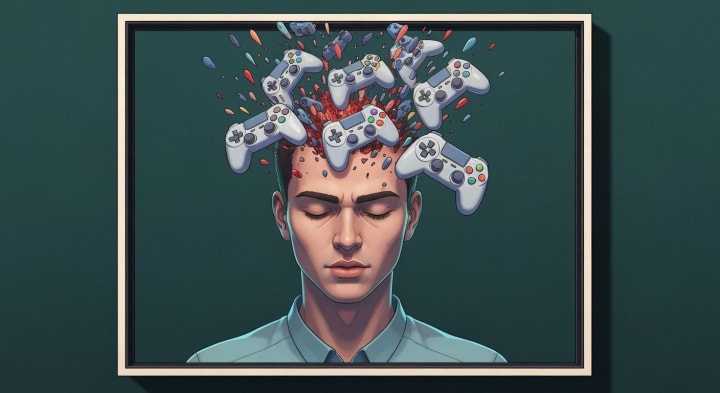
If used thoughtfully, video games can be more than just a distraction. They can train hand-eye coordination, help us stay calm when we need a break from the world, and even support mental health—especially for focus disorders or depression. The recent evidence helps nail down when and how gaming helps: it’s about game type, design intent, and balance in life.
Next time, when the world feels too heavy, or you feel stuck in life, a well-chosen game might offer more than a dopamine hit—it might be practice: training for calm, training for focus, training for precision. And when that training is done well, it shows up outside the virtual universe.
About the Creator
xJRLNx
Im a dude letting out his madness with the help of Ai.
Bruce Lee and The God of War: Kuan Ti
It starts with love.. The Power to the God Of War and Wealth Walk into a Chinese restaurant (even in Oklahoma, USA), a Chinese police station, a kung fu martial arts studio or even a Chinese temple and you often see a red faced warrior holding a heavy quan-do (spear like weapon).
By WILD WAYNE : The Dragon King5 days ago in Chapters



Comments
There are no comments for this story
Be the first to respond and start the conversation.