
Jet Set Radio, a lesson in individualism
Skate, Grind, Jam, and Be The Change!

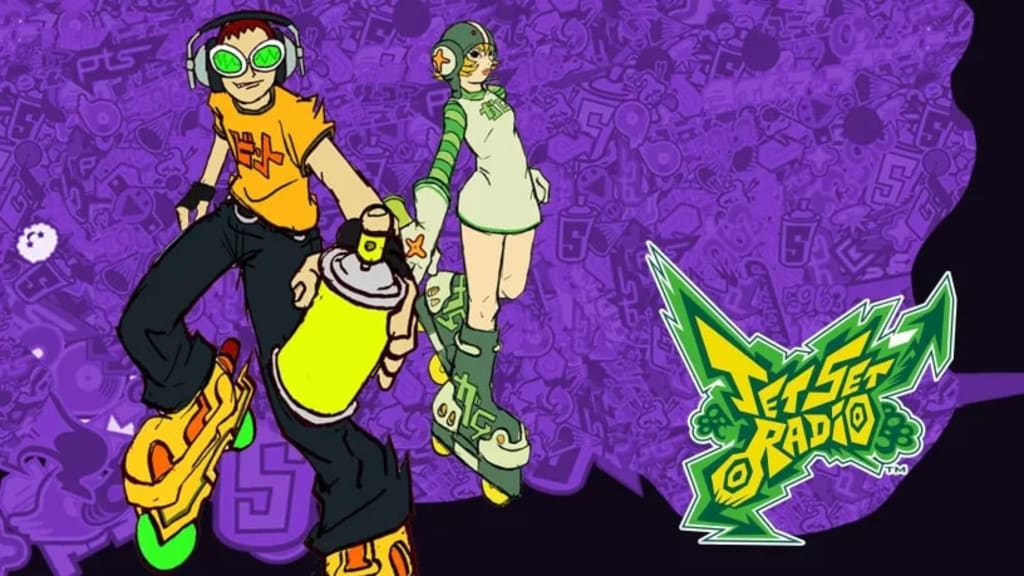
Sega has always been a hero
As could any fan of the very popular blue hedgehog, I could go on and on about why and how Sega revolutionized the landscape of gaming, as well as served as Nintendo’s rival for many years after the video game crash of 1983. Sega has done so much more for gamers across the world than we often give them credit for, far beyond the realms of Sonic the Hedgehog. Having produced many consoles in their career timeline, two distinctly return into the argument of best consoles of all time. Firstly, the Sega Genesis for all of its 16-bit “blast processing” power, as well as its long and varied library of games that include both exclusives and games shared among other consoles. Along with that, it carried two very intricate and technologically new and interesting add-ons, the Sega 32x (built to support games with 32-bit levels of technical demand), and the Sega CD (a CD based add on that game way to games that featured Full Motion video as well as higher quality audio that had not yet been seen in home console video games at the time).
However, the underdog console that many gamers across the globe still hold in high regard due to its technological innovation, sense of identity, as well as its library of exclusive and highly entertaining games is none other than the Sega Dreamcast released on September 9, 1999 (In North America).
Dreams Come True
The Dreamcast brought so much joy to so many people for all that it brought. Along with pushing forward with the development of CD technology at this time, it was the first console with a built in modem for internet connectivity without the need for additional add-ons. This was a very big leap forward for gamers to experience! Not only were they able to go beyond the realms of couch co-op across the air waves straight out the box, but they could partake in the new and exciting realm of Downloadable Content (DLC) that would provide more features to games you already had, as long as you had a stable internet connection to download them from Sega’s servers. This could be as simple as holiday based themes and levels being added, getting to listen to exclusive music, earning new cosmetics and features for your in game character, or just getting new, freshly developed levels for the game you already own!
The Dreamcast Controller truly is a work of technical beauty and class. The standard for video games in the late 90’s and early 2000’s had switched entirely to a focus on the third dimension. 3-D games were not only accepted by the general populous of video game consumers, it was fully expected. Developers of games were still finding out ways to make navigating this new plane of gameplay accessible to gamers old and new, making their games control in a way that made sense, but also designing their controllers so that they are as comfortable to hold, as well as economical with button placement and usage. Sega was very aware of these new challenges gamers would be facing — apart from the literal challenges coded into the games themselves — so they made very deliberate decisions with the design of this controller. The joystick was constructed with magnet based technology to avoid wear and tear, which would often cause stick drift — a condition controllers go under after the joy sticks have been worn down so much that they begin to lean in one direction or another, thus detecting unintentional input. The back triggers an analog. ensuring high levels of sensitivity and responsiveness in your gameplay. The wide, ergonomic design of the controller ensured comfort during long gameplay sessions, helping avoid hand cramps during intense, high level displays of gameplay. And ofcourse, how could one miss the middle slot that hosts the uniquely high tech memory card. The Visual Memory Unit (VMU) not only acted as a high tech memory card, but also sported buttons and a D-pad, of its own, allowing you to access all of your save files with ease, and even giving access to fun mini-games you could take on the go!
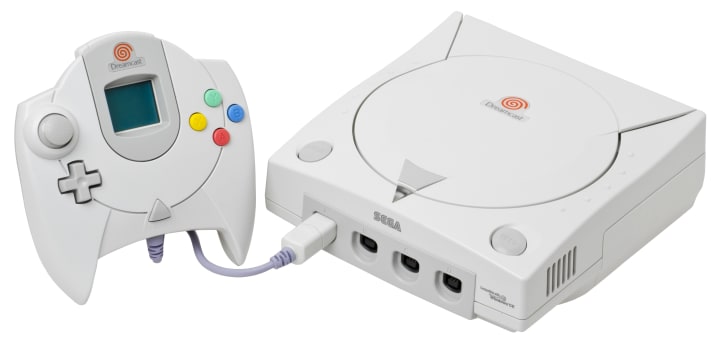
You take one look at this console and you are immediately met with an aesthetic that is both very representative of the era it is from, as well as very bombastic, in your face, and shameless in its authenticity and individuality. And that is not only reflected in the design and marketing, but also in its library of games.
The Pirate Radio Station to Rock Your Soul!
Jet Set Radio was released to North American audiences on June 29, 2000 (later re-released in October of the same year under the name Jet Grind Radio due to trade mark issues revolving around the Jet Set moniker), and it slid onto the scene of extreme sports games in a flashy and fresh new style! At E3 2000, to build hype for the North American release of the game, Sega had planned a reveal trailer performance that displayed the games spectacle, color, funk, and style. Not only by showing tons of in game footage and cinematics, but also with a real life roller skating spectacle featuring extreme sports athletes dressed up as the characters featured in the game! Choreographed to music and flashy visuals to coincide with the overall aesthetic of the game, this opening showcase really set the stage for the new and fresh style this game was going to provide for gamers across the world.
The title of this game actually comes from the in universe radio station that blasts all the funky beats you will be listening to along this extreme and jammin’ adventure. The vibes, the feel, the universe, it is all made abundantly clear within the first seconds of launching into the main game by the host of this titular radio station, DJ Professor K.
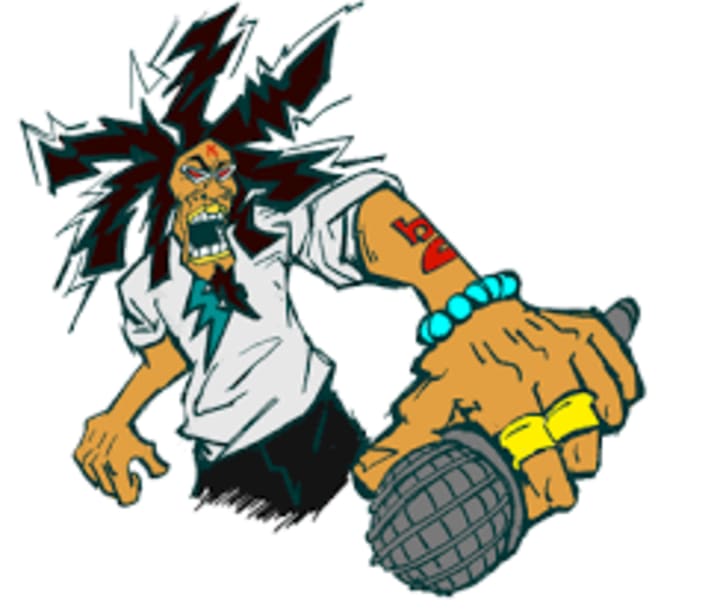
“Hey out there! This is Tokyo’s very own, #1, pirate power station, Jet Set Radio!
Over the hood, through the streets and right into your brain!
We’re transmitting our signal straight to you. Y’all got your antennas on or what!?
Yeah, we’re riding high on a smooth stream of supersonic sounds!
And I’m your captain and DJ, Professor K.
Jet Set Radio!!!”
I highly recommend that, even if you do not end up playing this game, you should absolutely watch a compilation of all the cut scenes featuring Professor K. His unabashed passion for rebellion and shocking and inspiring the masses of youth with his platform. Professor K greets the player after most missions, and for a game with so much defined polish and identity, there was always one detail involving these cut scenes with professor K that had me scratching my head. If you listen carefully, you can hear that his microphone quality is slightly muffled, and is constantly peaking from him yelling at the top of his lungs. Many game reviewers of today would notice this detail and point out something revolving around the limitations of the hardware, as well as the limited budget for the game, and how this is an excusable technical flaw that the game bears.
I however see this as a character fitting every part of his role. A deep and nuanced look into this universe and all of its characters. Professor K is not a subtle person, and probably would spend most of his money on the equipment that would push out all of this music to his listener, his microphone is the least important. As long as they can hear him, he doesn’t need his microphone to be perfect. Power to the people first, and the main crew of the game , the GG’s, personify this mindset for the player to experience.
The World We Skate
The GG’s are a crew of rebellious teens, who have a love for life, a hatred for authoritarian force, and a sick pair of skates. The main trio of think misfit gang features Gum, Tab, and the main mascot of the series, Beat. These three form the crew known as the GG’s and their mission is to skate all around their city of Tokyo-to (as well as the surrounding territories) and tag as much public property as possible with their spray paint art. While at the same time, they have to avoid the police and law enforcement trying to crack down on their operation and force them into societal normativity. It is here where I would like to personally dissuade any readers from partaking in any illegal usage of the graffiti art form, just as Sega does at the beginning of the game with a very informative info graphic stating:
“Graffiti is art. However, graffiti as an act of vandalism is a crime. Every state/province has vandalism laws that apply to graffiti, and local entities such as cities and counties have anti-graffiti ordinances.”
Now, some could look at this disclaimer and look at it as nothing more than a legal liability check to keep Sega’s lawyers in good standing. Others may say it is in complete contradiction with the goal the game seeks to teach — individuality is the key to pure happiness and self expression, no matter what the means. I see this pre-game info graphic as Sega giving a wink of acknowledgement to the rebel in all of us. The teenage anarchist that wants to fight back against oppression and give the big man in charge a slap of reality of what the working class really goes through, while at the same time telling us that there are always more peaceful resolutions to big, complicated problems in our world. Though many may not consider the act of grinding on rails and creating performative spray art as violent protest, we still need to be both artistic, as well as law abiding citizens.
Lets Get Scratchin’ — Individuality is King
The main lesson I learned from my two weeks of getting neck deep into the atmosphere and universe of Jet Set Radio was one of never being afraid to be the real you, especially in a day in age where conformity is seen as a means of necessary survival.
In my younger years, I had grown up as a very big Sonic fan, and every mention of the Sonic games that ruled the mid 2000’s took me to a very warm and tender place. I still think back to the many times after a long day of school, going into my room, laying back, and feeling all of my anxieties and young minded problems fade away as I allowed myself to be a part of the empowering journey Sonic led me through. And when I was playing JSR, my heart and mind were responding in the same way. I felt the goosebumps, the nostalgia, the wave of warm comfort, all for a game I had never played before. This was my first time ever experiencing this world, at the age of 23 during summer vacation between college semesters, and I could put myself back into that 7 year old boy who couldn’t wait to finish all of his school work and get back into beating that hard level when he gets home. I reawakened in me just how important it is to be connected to what truly makes you happy and gives you that feeling of love. Love for who you are and what you like. Your niches and preferences. Your memories that create new ones. It was like wearing rose tinted lenses — not for the past — but for a current day that can bear so much possibility.
The plot of JSR begins as nothing more than a simple turf war between you and other rival gangs, while police intervention tries to stop all parties involved. In this first chapter of the game you really get to be that mischievous revolutionary through the vehicle of art (and sick roller blades). JSR encourages the player to be their own, not just with how they choose to navigate these open levels, but with what exactly they choose to graffiti on these walls.
Before hopping into a level, you are taken to an interactive menu that features the warehouse garage where you and your growing crew reside. After some scrolling you find yourself in a menu that allows you to choose new options for your graffiti. A growing list of pre-made digital artwork that you can collect in these levels. But additionally, you get to create your own set of murals and art pieces. This game wanted the player to feel like a part of the GG’s, not just the overseeing body of this adventure like many games today. You get to decide exactly what statement the G’s are trying to make with their art, and what their rebellion stands for.
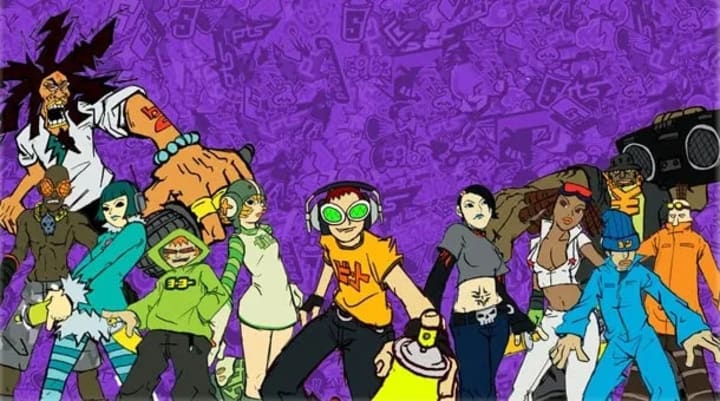
Additionally, JSR sports a wide range of 10 uniquely designed characters, each with their own tricks, dialogue, and play styles. One glance at each of these characters, and you won’t mistake them for another. Every color, every hairstyle, and every piece of clothing chosen represents exactly the type of GG you are playing as. Now two look alike, and you will soon have your favorite style alone. Another touch of individual detail involves how each character expresses themselves both in the character selection screen, as well as their reaction to being picked by the player. There is no simple selection sound, followed by being thrust straight into the level. The character chosen blurts out their own specific catch phrase, and performs a short dance that fits their design and and aesthetic to a tee (not to mention, all while still wearing roller blades)
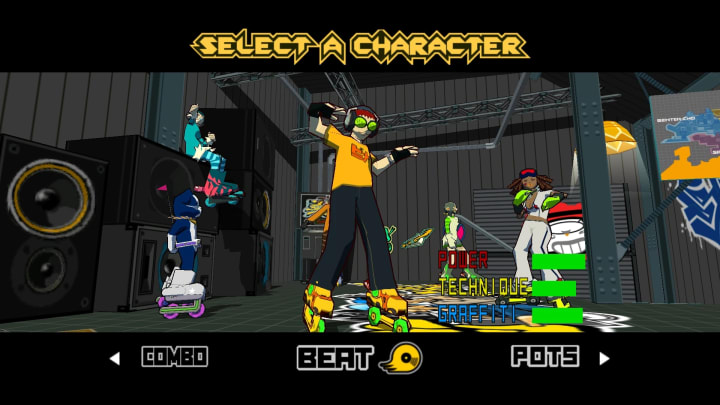
As you progress in the story, the GG’s gain more and more members, eventually going international with the second half of the game featuring characters from American cities banding together with the GG’s to fight an even bigger foe. A large corporation that seeks to eliminate all that the GG’s stand for, take over the airwaves with their own music, cover all of the murals and spray art with propaganda, and rule the planet with a record that will unleash a demon upon humanity.
After about 10 hours of gameplay, as well as beating the final boss, the GG’s save the world from a bleak and meaningless future. One where you can’t be the you that matters.
I know I talk about how the game looks a lot , but I need you to understand just why the look of this game means so much to me, as well as the dedicated following for this game. These young revolutionaries don’t care what is fashionable or what is new and flashy. They don’t need to fit in with the common crowd in the overstuffed and hectic cities they are from. What they need is to fuel their internal flame of courage and artistry, and while in many people that is rooted in something far beyond fashion, when you wear your heart on your sleeve, it’s hard for other people to misunderstand you. The GG’s are very young, all somewhere from their mid teens to their early adult years, and they are actively protesting ideas that, even in the real world, we are often too afraid to really stand up against. We hear all the time how big companies are ruining our world. Today especially, talks about how AI is taking millions of people’s jobs, creating art that is closely indistinguishable from human works, and music that is topping the charts around the world. These robots are always built by man. People who want this to happen. People who can be stopped. And the GG’s see that, and push back against authoritarian bodies, and skate away slick and fast before they can get turned into the same kind of corporate husk.
Technically, this game has problems
Now, it is here where my experience as a Sonic fan would normally prevent me from proving an accurate and authentic critic of this game from a gameplay perspective, but below the surface of a game that expresses all of the fun-loving themes of being true to ones self and facing adversity, lies a game from the early 2000's that took a lot of risks in a new dimension that still had yet to have a standard set in terms of controls and level navigation.
Though I may have been bobbing my head to the sound track and in awe of the art style through my initial play through, I do have to say that, at times, I was as equally frustrated and fed up with the game as I was in love with it. Referring back to the controls, this game managed to really do a lot with a little. There are really only four main actions you can perform in the game:
Joystick: Move around/Perform different graffiti actions
A button : Jump
Left Trigger: Reset Camera
Right Trigger: Boost of Speed/Interacting with graffiti tag spots.
Though that does seem like a quick way to engross a player and get them playing your game quickly, one thing that the developers failed to ease the player into was the overall weight and slide of each character. Remember, you are on high tech skates, which means every level feels like an ice level. You let go of the control stick, and you’ll keep moving for a bit. Additionally, jumping feels much heavier than you would initially expect, making necessary functions of the game such as tight platforming and rail grinding quite the frustrating slog to go through.
Arguably the main function of the game, as well as your main objective in most of the levels in this game — the graffiti — is one of the most unresponsive gameplay mechanics I have even encountered. When you approach an area in the open level that is marked for graffiti, you simply walk up to it and press down on the right trigger. After which, you will be initiated in a “mini game” of sorts where you are locked in place while you must move the joy stick in corresponding directions to emulate spraying paint on the wall/surface you are interacting with. To this day, many fans of the series debate on how exactly one performs these art pieces correctly. Do you do it in one fluid motion? Do you only do the direction that is shown, or do you follow through the rest of the implied direction that is shown (Example: the prompt may ask you to draw a counter-clockwise semi circle, yet some believe that the game is really asking you to make a full counter-clockwise semi circle)? Do you have to wait until the signal arrow fills out with color completely or can you go at your own pace? Playing for myself, I can say that it felt completely random whenever the graffiti mechanic chose to work or not.
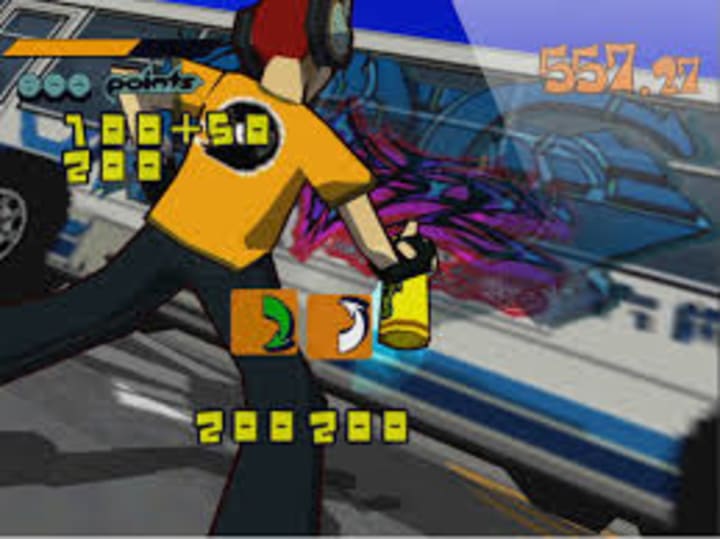
Adding on to that frustration is the enemy placement and interaction. You will encounter many different types of enemies that will try to take you down and prevent you and your crew from spreading paint all throughout the town. Standard policemen armed with rifles, rocket launching helicopters, and even Goliath-like martial artists who will hit you with a swift spinning heel kick. Quite the colorful and creatively designed group of goons. However, interacting with these enemies is nothing short of unfair, bothersome, unsatisfying, and down right frustrating. Remember when I said you are locked in place when you are trying to complete the mandatory graffiti markings? Well the game really does lock you in one spot, unable to avoid oncoming aggro’d enemies, resulting in the unfair taking of damage. There is no set combat system in this game, so your only form of self defense from these enemies is to get very close to them, avoid damage, and use one of your limited spray cans (that can only be regained by finding them around the level and take a fairly long amount of time to re-spawn) to temporarily stun them.
This open world format of gameplay is also fairly dated. You’re not getting the same open world access as the GTA’s and Red Dead Redemption’s out there. Rather, these are smaller chunks of levels that you have previously completed missions in — all fitting within the same aesthetic of the city you are in — connected by transitional tunnels. These transitions feature a very cinematic camera view of your character that, while interesting, serve to discombobulate where you are and how your character controls now relative to their positioning on camera.
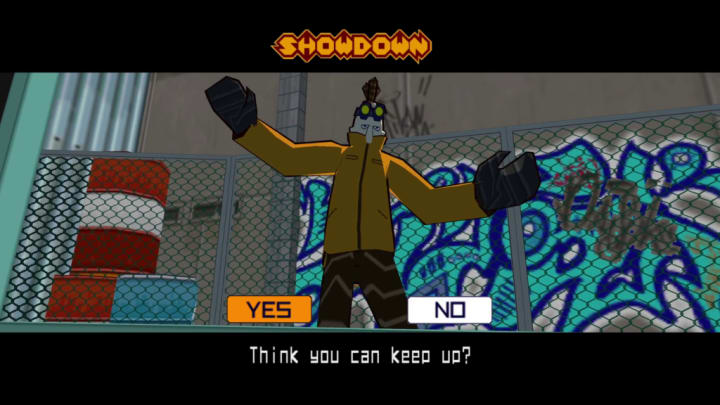
Finally I bring up the character battle races and challenges. Like I said, the GG’s start out as a humble trio, yet quickly evolve into more and more dedicated revolutionaries. The way you earn these new characters is by one of two ways: You compete in a race to the finish across a previously played level (called a “Showdown”), or you play a Simon says adjacent mini game where the new character will perform a chain of tricks and moves that you must repeat back exactly.
These races seem like a fun way to out smart the AI and use your knowledge of the level you’ve already played through to carve your own way to the finish. However, every time I tried this, I would make it to the finish line (Marked by an animated red arrow, by which you would tag the area to show your being there first), and no victory screen would come. I would be unable to tag the ground and be forced to reset the race I had already rightfully done. It was through reading some online forums that I learned I needed to take the same exact path that the AI would take, and over take them at the last minute. Only then would the game count my 1st place as winning.
For these challenges, you really do need to perform the chain of tricks exactly as the AI does. Jump for jump, exact distances, exact speeds, and one deviation from any of this and you are forced to reset.
It is here where I get a bit frustrated with the game itself. JSR has only taught me up until this point that I should be doing my own groovy thing and finding my own path to authenticity and individuality in this big, twisted, and confusing world, yet it constantly want to hold that freedom behind a wall of repetition and precise reenactment of what it deems fair play. But at the end of the day I do have to chalk it up to being a fairly old game on dated hardware that, while game changing, is outdated and discontinued.
But, despite all of these setbacks, I sit here and write all that I have to say. My heart knows that this game has much to teach and much to say. Failure or heavy shortcomings are not representative of an entire ideology or teaching. If online game and software updates and online video game reviews were common place at the time of Jet Set Radio’s release, I am sure that Sega would make sure that these flaws would be ironed out and reinstated in ways that only served to ease the players experience into playing it for the first or hundredth time. And in a strange way, these gameplay oddities and unfair attributes that have made me put the game down a few times and take a break, also serve to add on to this game’s unique sense of charm. Again, it is important to note that as a Sonic fan, I understand how people could play a game as — by modern standards — slippery, anger inducing, unfair, and aggravating as this and still find much enjoyment in revisiting it, and grinning ear to ear skating at high speeds once you have mastered all of its quirky imperfections and dated gameplay ideas.
Music and Storytelling — The Concept of Love
The music in Jet Set Radio is just as iconic and recognizable as all other aspects previously mentioned. It is the glue that ties all of these initially abstract and experimental ideas together. You may be off put by the visuals, the gameplay, and maybe even the console you are playing on, but when you lace up those skates and get grooving along with this funky, urban, electro-fusion sound track, you’ll find yourself being drawn into the city streets of Shabuya-Cho, begging to ride along with the GG’s and crew.
The soundtrack of JSR is composed by video game music legend Hideki Naganuma, who also had worked on the sequel to the game, Jet Set Radio: Future. Along with being a very prevalent and popular musician in Japanese style electronic genres, Hideki was known for have an ingenious ability to utilize samples from other songs (or even just sound bites of other media in general) and find a way to amalgamate that with his own musical ideas into a masterpiece of sonic media that captures lightning in a bottle, transfers to a spray can, and makes his mark on all who are lucky enough to hear it.
Growing up in 80’s Japan, Hideki soaked up all music around him that he could wrap his ears around. Being very attracted to many American funk and rock artists, he found his brand in the unconventionality that was within those genres, as well as relative to how prevalent they were to where he lived and the people who lived around him. Also working at Soul Blue as a teenager — a very high ranking Japanese jazz club — Hideki was bathing in sound and different artists fighting for the limelight since the very beginning of his creative blossoming. As I mentioned, Hideki found his voice in a very peculiar way for his time, and still to this day when people hear exactly how he composes music, it mystifies and enraptures his listeners, showing a level of musical prowess for his craft, as well as a high level of humanitarian sensitivity to those whose struggles are different from his own.
Ironically, that voice was found by using other people’s voices.
Hideki’s inspiration seems to be from any audio he can find, even if it doesn’t originate from a song. It could be a quote from a movie or political speech, it could be a vocal line or rap verse from a different song, or just an open access audio file that can be found online. And while many of these sounds and samples used at first glance may seem completely random and just to happen to fit some kind of general vibe, or maybe even the rhythmic meter of the piece, but after deeper investigation as to how it pertains to the game it is attached to. In the case of the GG’s and the imperialism they face, it is a rallying cry of the will of a people.
Take for example Rock It On, a track that plays during specific missions in the game district of Kogane-cho. Within the first seconds of this track, you hear a female voice crying “viva la revolution!” or Long Live the Revolution, a political slogan often associated with the french revolution. Hideki had sampled this voice line from a sampling CD known as Voice Spectral, where numerous other artists — musicians and not — will take inspiration from in their works. Many other digital musicians have used this sample, however it goes to show how Hideki takes careful consideration as to what gets included in his works and how it weaves with the media it is associated with. The GG’s seek to set the work straight with their graffiti and their antics. Revolution is exactly what they seek to right in the world around them. Political upheaval keeps them down and limits all that surrounds them, so much in fact that the later chapters of the game focus on an even larger corporation on their way to take over the world with a demon-infused vinyl record. Long love this revolution, so that none shall have to suffer under the thumb of a dictatorship that seeks to strip man of all that makes him who he is.
Hideki’s most popular work however was a piece he had composed for Jet Set Radio: Future, and many regard this piece to be something of Hideki’s deepest and most impactful work. The Concept of Love. In this song you hear a very passionate and powerful voice repeat the phrase “understand the concept of love!” The voice you hear is African American revolutionary and civil rights activist Stokely Carmichael, and his anger, passion, and power is fueled by the unjust arrest of one of his brothers in arms, Huey P. Newton. Though, it is important to note that while this speech was fueled by the arrest of Newton, it is also equally a series of rallies to the people, calling out the oppressive forces in the world on the injustice they have committed upon their fellow man. Therefore, not only is it an opportunity to save a brother in arms from a fatal situation, but is an eye opening call to all Americans to reflect upon who and what we are, and what we are going to do to spur change in the world we live in. Notably — where we get this sample from — comes from a portion in the speech where Carmichael comments on how the illegal occupation that Israel is enacting upon the Palestinians is a brutal crime against humanity, and how we must work as a humanitarian unit to fight for the right of a people being beaten and collectively punished.
“We must be clear on whose side we stand, we can be for no one but the Arabs, there can be no doubt in our mind. We can be for no one for the Arabs because Israel belonged to the Arabs in 1970. The British gave it to a group of Zionists who went to Israel, ran the Palestinian Arabs out with terrorists… that country belongs to the Palestinians.
“We do not understand the concept of love. Here are a group of Zionists who come anywhere they want to and organize love and feeling for a place called Israel which was created in 1948, where their youth are willing to go and fight for Israel. Egypt belonged to us 4000 years ago and we sit here supporting the Zionists, we got to be for the Arabs. Period.”
As a Palestinian American artist myself, this truly does bring inspiration to my eye.
In summation of all of these ideas that cultivate change and revolution, it is here where I say, hats off to you Hideki Naganuma. Through the world that you helped create through the beats jam too amidst our rail grinding and spray painting, we may come one day to truly understand each other, and with it, the concept of love.
The Small But Mighty Fan Base
Many fans of the JSR series are sad to see that (at the time of writing this) no new games or attempts to revitalize the franchise have been seen. When I face that reality — with any IP I really like — I also get a bit disappointed. Will this thing I am so deeply interested in ever get a re-release of some kind? Will modern gamers get to experience and fall in love with this game the same way I have? Does the company that created this game even care to see this idea come back, or are they too focused on what will make a profit?
I sit for many hours on long car drives thinking of situations similar to this, where popular ideas that clearly have a strong following are abandoned in place for something else that — may still have its merits — but fails to compare to the original. I think that what makes JSR so special is its dedicated following. There are so many active online spaces talking about this game, and all of them seem to be filled with individuals who fully embody all the lessons this game provided. One of the only things I find myself logging onto Reddit for is the JSR subreddit community postings. Musicians producing and creating their own songs based on the compositions in the game. Artists displaying their sketches, or real life spray paint works based on the art style seen on the virtual streets of Tokyo-to. Cosplayers bringing the characters and roller blade tricks to life on the city streets. It is such a delight to see. We didn’t need this game to be perfect, just as we don’t always need our daily lives to be perfect. What we need is to always be true to who we are. Who we really are.
Sure some may look at what the series has become and call it a failure, but failure hardly ever defines work. The Dreamcast opened up so many doors for the gaming industry, and JSR is still a proud part of Sega’s make up in history — evident that characters and elements from JSR went on to be featured in other Sega titles. The GG’s shredded so we could walk our own path. You’re never too young to stand up for what’s right, and you’re never too old to be in touch with that young soul deep within you. Strap on your skates, blast those funky beats, and hit the streets with your art, whether it comes out of a can or not.
References
The Cure to Nonchalant Energy (Grind fiction). (2025). YouTube. Retrieved October 28, 2025, from https://www.youtube.com/watch?v=yr4KAuqVglI.
The Dreamcast Controller is a Hidden Masterpiece. (2023b). YouTube. Retrieved October 28, 2025, from https://www.youtube.com/watch?v=Udpgko69ND8&t=138s.
JET GRIND (SET) RADIO — E3 2000 STAGE DANCE SHOW [Part 1]. (2012). YouTube. Retrieved October 28, 2025, from https://www.youtube.com/watch?v=4XUL3Mui-gc.
Jetsetpedia. JetSetPedia. (n.d.). https://jetsetradio.fandom.com/wiki/Jet_Set_Radio_Wiki
Kalina. (2012, December 28). How sensitive is tagging on the PC version?. gaming.stackexchange.com. https://gaming.stackexchange.com/questions/97551/how-sensitive-is-tagging-on-the-pc-version
Sega Dreamcast DLC is Awesome! RetroArch & Flycast Setup Guide Tutorial. (2023a). YouTube. Retrieved October 28, 2025, from https://www.youtube.com/watch?v=AoiLr0NRZPg.
SEGA Dreamcast Sonic Adventure 1 & 2 VMU DLC. (2014). YouTube. Retrieved October 28, 2025, from https://www.youtube.com/watch?v=JYLMr8jL-7o&t=287s.
Sega Retro. (n.d.). Sega Dreamcast — Sega Retro. segaretro.org. https://www.segaretro.org/Sega_Dreamcast
About the Creator
Omar Abdallah
Musician and educator with degrees from Montclair State University. Eagle Scout and lifelong learner passionate about writing, reading, and exploring creativity, discipline, and growth.
Keep reading
More stories from writers in Gamers and other communities.
Rsvsr Mega Evolutions Are Coming to Pokémon TCG Pocket – Get Ready!
If you’re a Pokémon fan, chances are you’ve been hooked on Pokémon TCG Pocket, the digital card game that lets you collect, trade, and battle Pokémon right from your phone. Well, there’s exciting news: the game is about to get a major update with Mega Evolution cards! And yes, that means Pokémon like Mega Gyarados, Mega Blaziken, and Mega Altaria are coming to your decks.
By Dangyc Ding3 days ago in Gamers




Comments
There are no comments for this story
Be the first to respond and start the conversation.