
How to Develop a Digital Board Game: Step-by-Step Guide
All the Information You Need to Make Interesting Board Games for the Web and Mobile

Board games have entertained families and friends for centuries by encouraging moments of humor, chance, and strategy. These games primarily rely on human creativity and interaction, and they can range in complexity from Snakes & Ladders to Catan or Chess. However, board games are changing in the current digital-first era, moving beyond the living room table and becoming accessible to millions of players globally through smartphones, tablets, and online platforms.
You're not the only person who has ever pondered how to create a digital board game. A large number of developers, startups, and even enthusiasts are joining this rapidly expanding field. However, creating a successful digital board game requires more than just knowing how to code; it also requires combining technology, creativity, and market knowledge.
In this guide, we'll take you step-by-step through the entire process of turning your board game idea into a profitable digital experience, from inception to launch.
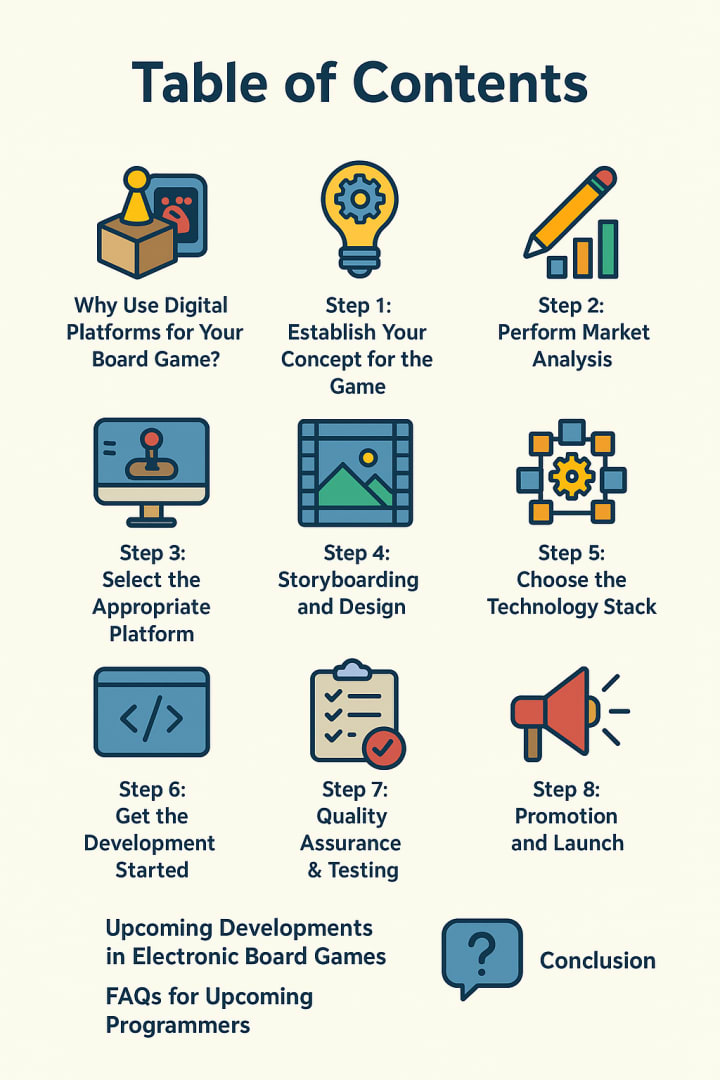
Why Use Digital Platforms for Your Board Game?
Digital gaming is revolutionizing gaming, not just a fad. Conventional board games have drawbacks, including limited customization options, physical availability, and the requirement that players be present in the same location. Digital platforms remove these obstacles.
- Principal advantages of playing board games online:
- Worldwide Access: Play anywhere, with anyone.
- Improved Features: AI opponents, tournaments, and leaderboards.
- Models of Monetization: Ad revenue, premium versions, and in-app purchases.
- Immersive Experiences: Animations, sounds, and 3D environments.
For example, Ludo King (India) began as a straightforward mobile game. By bringing friends and family together online during the pandemic, it received over 600 million downloads..
Step 1: Establish Your Concept for the Game
The first step in making a digital board game is coming up with an idea. Consider this:
- Does your game rely on strategy, luck, or a combination of both?
- Are you making this for families, casual gamers, or competitive gamers?
- What distinguishes your game from those that are currently available on the market?
- Advice: Add something different (special power-ups, new scoring systems, or AI twists) rather than simply copying Monopoly or Chess.
Step 2: Perform Market Analysis
Before writing a single line of code, you must conduct research.
- Examine rivals: Apps such as Tabletopia, Chess.com, and Catan Universe reveal what players like.
- Examine reviews to find out what people are complaining about; these issues could be your opportunities.
- Examine the latest trends in monetization: one-time purchases, freemium, or subscription-based models.
For instance, reviews of chess apps frequently point out issues like slow multiplayer servers. Your game might stand out if it resolves these problems.
Step 3: Select the Appropriate Platform
Where your game should be hosted depends on your target audience:
- IOS/Android mobile: Perfect for casual games like Rummy or Ludo.
- PC/Steam: Excellent for strategy-heavy games, such as board games in the Civilization style.
- Web: Excellent for casual, free-to-play games.
- Cross-Platform: Growing in popularity, this feature enables smooth playback across devices.
Step 4: Storyboarding and Design
Here, concepts turn into detailed plans.
- Make game flow wireframes.
- Make a user interface (UI) that is easy to use.
- Arrange the timers, penalties, scoring, and turn systems.
- Add features like chat platforms, animations, and avatars to encourage interaction.
Case Study: Although Among Us wasn't a board game, its popularity demonstrated how straightforward graphics combined with multiplayer and social interaction can result in a worldwide hit.
Step 5: Choose the Technology Stack
The performance of your game depends on the tools you choose.
- Game engines include Godot (open-source), Unreal Engine (excellent graphics), and Unity (2D/3D games).
- Programming languages: C++, C#, or JavaScript, depending on the engine.
- Backend & Servers: PlayFab, AWS, or Firebase for leaderboards and multiplayer.
- Payment gateways include in-app purchase APIs, Stripe, and Razorpay.
Pro Tip: Before spending a lot of money on extensive development, start small with a lightweight prototype.
Step 6: Get the Development Started
Break development into stages:
- A playable draft version is called a prototype.
- Turns, dice rolls, card draws, and scoring are examples of core mechanics.
- AI & Multiplayer: live matches for groups, bots for solo play.
- UI/UX Polish: Sound effects, animations, and visuals.
For instance, Chess.com started as a straightforward play-versus-computer model. It gradually added lessons, puzzles, and live multiplayer.
Step 7: Quality Assurance & Testing
Your game is made or broken by testing:
- Functional Testing: Verify that the rules function as intended.
- Test for compatibility across a variety of networks and devices.
- Ask actual players for their opinions during beta testing.
- Performance Testing: Verify multiplayer server loads.
Step 8: Promotion and Launch
A well-executed game should have a robust launch.
- Spread the word on YouTube, Instagram, and Twitter.
- Work together with gamers who are streamers or influencers
- Promote ratings and reviews from the start.
- To attract new users, provide free incentives.
Case Study: To increase participation and draw in players from around the world, Catan Universe hosted online tournaments.
Upcoming Developments in Electronic Board Games
Digital board games are developing quickly.
- AI-Powered Opponents that learn from your moves are one of the exciting trends.
- Merging AR and VR to create immersive tabletop experiences.
- Imagine playing Monopoly in a 3D virtual city with Metaverse Gaming.
- Cross-Platform Play allows for seamless connectivity between VR, PC, and mobile players.
FAQs for Upcoming Programmers:
Q1: Does creating a digital board game require coding knowledge?
Not all the time. Beginners can start small with tools like Unity (with plugins) or no-code platforms like GDevelop.
Q2: What is the price of creating one?
While sophisticated multiplayer platforms can cost over $100,000, a basic game may cost $5,000 to $10,000.
Q3: How can my game generate revenue?
Ads, in-app purchases, freemium business models, and premium versions are all common.
Q4: Is it possible for me to digitize an existing board game concept that I own?
Indeed! However, you will require licensing if it is copyrighted (such as Monopoly). These problems are avoided in original games.
Conclusion
Learning to create a digital board game involves more than just knowing how to code; it also involves audience engagement, strategy, and creativity. You can make a game that players adore and share by carefully defining your concept, conducting market research, building with the appropriate tools, and successfully marketing it.
Digital board games are extending the classics into new realms rather than displacing them. With developments like AI, VR, and the metaverse, the possibilities are virtually limitless.. If you've been hoarding a board game concept, this could be the ideal moment to digitize it and release it online.
About the Creator
Camila Torres
I'm Camila Torres digital Marketer at BR Softech, a game development company promoting innovative game & mobile app solutions.
Keep reading
More stories from writers in Gamers and other communities.
Marvel Rivals Patch Notes: Season 6 "Night at the Museum" - Full Breakdown, Deadpool Abilities, and Hero Buffs
The wait is almost over! NetEase Games has finally pulled back the curtain on the next massive update for its hit superhero shooter. If you’ve been searching for the latest Marvel Rivals patch notes, you’re in the right place. Season 6, titled "Night at the Museum," is officially set to launch on January 16, 2026, and it’s bringing the Merc with a Mouth along for the ride.
By Info Post Gate2 days ago in Gamers
Wild Card Weekend Recap: What Happens Now?
I think I figured out why I love Wild Card Weekend so much. It's because it's the first playoff anything of the calendar year. The NFL season starts in the fall, and once upon a time, the champion was crowned either on or slightly before New Year's. The evolution of the NFL schedule has resulted in the playoffs starting just into the New Year, and currently, the final week of the season falls on the first weekend of the New Year, with Wild Card Weekend coming a week after that. So yes, chronologically, the NFL's Wild Card Weekend serves as the first playoff anything of the calendar year.
By Clyde E. Dawkins3 days ago in Unbalanced




Comments
There are no comments for this story
Be the first to respond and start the conversation.