
Women in the Forbidden City
What was life like for a woman?

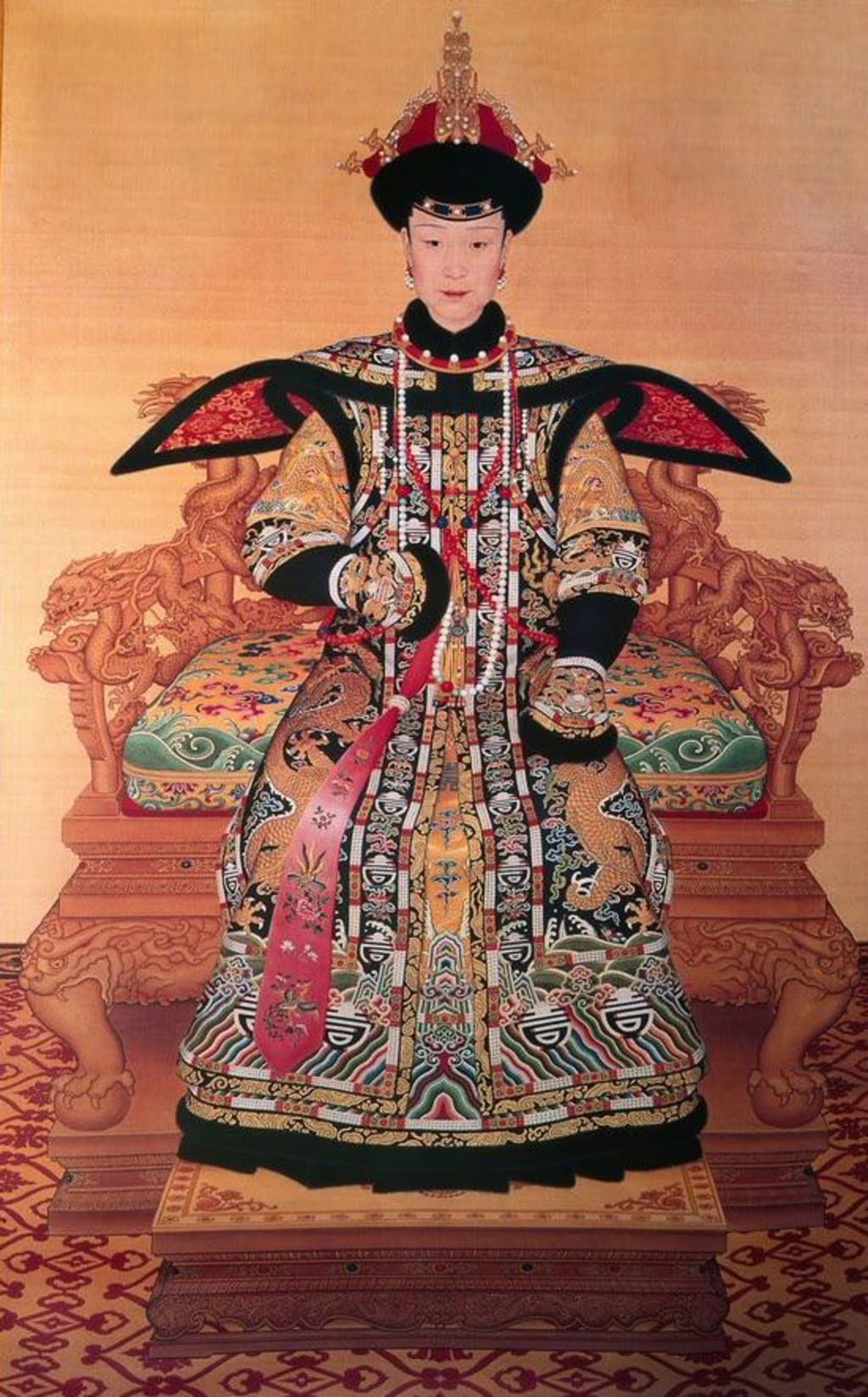
The Forbidden City is one of the most popular tourist attractions we have on earth today. It always fascinates me that at one time in history, this “City” was home to thousands of people. So, what was life like for the “Women” who lived in The forbidden City?
The Empress and Concubines lived in this “City”, along with hundreds of maids who served them. These females were ‘restricted’ to the Inner Court and forbidden from venturing out of the northern section. This Inner Court was composed of 3 major groups of women: 1) the Concubines 2) the Palace servants / maids 3) the Royal Princesses.
“The Empress” was the official spouse of the Emperor and was chosen for political or economical reasons. She was (usually) the daughter of one of the noble and rich ‘clans’ of the Chinese aristocracy, and was chosen from a very young age (some were chosen even before they were born!). At a certain age, the little girl would be moved into The Forbidden City, where she would be raised and ‘educated’ by the Ladies of the Palace, until she was the right age to marry, usually 14 years of age. Once married, the Empress’s main goal or ambition was to provide the Emperor with a male heir. Her son would be called “The Crown Prince” and would be the future Emperor. Being the “Head of the Inner Palace,” the Empress would dictate the rules of life within the Palace and she had a prominent role above the other ‘wives’ who were the “Royal Concubines.” However, the Empress did not have any power where politics was concerned but one or two were ‘crafty’ in trying to control political decisions.
The Empress and Royal Concubines were the only females allowed to wear “Phoenixes.” This symbolic animal was ‘exclusive’ to the Empress and the Royal Concubines and the more “Phoenixes” embroidered on the dress and crown, the higher the rank. This was a way of knowing ‘who was who.’ The Empress herself would wear rich robes and elaborate head-dresses, and also had a “cape covered with 3,500 canary-egg-sized pearls, secured by jade clasps.” Her jewellery was exquisite --- pearl and jade bracelets with jade rings --- with long gold fingernail protectors on the little and ring fingers.
Women were ‘selected’ as “Xiunu” or “Elegant Females” (for the Royal Court) as early as the Jin Dynasty (265-420AD). In the Ming Dynasty, no household was exempt from this selection. Only girls who were married or physically disabled were not selected. The girls would be accompanied by their parents, nearest relatives, clan heads and local officials when they arrived at The Forbidden City ‘on the appointed day.’ Less than a hundred girls would be selected to spend several nights with women who ‘specialized’ in training maids. The selected girls had their bodies inspected for skin infections, body hair, body odour, and so on.
Those who were chosen after this were ‘initiated’ into forms of acceptable behaviour --- how to speak, gesture and even walk --- as well as learning the arts (painting, reading, writing, dancing). The girls who showed the most talent would now spend several days serving the Emperor’s Mother as maids. Even their sleep was inspected, as bad habits like snoring, talking or walking in their sleep, ‘rooted out.’
Only a few who passed this rigorous process would actually be noticed by the Emperor, winning his favour. Most would spend their lives in bitter loneliness.
The Royal Concubines were only allowed to have sex with the Emperor himself. They had to bathe and be examined by a Court doctor before the Emperor visited their bed chamber. It was believed that a woman would conceive during the full moon, when the Yin was strong enough to match the Yan (Yin = female / Jan = male). This would produce children with strong virtue.
The Royal Concubines activities were watched over by the eunuchs, who had great power within the Palace. These women would spend their days applying make-up, sewing, painting and socializing with each other. Some spent their entire lives in the Palace without any contact with the Emperor.
The maids were ranked according to their families’ social position and would be recruited from the Eight Banners families who were mainly Manchurians and Mongolians. They were selected at the young age of 13 and their “role” was to attend to the daily needs of the Empress, Imperial Consorts and Concubines. The highest rank for a maid was the “maid-in-waiting.” These maids were allowed to leave the City at 25 years of age and were (usually) richly rewarded. It was a hard life for these maids though, who were vulnerable and who were often abused. Severe punishment and even execution was ‘usual’ for the most minor of offences.
When a baby was due in the Palace, 40 wet nurses and 80 substitutes were employed. The Imperial Consort or Royal Concubine who was about to give birth didn't want the physical challenges of breastfeeding and it also “marked their rank” to have wet nurses for their babies. The Imperial sons were breastfed by a wet nurse whose own child was a girl, and vice versa for an Imperial daughter. This way (they believed) the Yin and Yan could be matched and the ‘substitution of babies’ could be averted. Only mothers between 14 and 19 years of age were considered and both the husband and wife had to be healthy and normal in appearance. Whilst working within the Palace, the wet nurse received a clothing allowance, rice with about 5 ounces of meat a day, and coal in the cold weather.
With such a good system, life supported itself within The Forbidden City and it is no wonder that this ancient way of life went on for hundreds of years!
As in so many nations of the past, women were inferior to men and no female was allowed to rule in China --- except one, the Empress Wu. She was the only woman in more than 3,000 years of Chinese history to rule in her own right.
Wu Zhao entered the Palace of the Tang Emperor Taizong in 638, at the young age of 14 and was a junior concubine. Taizong died and Wu was said to have now entered into intimate relations with the Emperor Gaozong. She became his favourite concubine. Wu seemed ruthless in clearing her female rivals out of the Palace and eventually became the Empress herself in 655. Wu gave Gaozong four sons and a daughter.
Wu used the authority she had to clear out anyone who opposed the Emperor Gaozong, having them exiled, dismissed or even executed. Now that the Emperor Gaozong was too ill to attend state affairs, the Empress Wu ‘tactfully’ took them until Gaozong relied on her entirely. For the last 23 years of this Emperor’s life, Wu was the real ruler of China.
The Empress seemed to do a good job. She governed with great efficiency and employed men who were clearly loyal to her and who stood by her. The Empress Wu’s great ability as an administrator, her courage and decisive character, won her the “respect” of the Court. She was always ready to ‘use ruthless means against any opponent.’ The years between 655 and 675 saw the Tang Empire conquer Korea under certain military leaders who were picked and promoted by the Empress Wu.
The Emperor Gaozong died in 683, and he was succeeded by his son, the now Emperor Zhongzong. The wife of this new Emperor expected to displace Wu but her husband was weak minded, and within a month, Wu deposed Zhongzong, exiled him, and set up hre second son, the Emperor Ruizong, as the next Emperor. His authority was purely ‘nominal’ as Wu could continue her hold on the Emperor’s chair. A revolt was crushed with the loyal cooperation of the mian armies of the throne, which showed the support the Empress Wu commanded in the public service, and this made her position as Empress unshakable.
In 690, the Empress Wu usurped the throne at 65 years of age and she ruled for 15 years. Wu seemed to have no ambition where her family were concerned but only a determination to keep power for herself. However, from 699 onwards, Wu ‘favoured’ the Zhang brothers who, although artistic, were deprived courtiers. They were skillful in flattering the aged and ill Empress. The Court and senior officials resented these brothers and tried to warn the Empress Wu against their ‘activities.’ Wu did not listen and depended more and more upon the Zhang brothers in her old age and ill health. In 705, the leading ministers and generals seized the Palace, executed the Zhang brothers and compelled the Empress Wu to yield power to the Emperor Zhongzong (who reigned until 710). Wu retired to another Palace where she died in December, 705, aged 81 years old.
Wu is remembered for changing a society dominated by a military and political aristocracy to a society governed by a scholarly bureaucracy. The Empress Wu established a new unified empire and brought about social changes that stabilized a dynasty and ushered in one of the most “fruitful” ages of Chinese civilization.
Life for women with The Forbidden City was, literally, a world away from the life we know today. The highest in rank had privileges beyond compare and, yet, I can’t help thinking that they were like beautiful birds in gilded cages, whose only escape was death itself. Nevertheless, this subject is an endless book of research for me personally --- the dresses, jewellery, food, ‘rules’ and so on --- fascinate me. However, I would still rather live in this Era than in ancient China.
About the Creator
Ruth Elizabeth Stiff
I love all things Earthy and Self-Help
History is one of my favourite subjects and I love to write short fiction
Research is so interesting for me too
Keep reading
More stories from Ruth Elizabeth Stiff and writers in FYI and other communities.
Margaret Beaufort
An unmovable woman, Margaret Beaufort “knew” that she was special from a very young age. Married at 12 years of age to a man 12 years older, Margaret gave birth to her only child at the very young age of 13 --- it is amazing that this little lady survived childbirth! Her only child was the future Henry VII, father to Henry VIII.
By Ruth Elizabeth Stiff5 years ago in FYI
Miss Persephone's Manual to a Seemingly Ordinary Life
Miss Persephone was found at the dining table, her blue eyes swollen, her tears arriving and retreating like the tides of the ocean. Earlier that day, her family had visited her in the retirement home where she had lived for eight years. It was her eightieth birthday.
By Imola Tótha day ago in Fiction


Comments
There are no comments for this story
Be the first to respond and start the conversation.