
Margaret Beaufort
The grandmother of Henry VIII

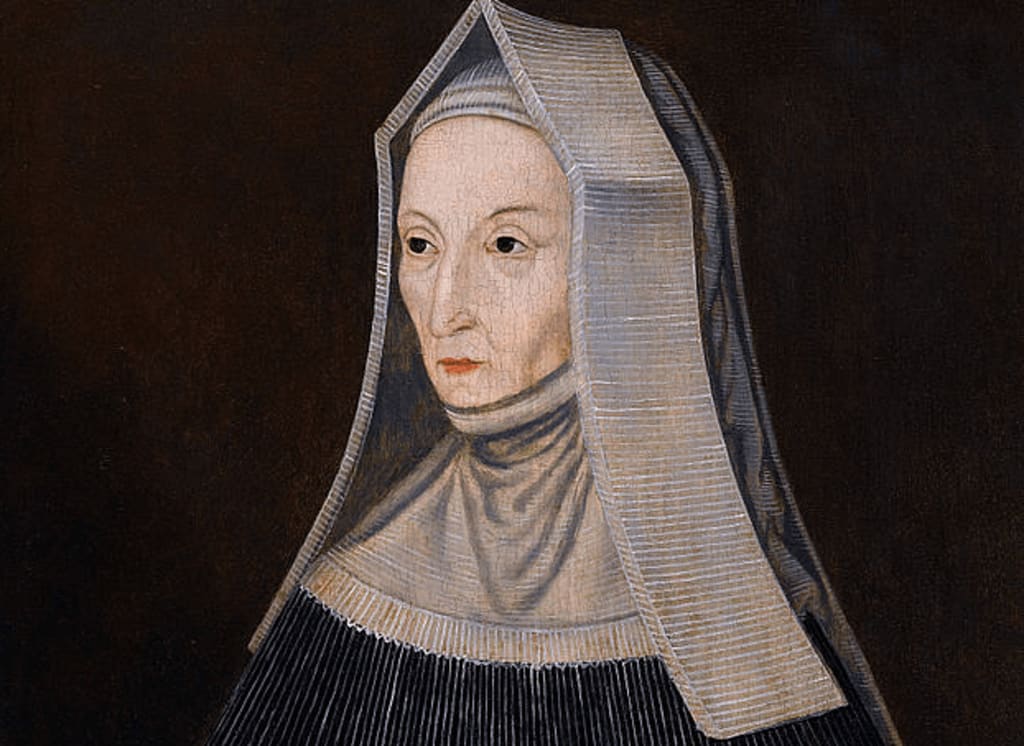
An unmovable woman, Margaret Beaufort “knew” that she was special from a very young age. Married at 12 years of age to a man 12 years older, Margaret gave birth to her only child at the very young age of 13 --- it is amazing that this little lady survived childbirth! Her only child was the future Henry VII, father to Henry VIII.
Born on 31st May, 1443, at Bletsoe Castle, Bedfordshire, Margaret had Royal blood. Her father was John Beaufort, the grandson of John of Gaunt, 1st Duke of Lancaster (who was the 3rd son of King Edward III). From the day she was born, this little Princess was “a pawn in the unstable political atmosphere of the Lancastrian court.” Little is known about Margaret’s education except that she was always in her mother’s ‘care’, her mother was Margaret Beauchamp.
At 9 years of age, Margaret traveled to London and was ‘introduced’ to the Court of Henry VI. Her father had died before Margaret’s 1st birthday and her mother instilled in her a strong sense of personal destiny and family pride. Thus, Margaret became bright and self-assured at such a young age and she was well aware of the possibilities before her. At the Royal Court, Henry VI chose Margaret as a bride for his half-brother, Edmond Tudor, 1st Earl of Richmond. As young as 9, Margaret ‘agreed’ to the marriage, believing that God was guiding her. The couple married on 1st November, 1455, --- Margaret was 12, Edmond was 24!
The “Wars of the Roses” had just started and Edmund (naturally a Lancastrian) was taken prisoner by Yorkist forces less than a year after the wedding. The bridegroom died of plague whilst in captivity in November, 1456. Margaret was 13 years old and 7 months pregnant! It is to her credit that Margaret asked to be buried alongside Edmund (even though she remarried).
Now in the care of Jasper Tudor, her brother-in-law, Margaret gave birth to a son. As she was not yet physically mature,(remember, Margaret was only 13 years of age!) the birth was extremely difficult and the new mother may have been permanently damaged physically as she didn’t have any more children. In fact, Margaret established “a set of proper procedures concerning the delivery of potential heirs” no doubt because of her own dangerous experience in childbirth.
Another marriage was set up to ensure the security of the new-born little Prince, and Margaret married Sir Henry Stafford on 3rd January, 1458. Margaret was 14 years old. The couple were given Woking Palace where Margaret would go to for peace and quiet and she also had a hand in restoring the Palace. The marriage seemed to be a harmonious one and the couple enjoyed a fairly long relationship. Margaret’s new-born son was in the care of Jasper Tudor at Pembroke Castle in Wales. For a while, ‘the Staffords’ were able to visit the baby.
The Yorks and the Lancastrians fought for power for years, the culmination of it being in the Battle of Towton in 1461. The Yorks won and Edward IV became the King of England. Margaret’s son, Henry, was now in the care of Sir William Herbert. Jasper Tudor fled to Scotland to ‘muster support to the Lancastrian cause.’ Margaret was allowed to visit her son. Jasper Tudor now fled to France and took Margaret’s 13 year old son with him (Margaret begged Jasper, hoping her son, Henry, would be safe). It was 14 years before Margaret saw Henry again!
Lord Stafford died of wounds suffered at the Battle of Barnet and Margaret was a widow for the 2nd time at the age of 28. The following year, June 1472, Margaret married Thomas Stanley, who was the Lord High Constable and King of Mann. It is possible that the marriage was ‘a marriage of convenience’, and Margaret was now able to return to the Royal Court of Edward IV and Elizabeth Woodville. She wanted to be in a good position in the Royal Court to help her son, and it seems Margaret’s ambition paid off when she was chosen by the Queen to be godmother to one of the Princesses.
Edward IV died and Richard III seized the throne. Margaret managed to stay at the Royal Court and carried the new Queen’s train at the Coronation. (The new Queen was Anne Neville) Wisely or unwisely, Lady Margaret ‘conspired’ with the last Queen, Elizabeth Woodville, and “began to hope well for her son’s future.” Elizabeth’s two sons had been put into the Tower by Richard III and rumours spread of their murders. The two women conspired to supplant Richard III and replace him with Margaret’s son, Henry Tudor. They sealed this ‘alliance’ by agreeing the betrothal of Henry to Elizabeth of York. “They hoped this proposal would attract both Yorkist and Lancastrian support.”
The question of who murdered the young Princes in the Tower has been an on-going one. Richard III certainly had reason to kill his nephews to keep the throne, but one other person had reason to kill these two young Princes. With the Princes out of the way, Margaret’s son, Henry Tudor, had a good claim to the Throne. Margaret was said to be a “highly able and totally committed representative” for her son’s cause. There is no evidence to support this though.
Richard III found out about these conspiracies and stripped Lady Margaret of her titles and estates. Margaret was imprisoned in her husband’s home but this did not stop her from communicating with her son, who relied heavily on his mother to raise support for him in England.
The Battle of Bosworth Field was in 1485 and Richard III was overthrown. Margaret’s husband placed the Crown on Henry’s head and Margaret’s son was now King Henry VII. Margaret was now styled as Countess of Richmond and Derby and invested as a Lady of the Order of the Garter in 1488. Margaret was referred to as “My Lady the King’s Mother” in the Royal Court, and Henry rewarded his mother for her support by giving his mother back all of her titles and estates. Margaret was now a “feme sole” (a title usually only given to Queens), which gave her considerable legal and social independence from men.
Henry married Elizabeth of York as planned but Margaret is the one who had considerable power at the Royal Court. Henry felt gratitude towards his mother because of all of her support in the past and gave Margaret ‘free reign’ --- it seemed that Henry was “much influenced by his mother.” The Tudor King and his mother were close, Henry VII writing this letter to his mother: “not only in this but in all other things that I may know should be to your honour and pleasure, and will of yourself, I shall be glad to please you as your heart can desire.” What Elizabeth of York, the Queen, felt about her mother-in-law was never committed to paper.
Although Margaret was not the Queen, she became actively involved in the domestic life of the Royal Family. “She created a proper protocol regarding the birth and upbringing of Royal heirs.” Margaret and the Queen worked together in planning the marriages of the Royal children. When the Queen died in 1503, Margaret became the ‘principal female’ at the Royal Court and set out raising her grandson, the future Henry VIII.
When her son, Henry VII, died in 1509, Margaret took charge of his funeral and of her grandson’s Coronation, who was now King Henry VIII.
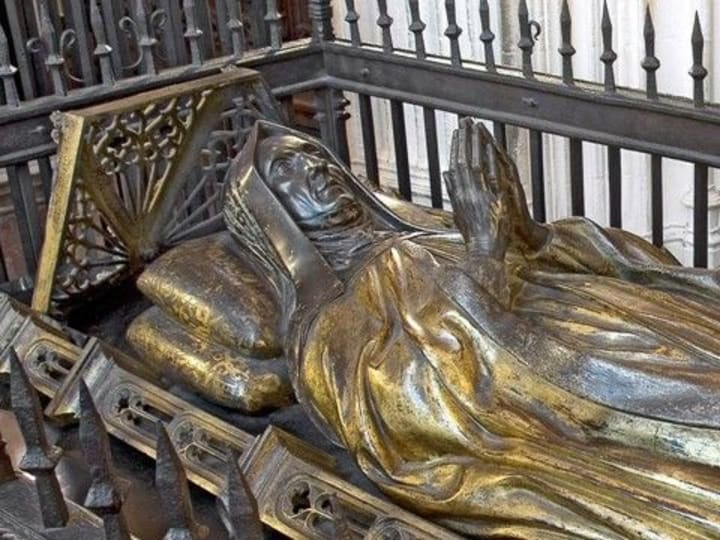
Margaret Beaufort died on 29th June, 1509, one day after Henry VIII’s 18th birthday and 2 months after the death of her own son. She is buried in the Henry VII Chapel of the Abbey. The inscription on Margaret’s tomb days: “Margaret, Countess of Richmond, mother of Henry VII, grandmother of Henry VIII, who donated funds for three monks of this abbey, a grammar school in Wimborne, a preacher in the whole of England, two lecturers in Scripture, one at Oxford, the other at Cambridge, where she also founded two colleges, one dedicated to Christ, and the other to St.John, the Evangelist.”
I personally admire Lady Margaret Beaufort. Getting married and having a child at such a young age could have ‘crippled’ this little lady, but Margaret was full of ambition and wanted only the best for her only son, and she was rewarded by helping to bring up Henry VIII. Her ‘fight’ in life is an inspiration to us all.
(My research comes mainly from Wikipedia)
About the Creator
Ruth Elizabeth Stiff
I love all things Earthy and Self-Help
History is one of my favourite subjects and I love to write short fiction
Research is so interesting for me too
Keep reading
More stories from Ruth Elizabeth Stiff and writers in FYI and other communities.
Prince Albert, Prince Consort
We know Prince Albert as the husband of Queen Victoria and Consort to the Queen. Victoria loved Albert so much that when he died (before his time), she went into full mourning until her own death --- 40 years! So who was this Prince who stole a Queen’s heart?
By Ruth Elizabeth Stiff5 years ago in FYI
A Failed Artist, A Disillusioned Poet, An Underpaid Game Show Host
I took my son and niece to Gori, a small town in Georgia where Joseph Stalin was born. They talked me into visiting the Stalin's Museum, the largest in the post-Soviet space. I had resisted going there because I just can't stand the monster and know enough about him, or so I thought.
By Lana V Lynx7 days ago in FYI
The Pentagon’s Secret Videos: Are UFOs Finally “Official”?
For decades, the idea of Unidentified Flying Objects (UFOs) was relegated to the fringes of late-night talk shows and sci-fi conventions. Believers suspected the military was hiding the truth, while the "powers that be" remained silent.
By Areeba Umaira day ago in FYI




Comments
There are no comments for this story
Be the first to respond and start the conversation.