
Why Apophis Remains A Serious Threat To Our Future
Why do some believe there’s still a chance of Apophis striking Earth in 2029? This overlooked scenario would mean there’s still a chance of an impact.


Is Apophis Still A Danger To Earth?
A potentially hazardous asteroid with some notoriety is again the subject of discussion and debate as scientists consider a new possibility about it and our future. Once believed to hit Earth in 2029, Apophis made big news when scientists announced it would impact on Friday, April 13th, 2029.
What are the odds of such a catastrophic collision? Typically, about one in a billion. But thanks to recent simulations, there’s a possibility that can’t be ruled out for three years.
Apophis (God of Chaos)
Apophis is a space rock measuring approximately 1,100 feet across. This speeding menace is about the size of the Eiffel Tower. It’s not large enough to be classified as a planet killer but could easily wipe out a large city such as New York, Chicago, or Los Angeles. Why Apophis continues to worry the scientific community is easy to understand.
Apophis’s close Earth flyby is going to be one for the books. At 1,100 feet across and traveling thousands of miles per hour, there is only a margin of error of about 18,000 feet. It seems remote, but there are outside influences to consider.
From where Apophis is currently, there exists the possibility that it could be influenced by another smaller object impacting it, such as the effect of the DART mission in 2022. A city destroyer asteroid that’s already going to be dangerously close to Earth could be nudged into a much closer trajectory, possibly as much as nudging it to a direct hit. Apophis could be nudged in a different direction as well, but this overlooked scenario is worth examining.
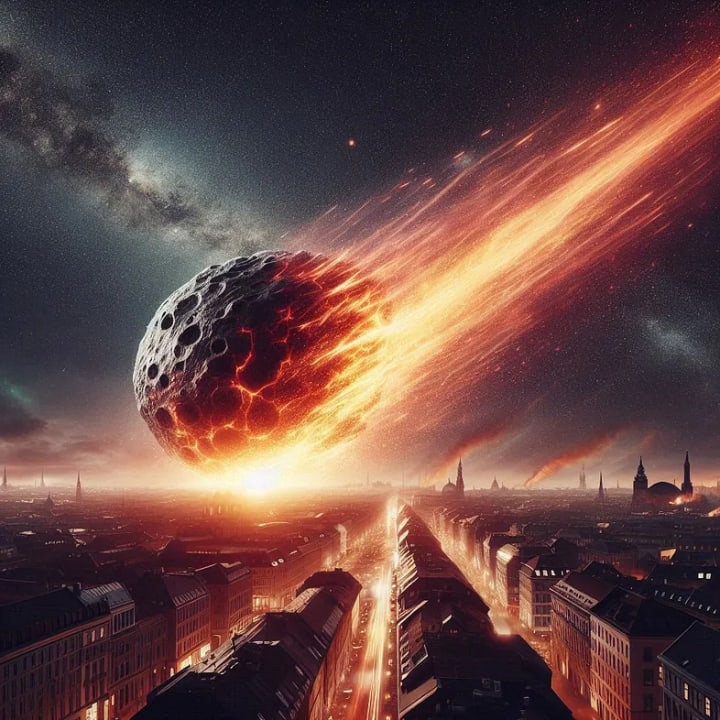
What An Apophis Impact Would Be Like
A bullet traveling a few thousand feet per second can do some damage. Imagine what something 1,100 feet across, traveling 20 to 30 thousand miles per hour, can do. The damage is hitherto undreamt of.
Should an asteroid of Apophis’s size and velocity ever strike Earth, it wouldn’t be the end of the world. It would potentially kill millions of people if it struck a major population center. The damage would be felt for a few hundred miles from ground zero. Then there would be fallout.
The idea of an asteroid of any size striking Earth has been depicted in movies. One thing that the movies got right, other than the timelines of an asteroid and the tech to stop one, is that the damage to our world would be on a biblical scale. Thankfully, Apophis hitting Earth is still the ultimate longshot, as long as nothing interferes with its current trajectory.
What if it does happen?
The reality would be devastating. Simulations have been ongoing for years since it was first believed that Apophis was guaranteed to hit Earth. The simulations are like something from a horror movie.
To put it into context we can all understand, let's look at the energy released if Apophis should hit, and is what scientists believe it is made of.
When the United States bombed Hiroshima during WWII, the bomb released .15 megatons of energy. The devastation was something that could only be dreamed of until that time. An impact by the God of Chaos asteroid would be far more devastating.
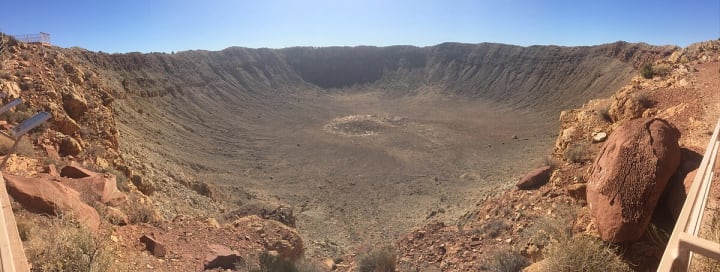
The above image is from the Arizona Meteor Crater. The asteroid that created the massive crater is believed to let out the force of 10 megatons of energy. It was a significantly more destructive force than the nuclear bomb dropped on Hiroshima and Nagasaki.
Apophis, should it strike, could deliver between 800 and 900 megatons of energy. If true, that would be more than 5,000 times as powerful as the bombs in Japan.
Should there be a change that knocks Apophis 18,000 miles off its trajectory and becomes an impact, there is no safe space on Earth. While it's not a planet killer, consider the areas it would possibly hit. Any place in the ocean would create a tsunami like we've never seen. The damages from that alone could bring havoc to coastal regions on multiple continents.
Should the trajectory change and it bear down on a population center like New York, millions of people would be killed. The energy wave would be felt for hundreds of miles in all directions, and there would be the equivalent of nuclear fallout from the dust and debris being launched into the air.
It's simply horrifying stuff to think about, but that's why we should give thanks that there are highly trained minds employed by NASA and the various space agencies, as well as the office of planetary defense, who are doing nothing but looking up and coming up with ways to mitigate the damages our planet faces.
About the Creator
Jason Ray Morton
Writing has become more important as I live with cancer. It's a therapy, it's an escape, and it's a way to do something lasting that hopefully leaves an impression.
Keep reading
More stories from Jason Ray Morton and writers in FYI and other communities.
Wild Card Weekend Recap: What Happens Now?
I think I figured out why I love Wild Card Weekend so much. It's because it's the first playoff anything of the calendar year. The NFL season starts in the fall, and once upon a time, the champion was crowned either on or slightly before New Year's. The evolution of the NFL schedule has resulted in the playoffs starting just into the New Year, and currently, the final week of the season falls on the first weekend of the New Year, with Wild Card Weekend coming a week after that. So yes, chronologically, the NFL's Wild Card Weekend serves as the first playoff anything of the calendar year.
By Clyde E. Dawkins3 days ago in Unbalanced



Comments
There are no comments for this story
Be the first to respond and start the conversation.