
Trapped In Space
The story of Sunita Williams and Butch Wilmore's eight-day mission disaster.

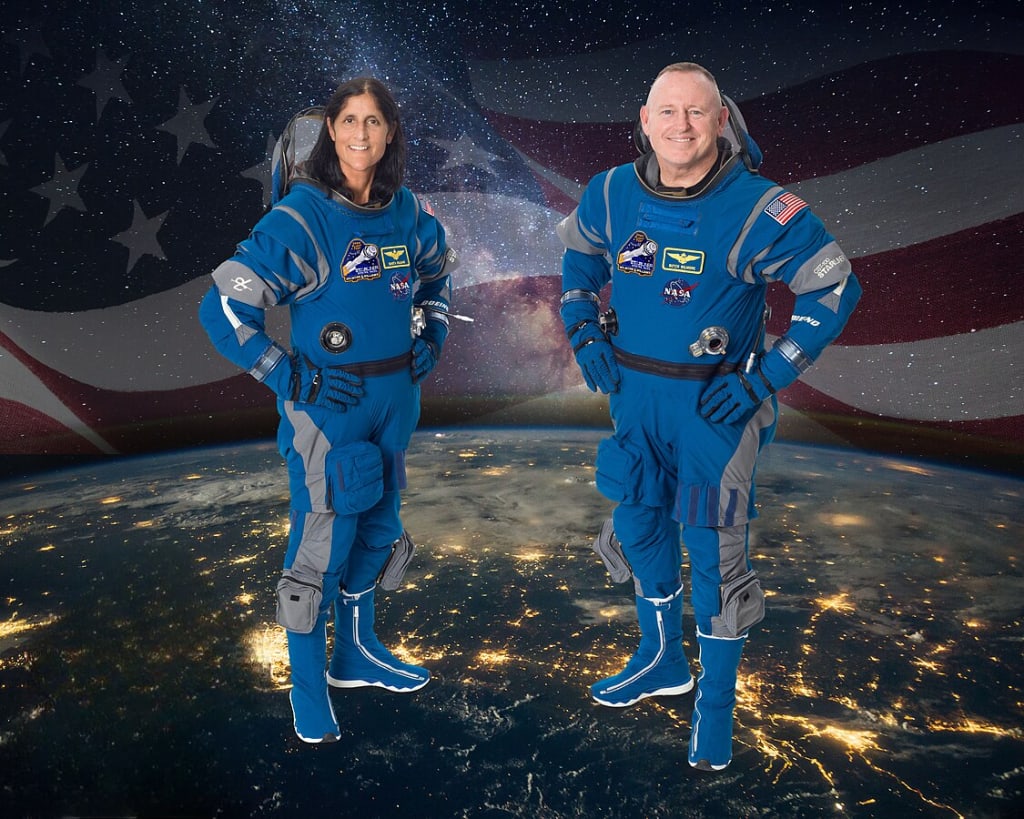
Sunita Williams and Butch Wilmore left on an eight-day excursion to space. That was June 5th. That ill-fated flight trapped them aboard the International Space Station, where they will likely remain until February. What happened?
Boeing’s Starliner Craft
Helium leaks and problems with thrusters forced Boeing and NASA to delay the astronauts’ return to Earth. The Boeing Starliner craft has already returned to Earth. The eight-day mission to the ISS was to last eight days.
There isn’t a rescue mission on the books. What happened comes down to the craft’s ability to carry our people safely back to Earth. The helium leaks reported in the propulsion system created a high-risk situation. While the thrusters might be restorable, leaking helium could have been deadly.
Problems started on day two of the mission when docking was delayed. It took almost an hour before the thruster problem was solved enough to get them safely aboard the ISS. Five of the 28 reaction control system thrusters malfunctioned. In the diagram below, that’s section B.
Thrusters on the service module move the capsule around as it’s in orbit and are crucial to docking and undocking safely with the space station. Four eventually were restored, allowing Williams and Wilmore to dock. NASA still had to investigate why the thrusters shut down.
The answer to why the thrusters shut down is an unproven theory according to Steve Stich, NASA’s Commercial Crew Program Manager. In an August NBC News report, he was quoted as saying that the team “can’t prove with certainty what we’re seeing on orbit is exactly what’s been replicated on the ground.” But it all may come down to a tiny Teflon seal that swells under high temperatures.
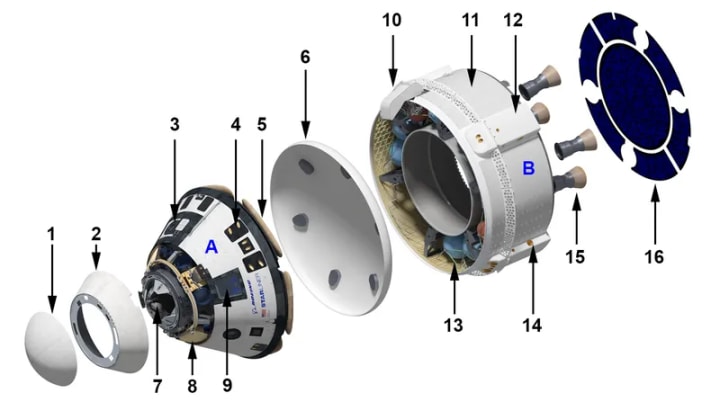
A: Crew capsule (reusable)
1: Nosecone protecting the docking system during launch (expended)
2: Cover for parachute compartment (ejected during landing)
3: Crew access hatch
4: MR-104J RCS (reaction control system) thrusters (x25) reserved for orienting the capsule during atmospheric re-entry
5: Airbags (x6)
6: Heat shield (ejected during landing)
7: NASA Docking System port
8: Parachutes (x3)
9: Window (x3)
B: Service module (expended)
10: Umbilical with cables and pipes connecting the command and service modules
11: Radiators (x4)
12: “Doghouse” (x4) containing the RCS (x7 per doghouse, x28 total) and OMAC (orbital maneuvering and attitude control) thrusters (x5 per doghouse, x20 total)
13: Propellant tanks (monomethylhydrazine and nitrogen tetroxide)
14: Roll control RCS thruster (included in above counts)
15: RS-88 engines for launch escape capability in the event of an abort (x4)
16: Solar panels
Elon Musk and Space X to the Rescue

It’s not a rescue mission. In September, there is an upcoming SpaceX launch. The Crew-9 mission was to take four new crew members to the space station.
Instead of taking four members up, there will be two astronauts aboard Crew-9. Williams and Wilmore will remain aboard the ISS and work with the Crew-9 mission team until its return in February.
While most astronauts wait a lifetime to go to space, Williams and Wilmore lived the dream. Many train for it, but few get to go. Williams and Wilmore are American heroes living in space for most of the year. While it’s unfortunate, it’s also a special treat they won’t likely forget.
Thankfully, thanks to SpaceX and the ingenuity of Elon Musk’s teams of engineers and scientists, the space program has a dependable system to make frequent launches to the space station and into orbit for studying our solar system. Between NASA and SpaceX, the astronauts will make it home. In the meantime, they’ve already received extra supplies.
For most of us, being trapped at work for eight months longer than expected would be a nightmare. Being trapped in space would be even worse. But this is what they do.
We can wonder, what’s their overtime policy?
About the Creator
Jason Ray Morton
Writing has become more important as I live with cancer. It's a therapy, it's an escape, and it's a way to do something lasting that hopefully leaves an impression.
Keep reading
More stories from Jason Ray Morton and writers in FYI and other communities.
More Monoliths: Those Rascally Space Men Are At It Again
Gass Peak, Las Vegas, Nevada Law Enforcement’s recent discovery of a monolith has the world buzzing. This past weekend, authorities discovered one of the oddities shimmering in the hills above the city. A search and rescue team found the structure near Gass Peak within the Nevada Desert National Wildlife Refuge.
By Jason Ray Morton 2 years ago in FYI



Comments (1)
A very interesting story! Astronauts are admirable, it would be quite the job.