
When Vampires Roamed the Earth – aka The Vampire Hysteria
It only took a few rumors for the Age of Enlightenment to show its dark side, as the firm belief of vampires walking amongst us swept through Europe and beyond.

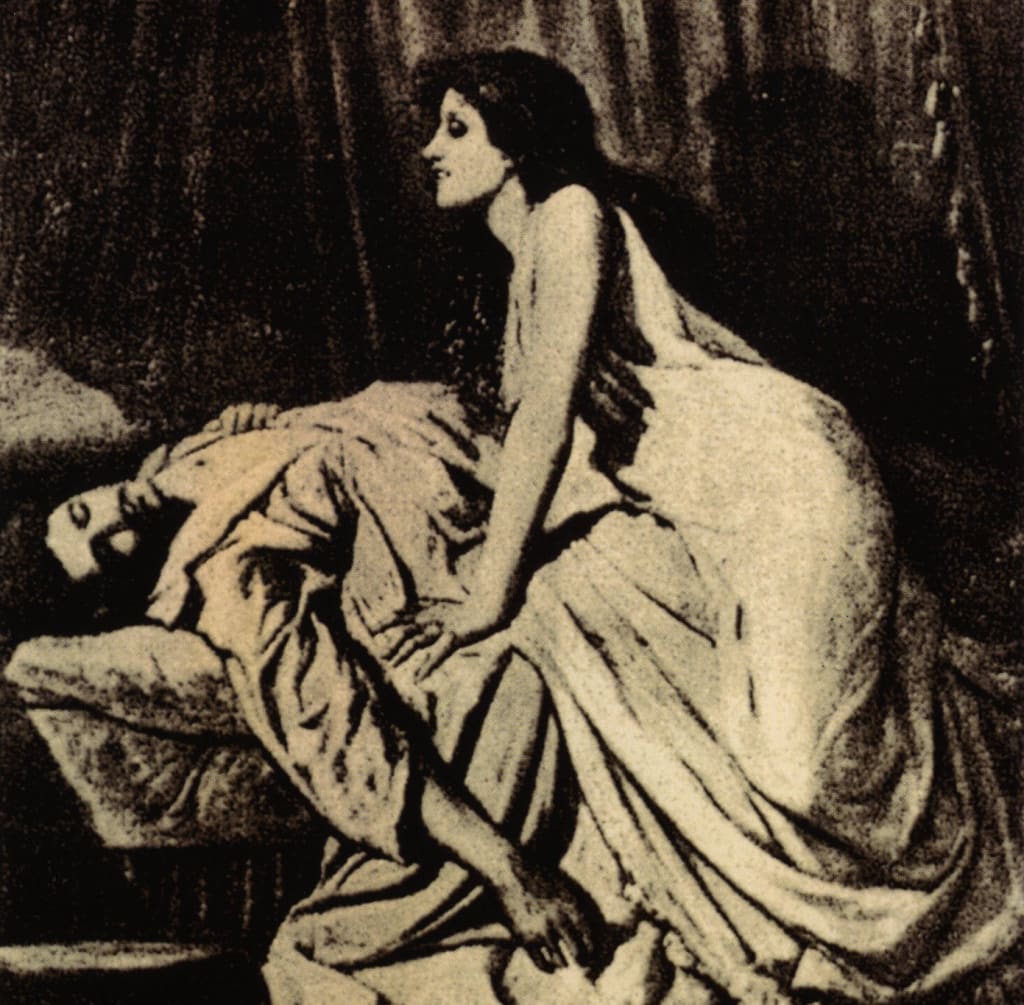
The sharp-toothed and blood-thirsty creatures lived in myths and tales worldwide for centuries. But never has the fear of actually encountering one been more real than in 18th century Europe.
And it all began with one unfortunate Serbian man.
The First Mentioning
To this day, there are different opinions as to where the word “vampire” originated from and what its exact meaning is. However, one thing is certain – it was first recorded in 1725 by an Austrian named Frombald.
He was an Austrian official appointed to oversee the matters of the Austrian Empire in Serbia - the country it was occupying at the time. As the legal representative, Frombald had to authorize and inspect everything, including the exhumation of a certain Petar Blagojevic’s body under suspicions of him being an already dead murderer.
It was in the report that Frombald later wrote that he mentioned the word “vampire”, and it became the first time it was used in official written papers.
What did Petar do? He died…
Or did he?
Apparently, his fellow villagers firmly believed the 62-year-old recently deceased man was indeed a vampire. Why? Well, in a span of eight days after his death, nine other villagers died, and those people swore on their death beds that the late Petar’s ghost had visited them at night.
Even the suspected vampire’s wife allegedly told her husband had shown up at their house and asked for his shoes. She fled the village soon after, most likely more terrified of the angry mob than her undead husband, and for a good reason, indeed.
Within a few days, their son was found brutally murdered in his home, and when the rumors spread that Petar came to the man the previous night asking to be fed, the villagers had their minds made.
They went to Frombald demanding to see Blagojevic’s body to check for the signs of vampirism, and they did not back down until he caved in. Frombald ordered for the coffin to be dug up.
Unsurprisingly to us, but to the shock and pure horror of the 18th-century peasants, they discovered the man’s body to be fairly undecomposed and having “grown” hair and nails after the death.
Convinced their former neighbor was indeed a vampire they pierced his chest with a stake and ultimately burned the corpse.
Maybe this one case would have gone unnoticed, but at the same time, a Serbian soldier (a dead one, of course) was accused of the outbreak of vampirism after sixteen people had died in his native village of Meduegna.
When his body appeared to have similar signs as Petar’s, the soldier’s corpse was dealt with in a similar fashion.
Fear Contagion
Maybe both stories would have remained just a tale in the Balkans, but with Austrian officials and even their physicians present on the spot, the news reached the Empire, as Frombald had to report back to base.
So he did, and somehow the reports ended up being published by an Austrian newspaper too. The interest in vampirism spread through every class of the society, reaching even those, supposed to be skilled at critical thinking not only in Austria but across Europe too.
Even some members of clergy went behind their beliefs of not desecrating a grave, and they helped people dig up cemeteries and stake or behead the suspected vampires.
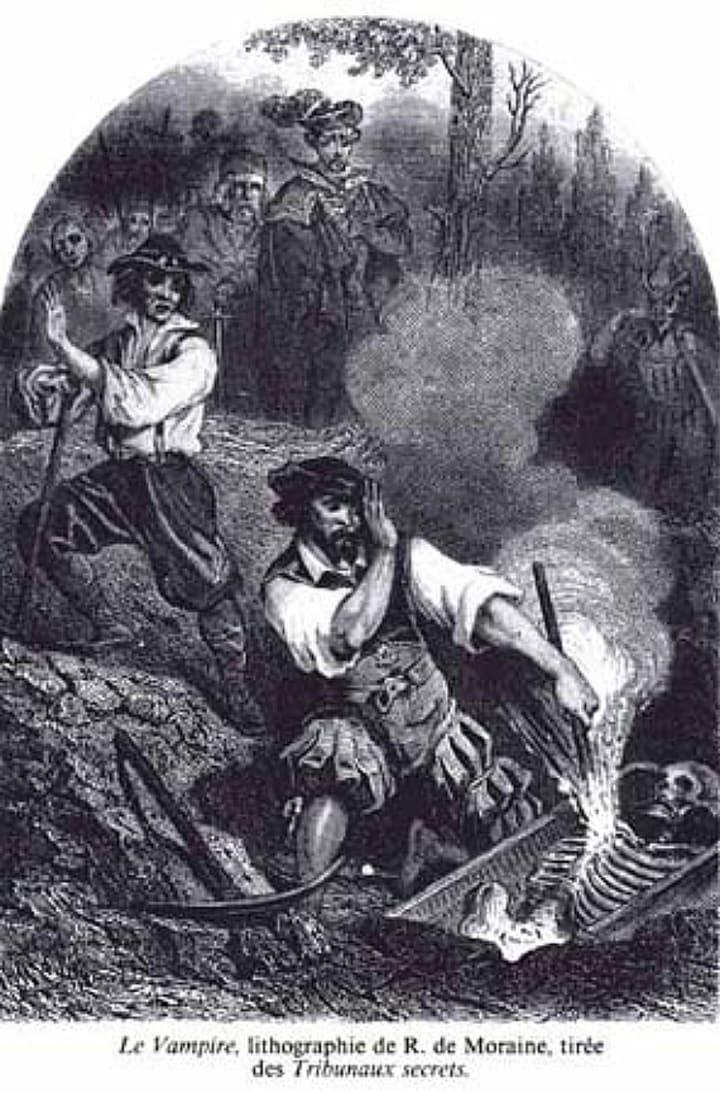
Discussions were heated between the believers and those calling it nonsense. Numerous works were published where scholars tried to reason with their readers, providing different explanations as to what made more sense than vampires being real, but the madness continued.
But when the madness reached the Austrian royal court, the Empress had enough of it.
When Punishment is Scarier than Death
Most likely sick and tired of the mess in her domain, Empress Maria Theresa appointed a court investigator to determine whether any of the rumors carried any weight, or if they were just that – fear-fueled superstitions.
Of course, being an experienced physician, her investigator Gerald Van Swieten quickly concluded that no vampires existed, and all the “demonic signs” were normal stages of a decomposing body.
This was more than enough for the Empress to pass a new law prohibiting any grave or corpse desecration. Seemingly, the fear of jail was bigger than the fear of an immortal creature sucking your blood dry, and the panic eventually seized.
Encouraged by Maria Theresa’s example, other European countries did the same, extinguishing the fire.
But a new spark ignited across the ocean instead.
Sail away, Sail away…
Just when all returned to normal in Europe, vampires apparently reached the shores of the American continent.
Sounds familiar?
Yes, Bram Stoker’s “Dracula” begins just like that – with the count arriving in the States in a ghost ship from Europe. And there is a reason for it. Some sources say that Stoker was aware of the story that unfolded in Rhode Island, and he based one of his characters on the last known victim/vampire.
In 1892, four members of the Brown family contracted consumption (tuberculosis) – a disease that was poorly known at the time. The three of them, all women, died from the devastating disease. And to add to the grief of the family, some not very bright souls shared their suspicions that one of the dead ones – the mother and her two daughters, may have been a vampire.
With his only son Edwin fighting for his life, the head of the family was pressured into agreeing to have the bodies dug up. At first, he stood his ground, but maybe wanting to put an end to this nonsense, or perhaps genuinely desperate to save his child’s life, he agreed.
The villagers, accompanied by a local doctor and a reporter did the job. And surprise! The mother and one of the daughters Mary Olive appeared to be decomposing “normally”, but the nineteen-year-old Mercy looked nothing like them.
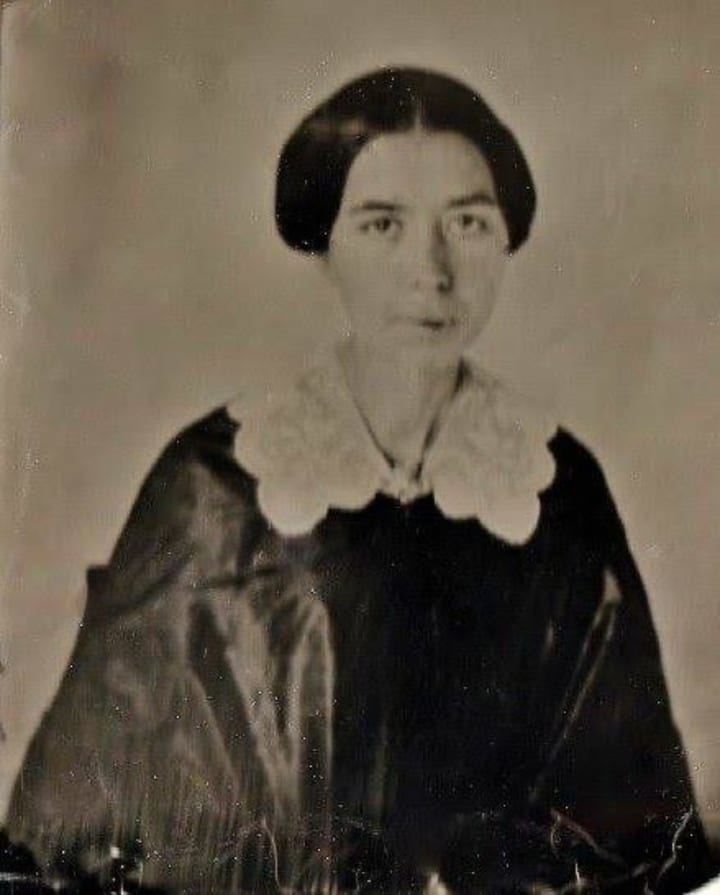
Ignoring the fact that her body had been lying in a freezing above-ground crypt for the first two months after her death, thus slowing down her decomposition, Mercy Brown was declared a vampire and the reason for Edwin’s deteriorating health.
So, they did what the panicking Europeans before them had done – they staked the girl’s still bleeding heart, which only added to their conviction. Then they burned both her heart and her liver.
However, the “experts” did not stop there and took it a step further – they mixed the ashes with water and gave this “tonic” for the sick Edwin to drink. Unsurprisingly, the magic potion didn’t work, and the boy died two months later.
Vampire Disease
One strange fact about the recorded vampire cases in the States is that every suspected blood-sucking creature was the victim of tuberculosis.
Since, in most cases, one family member would contaminate the other, people believed the sick person to be feeding off his healthy relative, thus making them sick later.

How exactly one family member contaminating another with infectious disease morphed into the “dead feeding off the living” remains a mystery. But perhaps, the wave of economic immigrants from Europe brought more than just their belongings across the ocean, even if the vampire madness was officially over by then.
From Life to Fiction
Bram Stoker first intended for the story of Dracula to carry a cautionary message, painting the vampires, although fictional, in a more scary light. However, due to Jack the Ripper already freaking out the entire London, Stoker’s publisher insisted on a more entertaining approach, and so the story as we know it today was born and published in London in 1897.
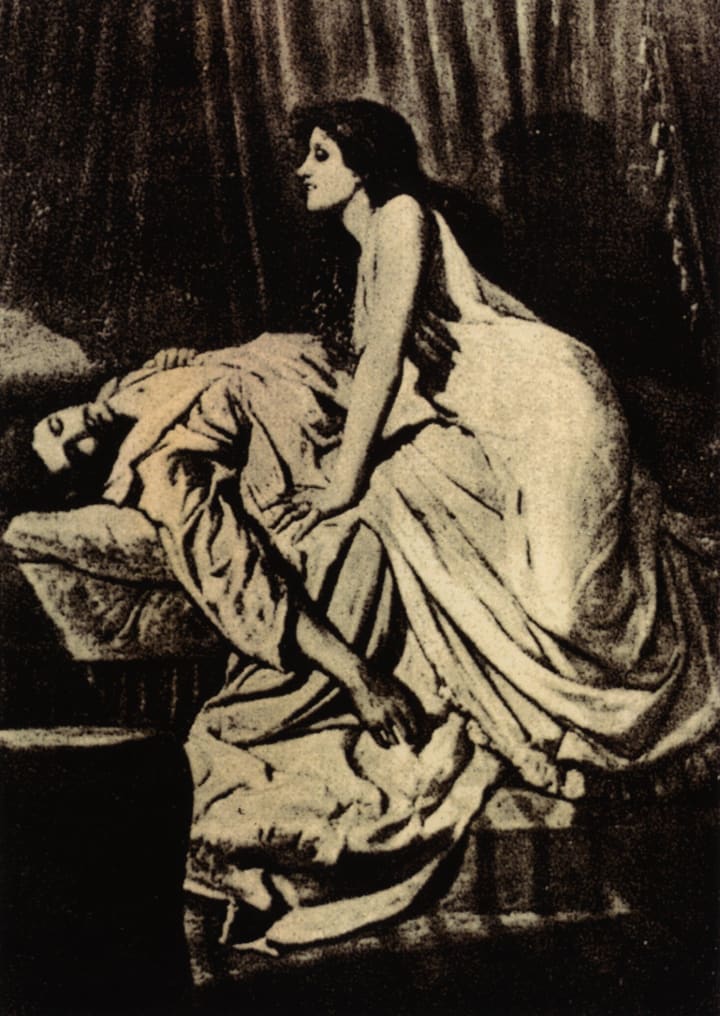
And if you had to guess, which one of the characters would you say was based on Mercy’s story? While there are reports of plenty of newspaper clippings about Mercy and her exhumation found on Bram Stoker’s table, the mystery remains. Was Mercy the true inspiration behind the book? Or was it Vlad the Impaler? And if it was Mercy, after all, was she Lucy or Mina?
Whoever inspired Stoker to create “Dracula”, the book became an instant hit, and vampires turned from cruel villains to lonely and charming immortals, with count Dracula leading the way.
Until even he had to step down from the throne to give way to brooding teenagers.
Note: This is an updated and rewritten article from a previously published one on a different platform: https://medium.com/curious-history-nook/when-vampires-roamed-the-earth-or-the-vampire-hysteria-cca215e3fb08
About the Creator
GD Madsen
A historian by education, a former journalist by profession, now living in the French countryside writing books and articles.
Top 10 Luxury Travel Experiences Around the World for 2026
Luxury travel in 2026 is no longer just about opulence; it’s about immersive, transformative experiences that combine comfort, adventure, and cultural depth. For seasoned travellers seeking something beyond ordinary vacations, the world offers a rich tapestry of unique journeys—from private islands to cultural explorations with personal guides. Below, we explore ten luxury travel experiences that promise exclusivity, personalization, and unforgettable memories.
By All 4 Season4 days ago in FYI


Comments
There are no comments for this story
Be the first to respond and start the conversation.