
The Tragedy of the Duke and His "Witch" Wife
What happens when a commoner messes with the plans you have for your son and the successor to your throne?

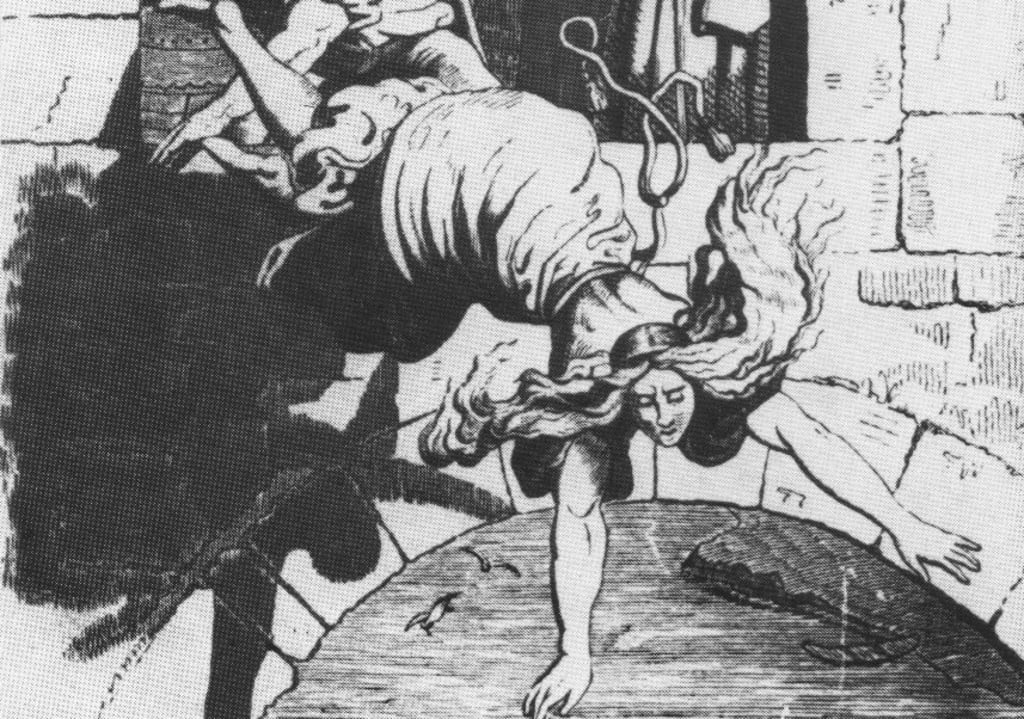
The story of Albert, the future Duke of Bavaria, and Agnes, a girl with no titles up her sleeve, begins like a true romance of the fifteenth century and ends with a tragedy only a couple of years later, nearly causing a war.
One Bride Lost, Another One Found
In a strange twist of fate, the couple could have never met, were it not for Albert's engagement to a count's daughter. Celebrations were in full swing when the future bride Elisabeth decided to run away to marry the page of her father's court.
But why ruin a good party, even when the cause for it is no longer? So, tournaments and carnivals continued all over Bavaria, and Albert was a willing participant in many of them, seemingly unbothered by the runaway bride problem.
It was exactly during one of those tournaments where he met Agnes, and it was love at first sight. Or, at least, this is what the tales and songs tell us, but they all have different versions of how or where the future couple met.
It is as much of a rumor as the story of Agnes prior to her meeting Albert.
A Mysteriously Beautiful Surgeon-Barber’s Daughter
Born around 1410, Agnes is believed to have been the daughter of the surgeon barber Kaspar Bernauer. However, other sources say he was a baker, or that he owned a bathing house.
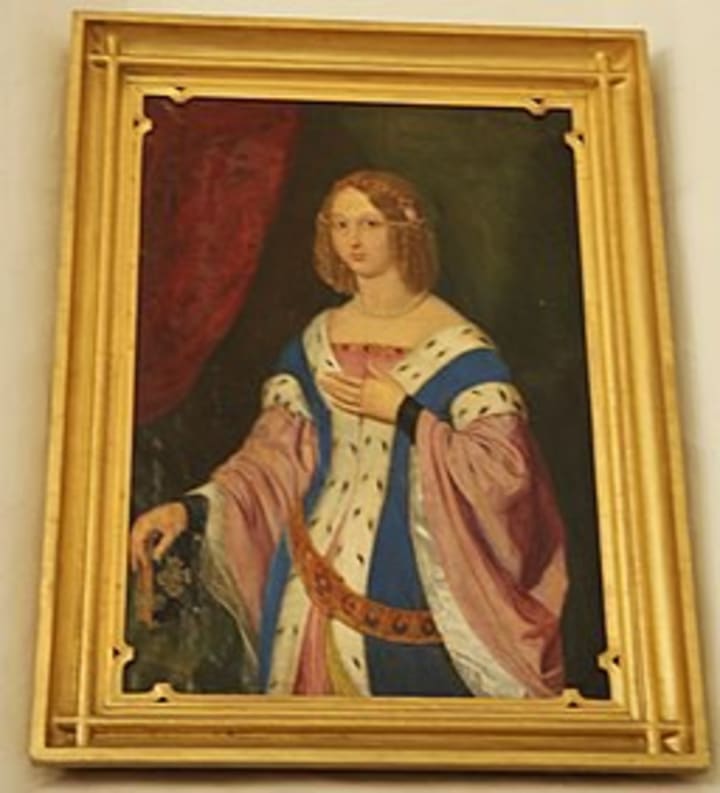
There is no doubt Agnes was a beautiful young woman, as there are paintings to prove it. Also, in 1493 (which was already after Agnes’s tragic death), historian Veit Arnpeik wrote in his chronicles: “It is said that she was so pretty when she drunk red wine, you could see how the wine went down her throat.”
Indeed, it is an odd way to describe beauty, but, by medieval standards, porcelain skin was the most admirable, so it’s fair to assume the wine going down her throat was the most sincere compliment.
What Agnes was doing in life at the time of meeting Albert is an equal mystery. Some say she was part of the ladies in attendance in the royal court. Others, those who believe in the theory of her father owning a bathhouse, speculate she may have been working there.
And this last possibility may be just the reason why Albert's father was so appalled by his son's choice.
Place of Hygiene and Sin
The popularity of bathing houses in Medieval Europe is quite understandable. After all, bathrooms, as we know them, did not appear until much later, and people needed a place to bathe. Despite popular belief that people in Middle Ages did not care about cleanliness and personal hygiene, the opposite is true.
Those houses were not too different from Roman baths, or perhaps they were the predecessors of modern spas, as they included not only the bathing option but also various massage services.
And a little extra.
Yes, a massage with a happy ending was also on the menu, and it was no secret to anybody.
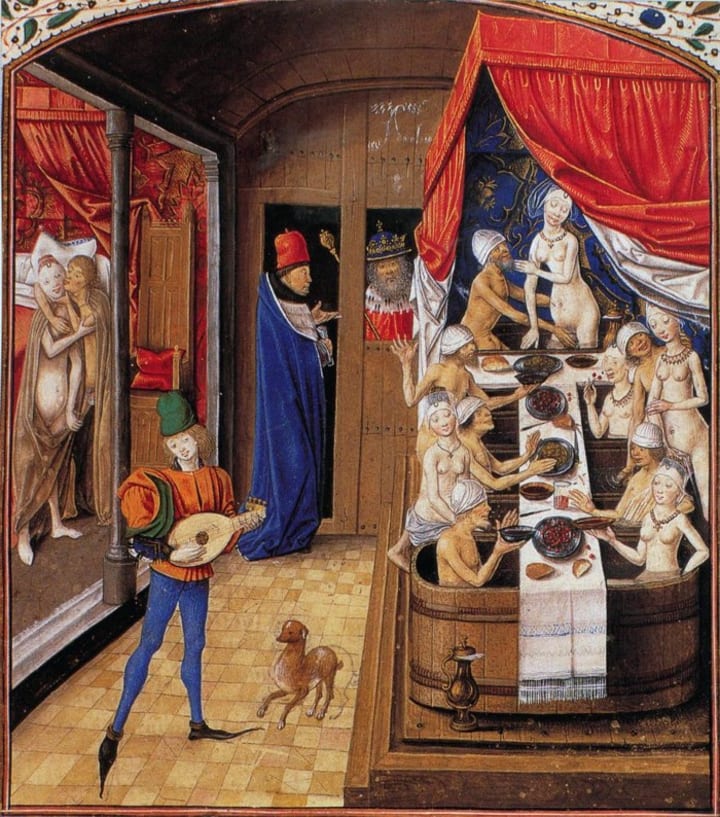
Even the Church publicly labeled these as places of sin and frowned upon their existence, but bathing houses retained their popularity, especially among the rich, including the future Duke of Bavaria.
One popular theory states, that after one canceled engagement tournament in 1428 Albert visited a bathing house, and that is where he met Agnes and brought her back to Munich with him.
A Wedge in Duke’s Plans
A mistress in the palace was not an uncommon occurrence, and for a couple of years, Agnes and Albert enjoyed their happily ever after.
However, Agnes was not the type to just sit and look pretty. She was not afraid to share her opinion on matters. She even helped in the capture of the infamous robber baron Münnhauser, and it is documented that Albert’s sister Beatrix was constantly annoyed by Agnes’s self-assured manners.
Maybe her strong-headed nature could have been overlooked further, but Albert suddenly became interested in political matters he had previously ignored. And his father started suspecting that somebody was whispering in Albert’s ear.
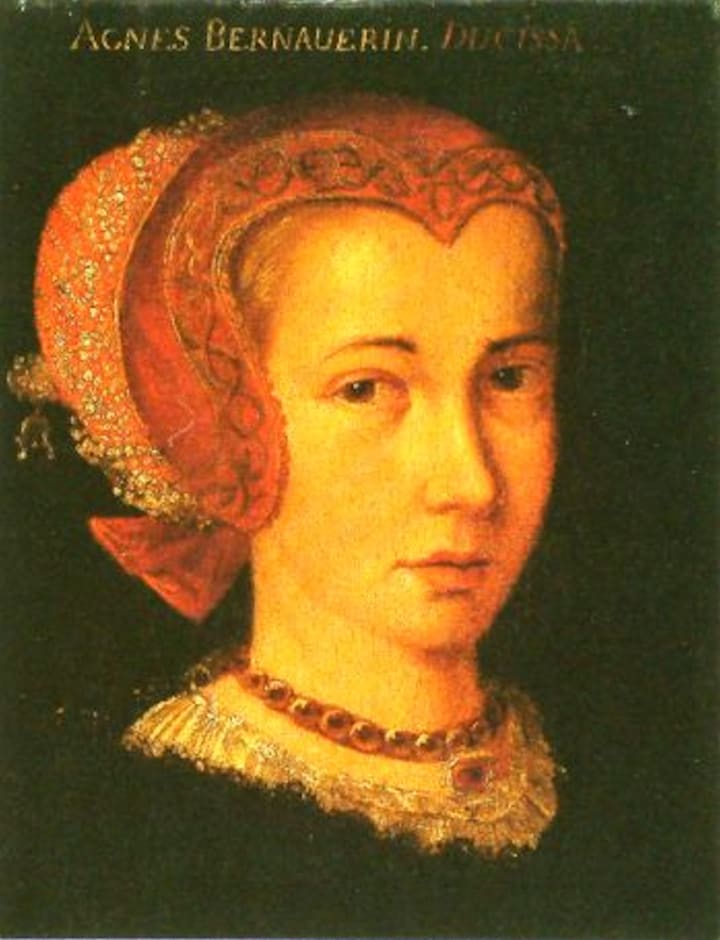
More so, although officially unknown, some strongly believe the couple got secretly married in 1431 or 1432 (look at her portrait above where it clearly says “duchess”), and this may have been the final nail in Agnes’s coffin because the duke certainly had different plans for his only son and heir to the throne.
All in a Day’s Work
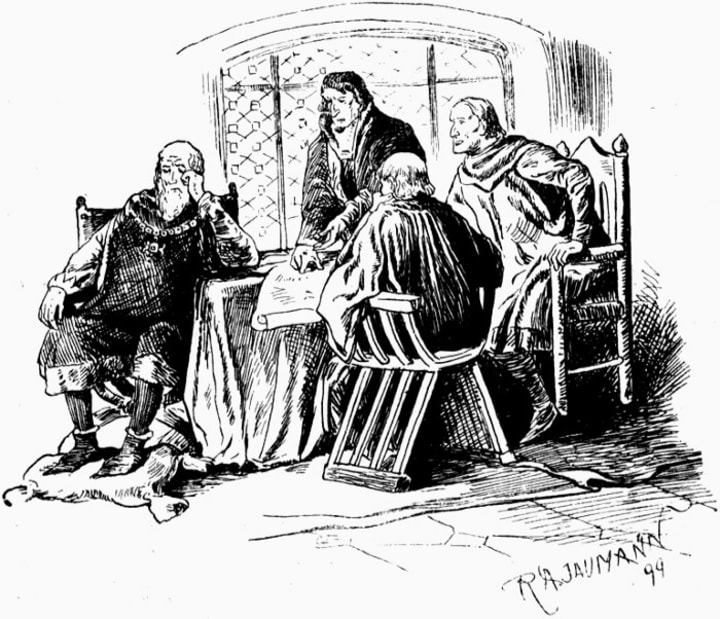
Who knows how long Ernest planned and waited, but once the opportunity arose, he seized it with no second thoughts.
On October 12, 1435, Albert went on a hunting trip, and it was the last time he saw his beautiful Agnes.
So, what did a furious father-in-law do? No, he didn’t throw Agnes out. He didn’t even plot anything to stage her infidelity, as done in so many cases in history. No… He publicly accused Agnes of bewitching his son.
And then he had her condemned to death.
Now, it is safe to assume that there was no proper trial, as Albert’s hunting trip could not have been that long. But, hey, who would ever be brave enough to question the word and the orders of the Duke of Bavaria himself, right?
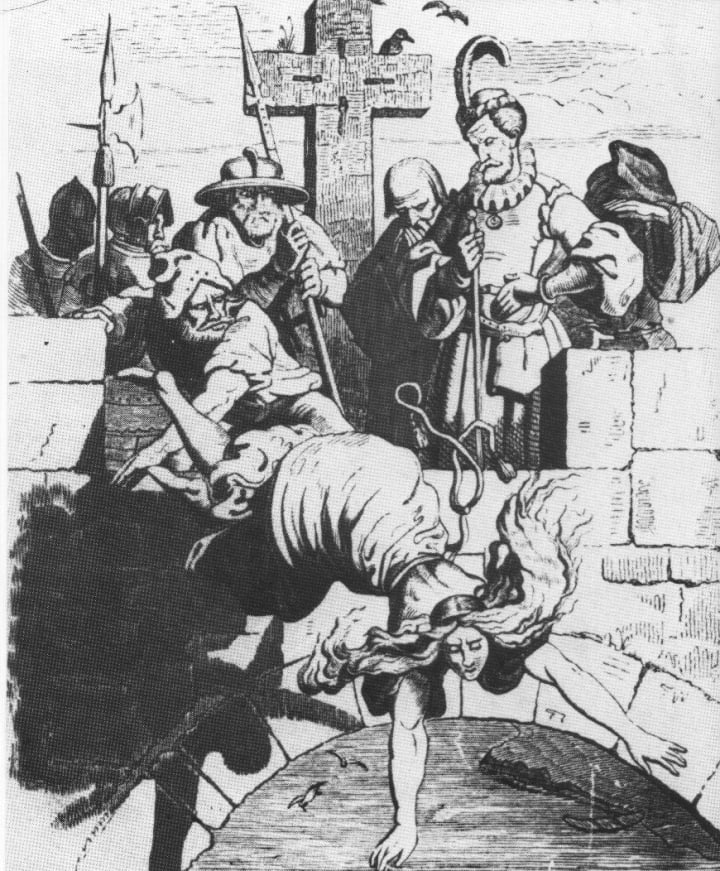
Nobody did… And so, Agnes, with her ankles and wrists bound, was thrown off the bridge into the Danube river. How exactly this happened, and who did the cowardly job remains unclear, but according to the stories told, Agnes did not immediately die.
She managed to free one foot and tried swimming to the shore while crying for help, but her executioner, or his servant, fearing the Duke’s wrath, caught up with the woman, and with the help of a long pole pushed her underwater.
From Family to Enemies
Once the news of the murder reached Albert, he refused to return. Instead, furious and plotting his revenge, he went to Ingolstadt, another Bavarian city ruled by another duke.
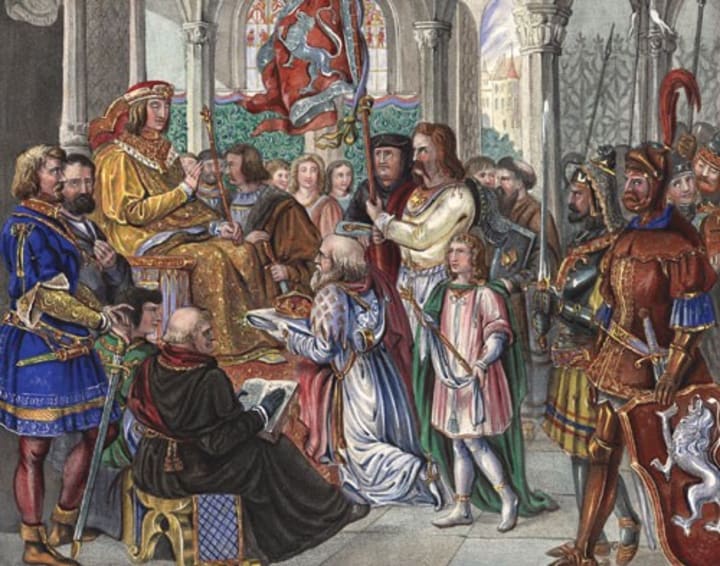
Speculations of the potential war between the father and the son grew to the extent where the Emperor of the Holy Roman Empire Sigismund had to interfere.
Like with lots of things in this story, again, his influence remains a rumor, but whatever and however it happened, the father and the son reconciled after Ernest, the very man who murdered Agnes, ordered a chapel for her to be erected in the cemetery of Saint Peter of Straubing.
A year later, Albert went on to marry a more “suitable” bride — the daughter of a duke, Anna of Brunswick, in November of 1436, and fathered ten children with her.
But not before making sure the memory of Agnes would be immortalized.
Two months after Agnes died, he endowed a perpetual mass and a yearly celebration in honor of Agnes in the Carmelite Cloister in Straubing, although it is unclear if he left her body buried in the cloister, as she wanted, or if he moved it to the chapel his father erected.
Either way, the chapel that still stands today has a human-size stone with the portrayal of Agnes lying on a pillow with two small dogs at her feet.
Legends and Legacy
So little was known about Agnes and her life that soon after her death various stories began to spread around Bavaria. People even created folk songs about her, one called “Patriotic Tragedy” (Vaterländische Trauerspiel).
However, only after Friedrich Hebbel’s play “Agnes Bernauer” was written and performed in Munich theater in 1852, did Agnes’s story become largely known all over the entire country.
The celebration that Albert endowed, takes place to this day. There is also a theater festival named after her where different actors perform the play and its interpretations.
Speaking of actors… The story of Agnes and Albert was also featured in the French movie from 1961 called “Amours Celebres” (“Famous Love Affairs”), where Bridgitte Bardot played Agnes, and Alain Delon was Albert.
And there is… a cake.
Yes, a cake.
Agnes Bernauer Torte is a layered meringue cake with almonds and coffee buttercream. I don’t know about naming cakes after famous people, but it sure looks delicious. The downside — if you want to taste the original recipe, you have to travel to one specific café in Straubing. Otherwise, there are always recipes online that probably are pretty close to the original.
Note: This is an updated and partially rewritten version of a previously published article on another platform: https://medium.com/curious-history-nook/the-tragedy-of-the-duke-of-bavaria-and-his-witch-wife-799c506cb0ef
About the Creator
GD Madsen
A historian by education, a former journalist by profession, now living in the French countryside writing books and articles.
How to Succeed at the Benson Directory®
Congratulations and welcome to the Benson Directory® employee #22391! As our newest call handler, you will have the privilege of speaking with dozens of unique and interesting people on a daily basis as well as the opportunity to earn bonuses for high performance. Contained within this handbook you will find a set of ease to follow instructions designed to help you settle in to your new role and begin paving the way to success.
By S. A. Crawford2 days ago in Fiction



Comments
There are no comments for this story
Be the first to respond and start the conversation.