
What high technology does Tianhe core cabin have? To break two world records, US demands technology sharing
To break two world records, US demands technology sharing

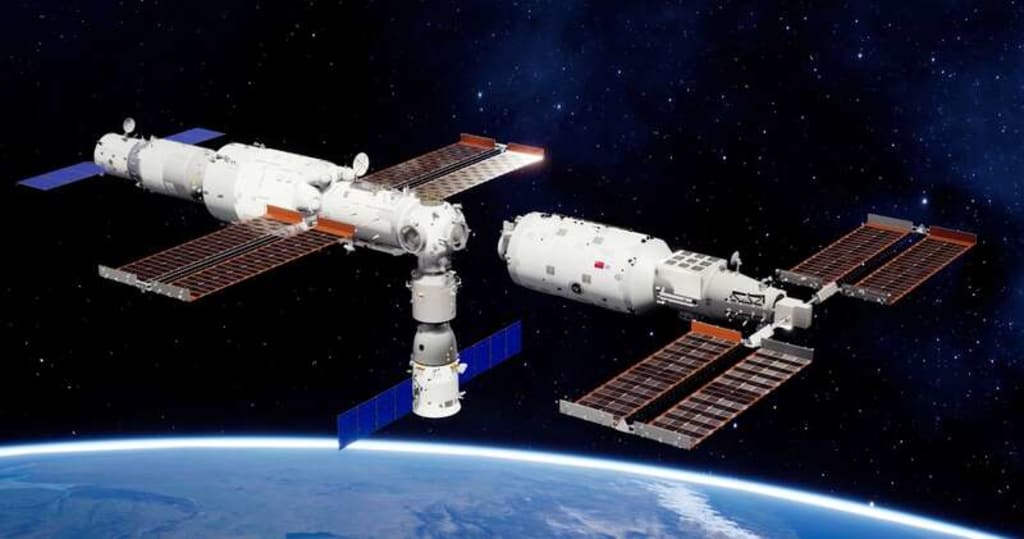
On April 29, 2021, with the successful separation of the huge Long March 5B low-Earth orbit from the core module of the Tianhe space station, my country finally has a space station in the true sense. The successful launch of the Tianhe core module not only represents a breakthrough in space technology in my country and even developing countries, but also broke a number of space station world records, taking a breakthrough step for the exploration of the universe for all mankind.
The Tianhe space station weighs 22.5 tons and is 16.6 meters long, breaking the world record for the length and weight of the core module of the multi-module space station. It is also the largest spacecraft successfully launched into orbit by humans since the 21st century. This amazing data is inseparable from the powerful carrying capacity of the Long March 5B rocket. The Long March 5B has a low-Earth orbit carrying capacity of up to 25 tons and a fairing up to 20.5 meters. In particular, the inner space of the fairing is the largest in active rockets in the world, which fully guarantees the carrying mission of the Tianhe core module.
Contrary to the inherent impression of most people, before the International Space Station project, the United States in reality did not have much space station development experience. The United States has launched only one space station in the last century, Skylab. This is a space station transformed from the third stage of the remaining Saturn V launch vehicle after the Apollo program was terminated. Due to the capacity of the strongest rocket in human history and the largest transformation space, the skylab has an extremely atmospheric design, weighing 76 tons and reaching a length of 32 meters. It has luxurious living facilities and a large number of experimental equipment. But Skylab has only one docking port, which is essentially the first-generation single-module space station. What's even more tragic is that Skylab had a serious problem during the launch, which caused it to lose a solar panel and the orbital height was significantly lower than the design value. In the end, this giant spaceflight was born to verify the space shuttle technology. The spacecraft could only crash into the earth after barely 6 years of service, and failed to last until the first flight of the space shuttle.
Since then, the modules developed by the United States for the International Space Station are all transported by space shuttles and have no autonomous power. So much so that the large-scale maneuvering of the International Space Station today must rely on the Russian service module or the spacecraft/space shuttle (retired) that comes to dock from the earth. With the increasing failure of the Russian-made "Xingchen" service module that entered orbit at the end of the last century, the emergency maneuverability of the space station is also increasingly challenged.
In addition, Tianhe core module is also the first manned spacecraft in the world that relies on electric propulsion engines for daily orbit maintenance and attitude adjustment, which greatly reduces daily fuel consumption and sets an example for energy conservation and emission reduction in the field of human space. According to the plan, the first phase of the Chinese space station also includes two experimental modules with similar specifications to Tianhe, which will be launched next year. The Tianhe has already demonstrated the feasibility of doubling the expansion, that is, expanding to the state of six cabins. Considering that both Russia and the National Aeronautics and Space Administration (NASA) are preparing to abandon investment in maintaining the International Space Station after 2024. After the completion of the construction of the Chinese space station, it is entirely possible that it will become the "main position" of global space scientific research in the future.
The successful launch of the Tianhe core module marks that the space station that regularly flies over the world every day will no longer be the patent of western developed countries. day.
About the Creator
witty lukas
The doubts held by human beings are the germs of science
Keep reading
More stories from witty lukas and writers in FYI and other communities.
It is a large canine that dares to snatch food from cougars, and the cause of its extinction is a mystery
Back in North America 100,000 years ago, a hungry cougar successfully hunted down a flat-headed lion after a fierce battle. When it was about to enjoy delicious food, in the jungle not far away, there were hissing footsteps, accompanied by a low roar. The cougar was immediately alert, his eyes fixed on the direction of the sound. At this moment, a pair of dire wolves with green eyes came out of the jungle and slowly approached the cougar.
By witty lukas3 years ago in FYI
The Fall of the Iranian Regime Will Destroy Russia
A lot has been happening in the world of geopolitics lately. We’re not even three weeks into 2026, and we’ve already seen wars, bombings, regime changes, capitulations, and escalating unrest across multiple regions. The year has opened at full throttle, and one of the next countries that appears to be teetering on the edge is Iran.
By Lawrence Lease3 days ago in FYI


Comments
There are no comments for this story
Be the first to respond and start the conversation.