
Three Days of Darkness
A Retrospect of the 2003 Blackout

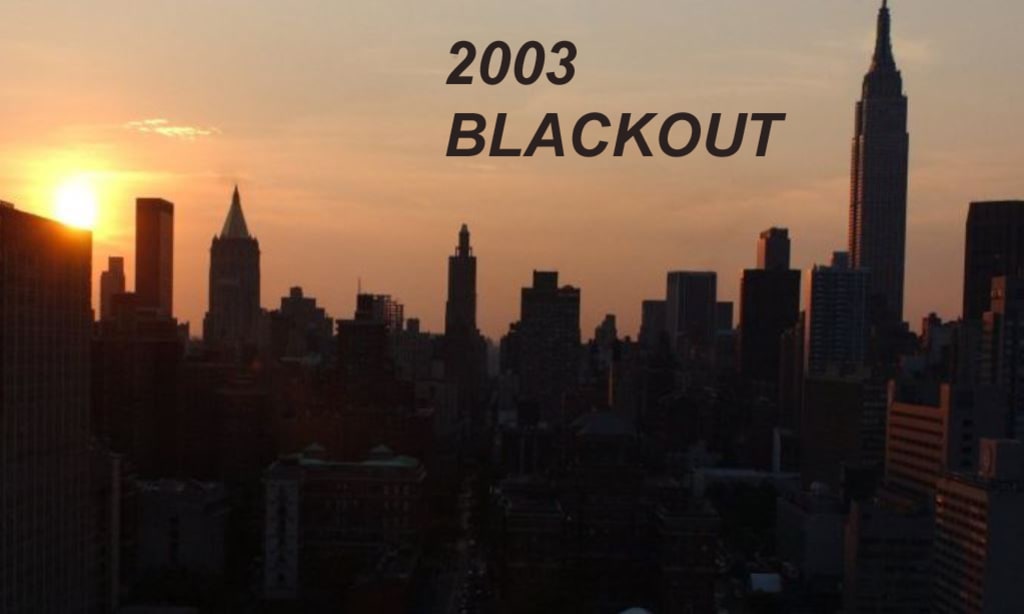
“There was a cold winter wind and it blew and it blew. It blew through the trees and the little town too. It blew past the houses where the children were sleeping. It blew through the keyholes where peepers were peeping. It blew down the streets that were shrowded in slumber and rattled the roofs right down to the lumber. “
Those are the first few lines spoken in the 1996 feature film “The Trigger Effect”, starring Kyle Maclachlan and Elizabeth Shue, about a widespread blackout that lasted almost three days and the complete and total breakdown of society that it caused.
However. oblivious to everyone at the time, seven years later the real thing would happen.
Some reading this may be too young to remember or were not even here on August 14, 2003, when it happened. A catastrophic failure of the grid network between the state of Ohio and the province of Ontario caused a cascading effect that plunged the entire northeast United States and the province of Ontario into darkness for almost three days.
However, unlike in the film, the complete and total breakdown of the grid did not cause a complete and total breakdown of society.
It was one of those events that everyone remembers where they were, and this year (2023) marks the 20th Anniversary of the event. A small localized blackout near Columbus, Ohio caused an overload and shutdown of the electrical system that just kept going.
I certainly remember where I was. In one of the most inconvenient places to be during a blackout. On the subway in the middle of the Price Edward Viaduct.
I lived in the east end at the time and was on the way home. I had always hated crossing that stupid bridge, but up to that point, I had never imagined stopping on it and having to walk it.

One of the first things to go was the interior lights and the sound of the motor grinding to a halt and the vehicle slowly coming to a stop right in the center of the bridge. At first, I didn’t think anything of it. I thought it was just a local power problem with the traction rail and that the transit company would fix it shortly, but that couldn’t have been further from the truth.
We actually waited quite a long time, although I don’t remember the exact amount of time. The subway operator and conductor then went to each car advising everyone to move to the rear car as they were instructed to evacuate the vehicle.
We were to exit and navigate the bridge back to the previous station. I didn’t know why we couldn’t walk in the direction we were traveling instead of going back.
When I stepped onto the bridge the first thing I noticed was that it was a catwalk and you could see right through to the river below. No. I don’t think so. Just leave me a bottle of water and I’ll be fine right here…
Upon returning to the previous station, we were escorted onto the platform and advised to exit the station.
Upon exiting the station was when I realized that it was more than a localized power problem.
I continued my trek back across my favorite bridge to the next station to grab the bus since I knew there would not be any subway trains for a while and possibly not a bus either but I had to try.
Once I arrived at the station I was surprised to see a bus waiting. It was the number 62 which would take me almost home, but by that time it was pretty packed but I was able to squeeze on.
The bus left almost immediately and there we were packed like sardines on the 62 Mortimer bus with butts pressed against the windows on what could possibly be the only bus for a while as most others were stuck someplace in traffic.

The bus terminated at Main Street station, but I had to get to Dawes Road, where I lived at the time. Still a few minutes east.
The trip did not take as long as I expected since Mortimer Avenue was not a major thoroughfare and not clogged solid so the bus could “sort-of” get through, albeit navigating through intersections without working traffic lights. The normally 15-minute trip took just slightly over 30 minutes.
When we arrived at Main Street station, there were no buses in sight, so I decided to just walk to Dawes Road. I didn’t feel like waiting an unknown amount of time for another bus.
As I walked east along Danforth Avenue there was chaos in the street. Traffic was at a dead standstill but there were a lot of people walking.
Despite the chaotic traffic condition, people seemed very content with the situation. They were just making the best of the situation because, after all, there was nothing anyone could do about it.
Along the way, people were standing outside of shops handing out bottles of water to people as they passed. A nice gesture. Only one business, a chain coffee shop, was actually charging a dollar for a cup of water because “We still have to make money”.
Along the way, I also noted many people out helping to direct traffic.
I arrived home hot and tired, and of course had to walk up to the apartment. There had been many cases of people trapped in elevators. Now, buildings are required to have a generator backup for their elevator cars, but back then it wasn’t and many didn’t.
Later in the evening, I started to get bored. While many in the neighborhood were having street parties and barbeques, and general fun, I had decided to stay in.
I wanted to try the radio, so I grabbed the battery-operated multi-band receiver that I still have, just in case.
I began to manually turn through. FM was completely dead. It gave me a rather creepy, eerie, post-apocalyptic feeling. Imagine tuning through the radio and finding nothing but static all the way.
Radio stations have a generator to keep their transmitters operating during an outage, but are usually only good for about six hours. After that, the fuel runs out, the generator stops, and so does the broadcast.
I switched to AM and had a bit more luck. One station particularly caught my attention because they were playing music. 1150. After enjoying the music for a bit, I found out that the station was broadcasting from Corpus Christi, Texas. My first thought was, “How big is this blackout?”

The blackout impacted the two largest cities the most, New York and Toronto, and also lasted the longest in those cities. The area where I lived did not see a full restoration of power until about two and a half days after the initial outage.
Almost three days without electricity. That thing that most of us in modern society can’t live without, but I found it rather peaceful.
I couldn’t go to work because not only was there no way to get there, but they couldn’t open without power, so I spent the time in peaceful relaxation. Something the people in a major city don’t do often.
I remember at the time, the rural dwellers called us city people, City-ots”. Well, you know, if a city with a population of over 3 million can get together and help each other under an unusual cercostamnce, I say we didn’t do that poorly.
The film predicted incorrectly.

About the Creator
Paul 'The Brick' Brec
Boxer from Toronto, Ontario, Canada.
Photographer, electronics (build and repair) enthusiast, owner and operator of Stockyards Studios/Stockyards Radio.
Keep reading
More stories from Paul 'The Brick' Brec and writers in FYI and other communities.


Comments
There are no comments for this story
Be the first to respond and start the conversation.