
There's a n--ger in the woodpile
This term originated during the enslavement of Africans in America and the Underground Railroad. it has evolved to have several meanings today depending on who is talking.


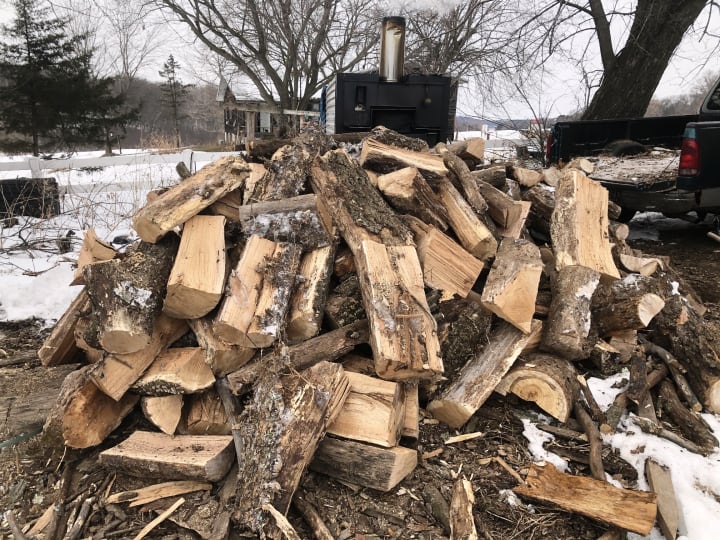
"There's a n--ger in the woodpile" is a term my grandmother used on occasion to indicate that a situation had something hidden that needed to be revealed. We lived in the county and actually had a pile of wood from which we gathered the sticks to make a fire. I could not imagine anyone hiding inside of a woodpile and never pondered that what my grandma said was more than just a phrase and at one time was a reality.
This changed recently as I was enjoying some old black and white Looney Tunes episodes late one night. I was stunned by a particular scene. It happened so fast that I had to rewind several times to make sure I saw what I thought I had viewed. I was watching the 1937 Looney Tune's classic Porky's Railroad where Pory Pig's little train Toots is in a race with a dog driving a huge locomotive called Silverfish. During the race you can hear California Her I come playing as the background music.
As Toots picks up steam she passes by a number of items on the side of the railroad tracks. One of them happens to be a pile of wood. At the precise moment, the train passes the wood falls away to resemble what looks to be a monkey or African American who had been hiding underneath, He has a surprised look on his face and for a few brief seconds, the song changes to Dixie and the meaning is clear. The visual was purposely put there by the cartoon creators because they thought it humorous to depict a black man./ Negro/monkey. n--ger in a woodpile.
I was stunned but not offended and when I thought of my grandmother I smiled. I never heard the woodpile phrase from anyone except my mother's mother, who was African American. For this reason, the depiction did not sting as it might have or anger me as it may do to others. Animators have been trying over the years to clean of the racism in cartoons and truthfully if one did not know what this animated short really meant it probably was missed.
It happened so fast and there are those who probably assumed it was just a monkey who had been hiding in the woodpile. According to Wikipedia and other sources, those animators knew exactly what they were doing and obviously found the scene funny. The wording of a 'n--ger in a woodpile is said to have originated when enslaved Africans were trying to escape through the Underground Railroad between 1840-1850.
It is believed that one of the hiding places for those seeking freedom was within a pile of wood. Upon detection, someone would announce that they had found a n--ger in the woodpile. My grandmother's use of the phrase could be translated as "Something fishy is going on" or when an unmarried woman was found to be expecting a baby. If no one knew she had been keeping company with a young man it would be said that a n--ger was in the woodpile.
`
There was an American film comedy titled A N--ger in the Woodpile that was released in 1904 and the idiom was common in film and literature during the 1920s and 1930s. In the original 1927 version of the Hardy Boys book The House on the Cliff (pg. 77), Frank Hardy uses the expression but it was removed in 1959. In 1930 the group Skillet Lickers actually recorded a song titled "N--ger in the Woodpile". In the book The Razor's Edge by Somerset Maugham one of the characters from America is on the brink of closing a business deal and says the following: "I'll fly down to Texas to give the outfit the once-over, and you bet I'll keep my eyes peeled for a ni--ger in the woodpile before I cough up any ... dough.
In 1929 the famous Dr. Seuss whose books have thrilled children of all races used the term in a cartoon "Cross-Section of The World's Most Prosperous Department Store". Customers were browsing in a department store looking for items that would make their lives more difficult. There is a series of scenarios that are based on popular figures of speech: One examines haystacks with matching needles, (A needle in a haystack).
A man with a net tries to catch a fly for his ointment, (A fly in the ointment) and another looks at monkey wrenches to throw into his machinery. (He threw a monkey wrench into the situation or in other words soemthign was done to block a deal or interupt an activity. There comes a scene where a mn is looking at a selection of people drawn with stereotypical black features for his woodpile.
Because my grandma was black and used this idiom, I assumed that it was something African Americans had been saying about themselves. Now thinking on the origin I realize how traumatic it must have been for a slave trying to escape and being caught in a pile of wood. Certainly he or she was beaten within an inch of their life and possibly even killed for their actions. This is yet another dark side of American history that has not been taught in the fullness of truth.
About the Creator
Cheryl E Preston
Cheryl enjoys writing about current events, soap spoilers and baby boomer nostalgia. Tips are greatly appreciated.
Keep reading
More stories from Cheryl E Preston and writers in FYI and other communities.
Balloon releasing deemed unsafe and illegal
On July 1 it will become illegal in the state of Virginia to release balloons into the air. The practice has been deemed unsafe for the environment as well as for small aircraft. There will be a $25.00 fine for those caught in the act in the Commonwealth. Other states including California, Texas, Florida, Connecticut, Tennessee, and New York, have also banned this popular activity. In Florida, it was determined that large numbers of balloons that were inflated with lighter-than-air gases posed a nuisance and a danger to the environment, marine animals, and wildlife.
By Cheryl E Preston5 years ago in FYI


Comments
There are no comments for this story
Be the first to respond and start the conversation.