
The world's lightest material, lighter than air, can now be 3D printed
The ability to successfully 3D print using the world's lightest material - graphene aerogel - promises to open a new chapter for the materials industry.


The ability to successfully 3D print using the world's lightest material - graphene aerogel - promises to open a new chapter for the materials industry.
Graphene aerogel is the lightest material in the world , weighing 7.5 times less than air. One cubic meter of graphene aerogel weighs less than 160 grams. In fact, graphene aerogel is 12% lighter than the second lightest material in the world, aerographite.
A very good question is if it is lighter than air, why can't it fly? It's because there are a lot of spaces between the molecules of this material, allowing air to get in, preventing it from flying.
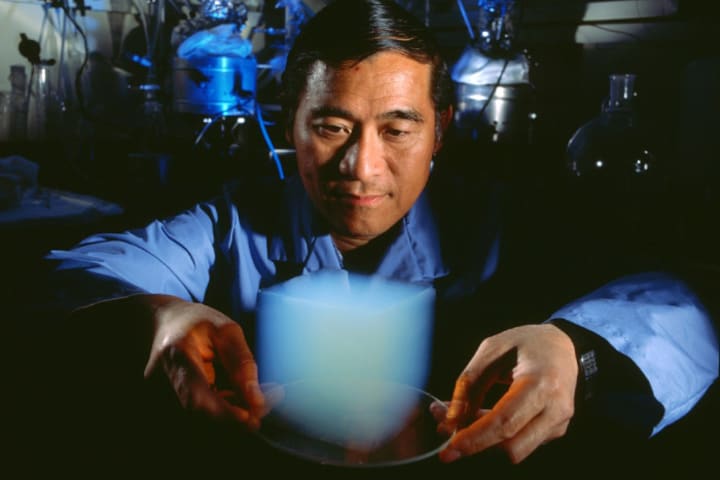
Graphene aerogel is the lightest material in the world.
Humorously nicknamed “frozen smoke,” aerogel is a solid that is flexible, conductive, compressible, and absorbent.
Because of the strange properties of this material, scientists have discovered many potential applications from invisibility cloaks to environmental cleanup. Just 1 gram of aerogel is enough to absorb some raw materials up to 900 times their weight, such as oil. A method that is completely cheaper than the market.
Currently, in many studies and experiments, silica aerogel is the most common shape used to study aerogel. The difficulty of this material is that it is not easy to produce. However, scientists have worked hard to research and successfully found a way to 3D print this lightest material in the world.
Recently, scientists from the State University of New York and Kansas State University, USA said they were able to 3D print aerogel material for the first time. The entire process was automatically controlled and uniform across all layers of material.

A graphene aerogel block can float above grass or even the heads of flowers.
The aerogel itself is a thick, two-dimensional layer of pure carbon atoms. They are stacked together in a hexagonal honeycomb lattice. To produce graphene aerogel, researchers would have to freeze the graphene layers and stack them into a three-dimensional structure.
According to ScienceAlert, the use of 3D printing technology to successfully manufacture graphene aerogel for the first time shows the remarkable efforts of researchers. Because the molecular structure of graphene aerogel is considered very difficult to 3D print.
Researcher Akshat Rathi, whose team successfully 3D printed graphene aerogel, said:
"Usually, to 3D print graphene aerogels, the main material is mixed with other components, such as polymers, so that it can be printed on an inkjet printer. Once the structure has been shaped, the polymer is separated from the main material after another chemical process. However, in the case of aerogels, this method can destroy the crystal structure of the aerogel."
The solution the research team came up with was graphene oxide - a form of graphene combined with oxygen molecules . The team mixed this compound with water and placed it on a surface cooled to -25 degrees Celsius. At this temperature, the researchers were able to instantly freeze each individual graphene layer and create a three-dimensional graphene structure.
3D printing process of the world's lightest material - graphene aerogel.
Rathi also added that after the 3D structure creation process is complete, they will remove the surrounding ice blocks by using liquid nitrogen to freeze the water and separate it from the object's surface without affecting the structure.
The 3D aerogel material layer will continue to be exposed to heat to separate oxygen atoms. The result will be only graphene aerogel. According to Rathi, "the resulting solid will have different densities ranging from 0.5 kg/m 3 to 10 kg/m 3 . The lightest graphene aerogel ever successfully produced weighs about 0.16 kg/m 3 ".
The birth of Aerogel originated from a story told in the late 1920s, when Samuel Kistler (1900-1975), an American chemistry professor, bet his colleague Charles Learned that "there exists a gel that is not liquid". Of course, no one believed what he said was true. Because the liquid property was an inherent property of gels that had been known for a long time before that.
With his perseverance and determination, after many experiments and many failures, Kistler finally found a gel in a gaseous state (not a liquid state), a new gel that had never been known before, and that no one had even imagined. He became the first person to replace the liquid state of the gel with a gaseous state, and named it "Aerogel". In 1931, he published his discovery in the article "Coherent Expanded Aerogels and Jellies" , published in the scientific journal Nature.
Aerogels make excellent insulators because they virtually eliminate two of the three methods of heat transfer – conduction (they are composed almost entirely of insulating gases that are very poor conductors of heat) and convection (their microscopic structure prevents net gas movement). Aerogels can even have a thermal conductivity that is less than that of the gas they contain – a phenomenon known as the Knudsen effect .
Although very light, an object made of Aerogel is capable of "carrying" another object weighing 500 to 4,000 times its own weight. When it first appeared, Aerogel was applied in every field that people could imagine, from makeup products for women to more romantic things like paint for... napalm bombs. They are also used in cigarette filters or insulation for refrigerators. Currently, Aerogel can be found in fields such as: Swimwear production; Firefighters' clothing; Glass doors; Missiles; Paint; Cosmetics; Nuclear weapons.....
About the Creator
Ken Daklak
Telling stories my heart needs to tell <3 life is a journey, not a competition
If you like what you read, feel free to leave a tip,I would love some feedback
https://s.shopee.vn/VwwLTGLe9
Keep reading
More stories from Ken Daklak and writers in FYI and other communities.


Comments
There are no comments for this story
Be the first to respond and start the conversation.