
The Unsolved Murder of Mary Cecilia Rogers
A cigar girl who became the talk of New York, in life and after death

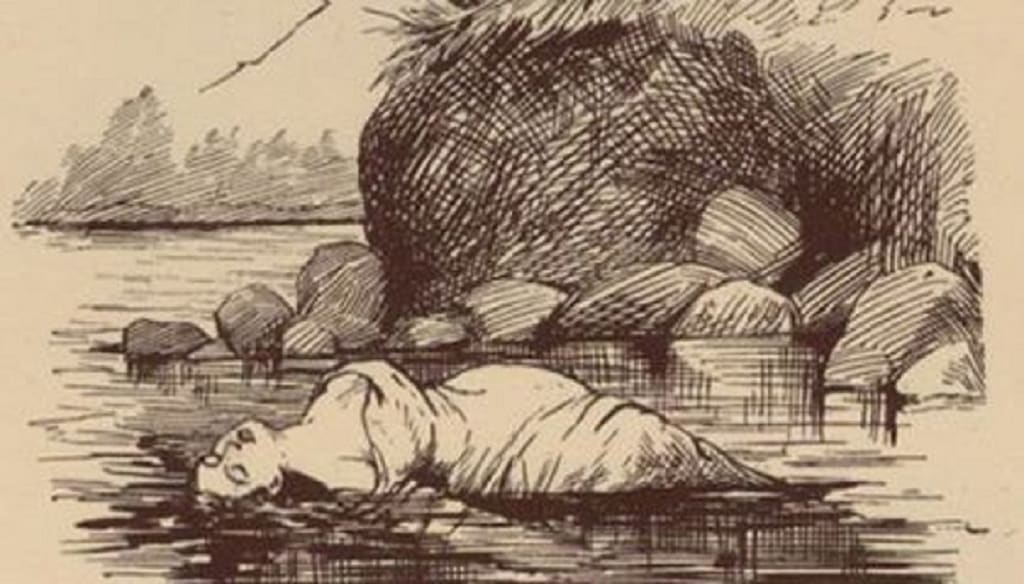
Mary Cecilia Rogers was known as a great beauty. She worked in a New York tobacco store where she turned the heads of many prominent men. When her body was found in the Hudson River on July 28, 1841, it was assumed that she had been the victim of gang violence. However, a witness claimed that she had been dumped there after a failed abortion attempt. A note written by her boyfriend before his suicide suggests that he might have been involved in her demise. After all of these years, her death continues to be unexplained.
Although Mary’s exact date of birth is unknown, she was likely born around 1820 in Lyme, Connecticut. She was the only child of a widow, her father having died in a steamboat explosion when she was seventeen. Soon after, she took a job at the tobacco shop owned by John Anderson in New York City while she continued to live in her mother’s boarding house.
Anderson paid Mary quite well, in part because her good looks brought in quality customers. One customer went so far as to say he spent an entire afternoon at the store just to exchange glances with her. Another published a poem in the New York Herald that referred to her “heaven-like smile” and “star-like eyes”. Some customers fond of stopping by to flirt with Mary were well-known men like James Fenimore Cooper, Washington Irving, and Fitz-Greene Halleck.
On October 5, 1838, the Sun newspaper reported that Mary had disappeared from her home. Her mother Phoebe said she had found a suicide note, but it turned out to be a hoax. The next day Mary reappeared, having only gone to Brooklyn to visit a friend. Because the Sun had previously printed a story called the Great Moon Hoax, some people suggested that perhaps Mary’s return was the hoax rather than her disappearance. Their theory was supported by the fact that she did not immediately return to work at the Tobacco Shop. Some even suggested the whole thing was a publicity stunt by Anderson. It was all put to rest when she came back to work a few days later.
On July 25, 1841, Mary told her fiancé Daniel Payne that she was planning to visit her aunt and other family members. Three days later, her body was found floating in the Hudson River in Hoboken, New Jersey. Local newspapers wrote all about the “beautiful cigar girl” and her mysterious death. The events of her death were sensationalized and received national attention. The details of the case suggested that she was either murdered or dumped by a local abortionist, Madame Restell, after a failed procedure.
The inquest into her death went on for months and her grief-stricken fiance Daniel Payne decided to overdose on laudanum while heavily intoxicated. The note he left was found among other personal papers he was carrying when he was found near Sybil’s Cave in October 1841. It read:
“To the World — here I am on the very spot. May God forgive me for my misspent life.”
Even Edgar Allan Poe became fascinated by the case, writing “The Mystery of Marie Rogêt” in 1842 as a follow up to “The Murders in the Rue Morgue." Though the story was set in Paris and the victim’s body was found in the River Seine, it was based upon Mary’s murder. His detective in the story, C. Auguste Dupin, suggests several possible suspects in Marie’s murder, but never names the killer. Poe wrote in a letter regarding the story that he had himself attempted to solve Mary’s murder to surmise how Dupin might have gone about unraveling the mystery of Marie’s death.
The number of stories written by newspapers and other writers about a simple cigar girl based solely on her great beauty continued for weeks until it was abandoned for a much bigger story — that of John C. Colt’s murder of Samuel Adams, but the mystery of her murder remains until this day.
About the Creator
A.W. Naves
Writer. Author. Alabamian.
Keep reading
More stories from A.W. Naves and writers in FYI and other communities.
We Shall Never Surrender: The Speech That Turned Britain’s Darkest Hour Into Defiance
There are speeches that explain history, and then there are speeches that intervene in it. On June 4, 1940, Winston Churchill delivered one of the most consequential addresses ever spoken inside the House of Commons. Britain had just pulled off the miracle of Dunkirk—an evacuation that saved more than 330,000 Allied troops from annihilation. But make no mistake: this was not a victory. France was collapsing. Nazi Germany looked unstoppable. Invasion felt inevitable.
By Lawrence Lease5 days ago in FYI



Comments
There are no comments for this story
Be the first to respond and start the conversation.