
The Shadow of Decadence: Gilles de Rais, the Knight Killer
The Nobleman Turned Monster and its Impact on Medieval History

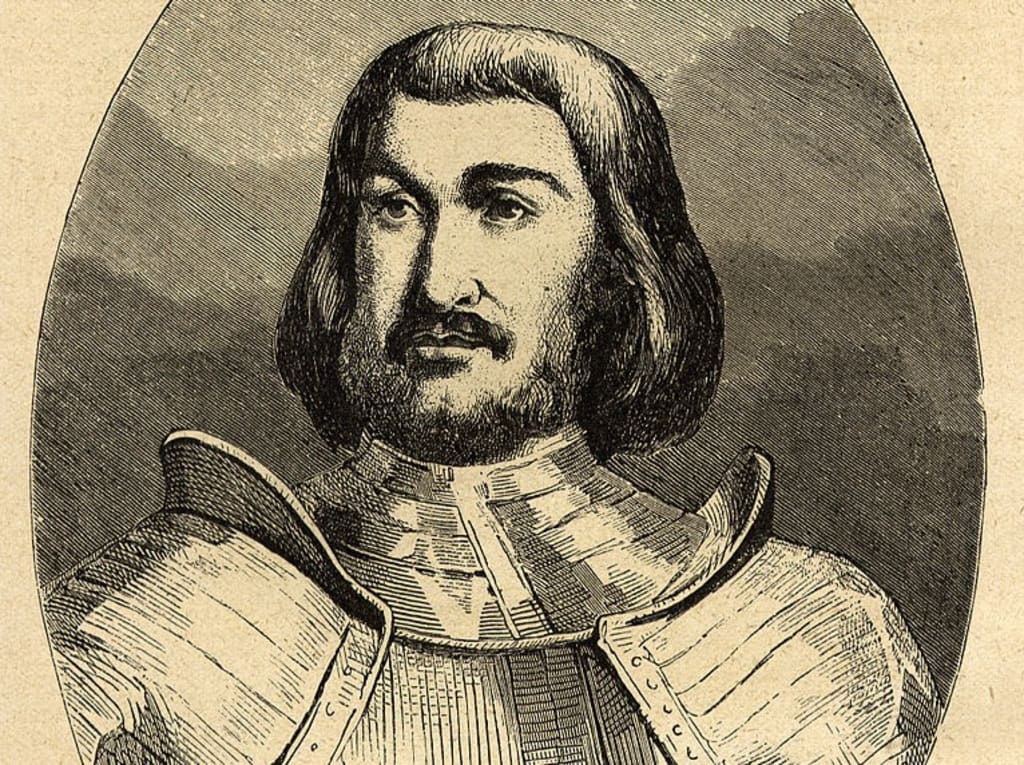
Gilles de Rais has the dubious honor of being part of the long list of "infamous" characters that make up black history. Along with figures such as Vlad Tepes or Erzsébet Bathory, who were considered monsters even in times when living with horror was commonplace, Gilles de Rais was defined by his own contemporaries as a serial killer, pederast, sadist, sodomite and heretic, even though he belonged to the nobility of 15th century France.
Many historians have branded Gilles de Rais as a spoiled and empowered child, a man whose evil deeds inspired 17th century French author Charles Perrault to write his fairy tale Bluebeard. Of his capricious and impulsive way of acting he himself would attest during his trial, when he declared that "one gets tired and bored of the ordinary. I started killing because I was bored and continued because I liked to let off steam".
Childhood
In the icy autumn of 1404, in the Black Tower of the castle of Champtocé (Anjou), Gilles de Montmorency-Laval, Baron de Rais, was born of Champtocé (Anjou), Gilles de Montmorency-Laval, Baron de Rais, was born.
His blood was one of the noblest in France, for in him were united three of the most noble French bloodlines: the three of the oldest French lineages: the Montmorency and Laval on his father's side and the Craon on his mother's side. Craon on his mother's side. To this it should be added that his noble progenitors were also immensely
were also immensely wealthy, for the fortune they possessed separately was increased by their union. separately was increased by their union. During his early years, his education and and upbringing (along with that of his only brother René) were in the hands of tutors and governesses, in the face of the neglect and and indifference of his parents; he because he was busy all the time in his war campaigns. because he was busy all the time in his war campaigns, and she because she simply never never wanted to have anything to do with her children. However, his education was painstaking and he soon mastered reading, Latin soon mastered reading, Latin and Greek.
In 1415 his father, Guy de Rais, was mortally wounded by a wild boar during a day of hunting. He was taken to his chambers, requesting the presence of Gilles, his eldest son. The latter not only showed no pity, but seemed to delight in the image of his father's viscera scattered on the bed. During the days of his agony, Gilles did not leave his father's deathbed, and never ceased to contemplate the macabre scene with indifference. Finally Guy de Rais died, arranging as last will that his cousin Jean Tournemine de La Hunaudaye took charge of the guardianship of his children.
However, ignoring the will, their maternal grandfather, Jean de Craon, took charge of the two brothers. Jean de Craon who took charge of the two brothers. His motivation was not so much love for his love for his grandchildren but the immense fortune they possessed. De Craon had amassed his wealth through banditry and was a violent and immoral person who was unconcerned moral who was unconcerned with the care of the children. Thus, while his teachers his teachers strove to inculcate in the little ones an interest in science and letters, their grandfather left them to their own free will. As an example of the bad influence influence he exerted on Gilles is what the latter would say years later about him. him:
His mother died soon after, leaving his grandfather free to do and undo as he pleased with the fortune of his grandchildren. At first, de Craon showed more interest in his younger brother René than in Gilles, whom he almost totally disregarded, so the latter sought refuge in the immense library of his grandfather's castle. There he passionately read Suetonius' Life of the Twelve Caesars.
He admired the way in which Tiberius, Caligula and Nero carried out with impunity all kinds of crimes and orgies, which made a great impression on him. Undoubtedly, this book had an enormous influence on him, this book had an enormous influence on what was to follow.
First murder
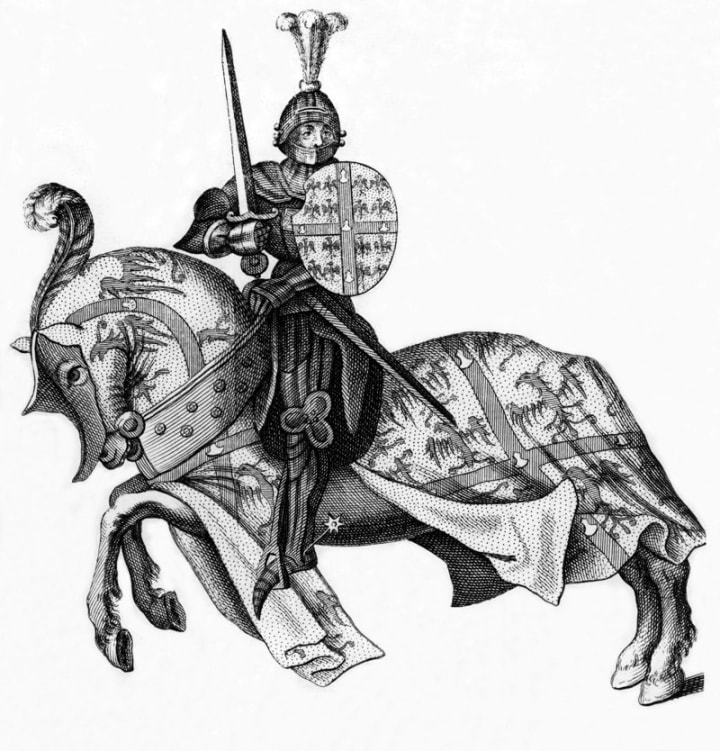
Gilles de Rais showed from an early age a great expertise in everything he undertook. However, he also soon showed signs of an egocentric temperament and a rebellious character that made him always want to impose his will on all those around him. He excelled enormously in the handling of weapons, something that would be very useful to him when some years later he participated in the different wars that were happening around him. around him. At the age of 14, his grandfather gave him a splendid white armor Milanese white armor while granting him the distinction of knighthood. It was his first official ceremony
It was around that time that he committed his first murder. The victim was named Antoine and was the son of some servants of the castle. Gilles Gilles challenged him to a duel in the spirit of playing together, and in the course of it and in the course of the duel he plunged his sword into Antoine's neck. Gilles, instead of asking for help, watched with delight as his friend bled to death on the ground. The incident was The incident was quelled with a meager compensation to the dead young man's family. After all, Gilles was after all, Gilles was a nobleman who had accidentally killed a commoner, so it was to be expected that he would get off scot-free. so it was to be expected that he would get off scot-free in the whole affair.
At the age of 16, Gilles' physical appearance was truly impressive. imposing. He was over six feet tall, muscular and broad-shouldered. He possessed great agility of movement and an innate natural elegance. The was completed with large blue eyes and wavy black hair. black hair. No doubt it would not be a problem to find a wife for him, given his fortune and beauty. fortune and beauty. However, there was one thing that made it difficult: Gilles was a homosexual. a fact that his grandfather noticed when he caught him red-handed with some pages and even with his grandfather's wife. with some pages and even with his own cousin. So, de Craon began to desperately look for a desperately looking for a candidate to marry his grandson. The first one he found was a wealthy heiress of four years of age, but the whole plan was thwarted when, at the protest of the local nobles, the Parliament of Paris forbade the wedding, and the banned the wedding
wedding
At that time Gilles had his baptism of blood. He placed himself under the command of John V, Duke of Brittany, in the throes of the war of Breton succession between the Montforts and the between the Montforts and the Penthièvres. The chronicles narrate that Gilles always fought in the vanguard with his soldiers, riding his favorite horse, Noisette, and Noisette, his favorite horse, showing great bravery and above all an unusual violence. unusual violence. He seemed to have no fear of death, and his comrades-in-arms admired him because he always admired him because he always seemed to fight as if possessed. He liked to heads and his armor invariably ended up bathed in blood. The soldiers followed him enthusiastically into battle, and he distinguished himself as a great military leader. military leader.
A year later and once he had returned from the campaign, Gilles found that his grandfather had finally found the ideal candidate to marry him. to marry him. It was his neighbor and cousin Catherine de Thouarscon, 15 years old.
Thouarscon, 15 years old. The girl's family refused the marriage, so grandson and grandfather abducted her and Gilles married her on the same day, April 24, 1422. April 24, 1422. To a large extent, the grandfather's choice was motivated by several castles owned by the young woman's family, which, together with his own, would make them the richest family in the world. would make them the richest and most powerful family in France. However, Catherine's Catherine's family did not accept the marriage union and flatly refused to give these castles as part of the marriage. those castles as part of the dowry. Demonstrating that he was not messing around, Gilles kidnapped Gilles also kidnapped his mother-in-law shortly thereafter and kept her locked up on bread and locked up on bread and water until the young woman's family gave them up. The couple had a daughter, Marie, in 1429, although Gilles never showed much interest in his wife. interest in his wife. Catherine, with her daughter in her arms, finally fled to one of her father's castles. her father's castles without Gilles putting too much effort into recovering them. to get them back.
The Dark Circle Of Gilles De Rais
Alone in his castle, separated from his wife and daughter and surrounded by a court of sycophants, Gilles made a firm promise surrounded by a court of sycophants, Gilles made a firm promise to himself never again carnal contact with women and indulged in the most notorious excesses and wastefulness. excesses and squanderings. For example, he was enraptured by Gregorian chants and if he heard of a beautiful voice, he would not rest. news of any beautiful voice, he would not rest until he got its possessor to sing before him. to sing before him.
The sound of the organ produced in him such a religious alienation that he had some portable ones built to accompany him in the slightest movement. transfer. Everyone who came to him was treated with generosity, had a table at any time of the day or night. table at any hour of the day or night, and it was rare for him to leave his castle without being without being showered with gifts in kind or in cash. He also had bird-shaped bird-shaped automatons, something extremely expensive.
He spent an enormous fortune on the theatrical representation of the campaigns campaigns carried out with Juana. Particularly onerous was the one he staged in May 1435 for the in May 1435 on the capture of Orleans, in which more than 150 actors took part, the costumes were actors, the costumes were luxuriously worked, the infantry was in authentic armor and there were armor, and there were large tableaux simulating crowds. Admission to the to the show was free and all attendees were treated to large quantities of food and wine. food and wine. All in all, some 80,000 crowns of the time were spent on the crowns of the time.
Because of all this squandering, his fortune began to dwindle. He borrowed money from moneylenders at usurious interest rates and, in order to pay, began to sell property at ridiculous prices. Soon his family became frightened at how quickly Gilles was squandering everything he had and asked the King to intervene. the King to intervene. Among the documents provided was a memorial stating that his immense estate would be gone in less than 8 years. Charles VII agreed and in 1436, certain of how badly the Lord of Rai was governing, forbade him in his Grand Council and by letters dated Amboise to sell or alienate any castle, fortress or land, fortress or land. No one then dared to buy anything from Gilles for fear of arousing the King's wrath, so he soon found himself without liquidity to be able to continue the luxurious life he was leading.
Faced with this situation, Gilles de Rais turned to esotericism and alchemy, convinced that he could replenish his coffers and alchemy, convinced that he could refill his coffers by finding the philosopher's stone. through the discovery of the philosopher's stone. He surrounded himself with a court of necromancers, witches and alchemists who assured him that they could manufacture gold and make him the make him once again the richest man in France. Finally, he fell into the hands of a Florentine trickster named Prelati, who assured him that he was in dealings with the Devil himself. the Devil himself. The latter assured him that only by sacrificing innocent blood would he once again achieve his dream of becoming rich again.
So it was that the servants of Gilles de Rais began touring towns and villages looking for children and adolescents and promising their families that they would make them pages of the castle. Sometimes, de Rais himself would personally visit the homes of the families to kindly assure them that the children would have a promising future. The victims were never heard from again and when the relatives asked, they were told that they were fine. He also took advantage of the fact that many children came to his castle to beg for alms to make them pass and disappear forever. Soon the alarm began to spread and de Rais was forced to resort to kidnappings. Up to 1,000 disappearances of children between 8 and 10 years old were counted in Brittany and Gilles de Rais was involved in many of them
In addition to the castle of Tiffauges, he used others for his misdeeds, such as Machecoul and Champtocé. The madness came at nightfall, when de Rais and his henchmen dedicated themselves to torturing and killing the children they had previously kidnapped. After each bloody night, Gilles de Rais would go out at dawn and wander the streets and forests alone, sobbing in repentance as his henchmen cleaned the rooms and burned the corpses. Fear took hold of the villages, whose inhabitants had baptized de Rais as Blue Beard as the dawn light gave bluish tones to his black beard, and his servants were forced to widen their field of action, so that fear spread more and more.
Arrest, trial and execution
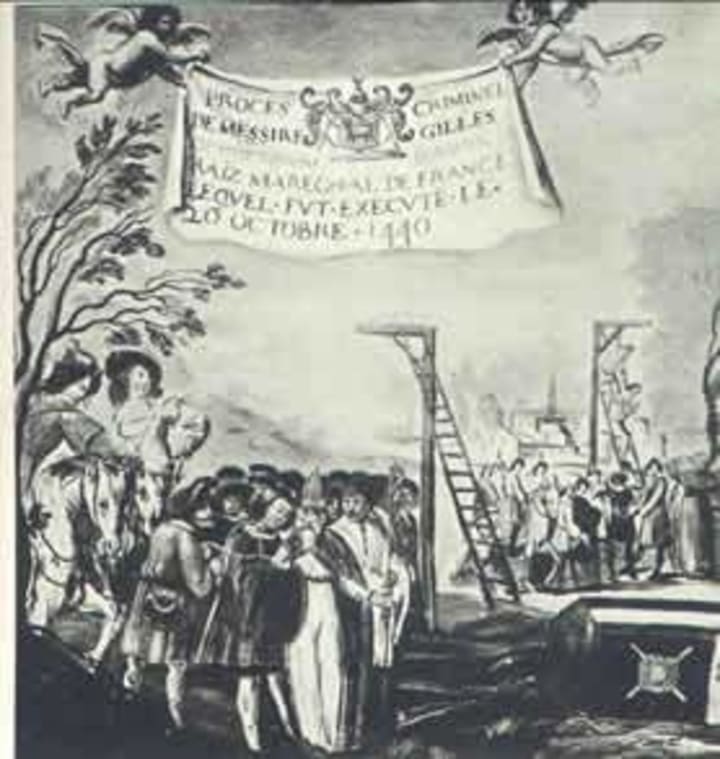
Everything came to a head in 1440, when de Rais sold one of his last possessions, the castle of Saint-Etienne-de-Memorte, to the treasurer of Jean de Rais. last possessions, the castle of Saint-Etienne-de-Memorte, to the treasurer of John V, Geoffroy de Farron, who put his brother Jean V, Geoffroy de Farron, who put his brother Jean, an ecclesiastic, in charge of the possession. the possession. However, shortly after de Rais learned that his cousin the lord of Villecigne wanted to of Villecigne also wanted to buy it from him for a larger sum, so he asked Farron to cancel the Farron to cancel the sale. When the latter refused, he attacked the church where Jean de Farron was officiating mass and kidnapped him, taking him to the castle of Tiffauges. Tiffauges. When the Duke of Brittany and the bishop of Nantes heard the news, an armed Nantes, an armed party was sent to rescue the kidnapped man. De Rais, who was then in the castle of Machecoul, was captured on September 15, 1440. September 1440. The surprise came when in the castle they found the bodies of 50 teenagers in the castle. Inquiries began to be made and the result was that the Duke of Brittany brought Gilles de Rais to justice accused of having killed and tortured between 140 and 200 children in diabolical practices.
Two trials were held against him, one religious, where he was accused of Satanism and witchcraft, and the other civil, where he would have to answer for his death. of Satanism and witchcraft and another civil one, where he would have to answer for the death of the children. of the children. The minutes of these trials are still preserved, and allow us to have a detailed knowledge of what happened in them. a detailed knowledge of what happened in them. At first he pleaded but in the face of the avalanche of testimonies and confessions of his accomplices (who were tortured) and the (who were tortured) and the threat of excommunication, he finally confessed his crimes. crimes. It was a tremendous and meticulous confession of the acts that he had during his 8 years of terror, and such was the horror of the confession that during the trial one of the confession that during the trial one of those present covered the crucifix that presided over the courtroom out of shame. the courtroom because of the shame provoked by his words. The murder of 200 victims was murder of 200 victims, although there were probably many more. During his confession, he proclaimed his deep repentance and asked for forgiveness from the families of the victims. of the victims
On October 25, 1440, the ecclesiastical court issued a sentence of excommunication against him and the civil court decreed capital punishment. sentence of excommunication against him and the civil court decreed capital punishment. His gang was also punished. Francesco Prelati, alchemist and priest of the marshal, was marshal, was given a sentence of thirteen hundred gold crowns and life imprisonment in a Church prison, receiving periodic physical punishment and a diet based on bread and water. a diet based on bread and water. This punishment did not last long, since the Duke of Anjou took him out of prison, attracted by his alchemist arts. Perrine Martin, the only woman in the group, committed suicide in prison. Gilles' two other assistants were condemned to Gilles' two other assistants were condemned to the gallows and the stake. On October 26, Gilles de Rais was taken to the Madeleine meadow in Nantes to be hanged, after having refused the royal pardon (grace that was granted to him being a great of France). of France). Because of the repentance shown at the trial, his remains were only partially burned and were partially burned and received burial in the convent of the Carmelite nuns of Nantes, in Carmelite convent in Nantes, at the request of Baron de Rais himself.
Thus died at the age of 36 one of the greatest serial killers in history, a bloodthirsty monster whom only a mistake allowed to be captured. a bloodthirsty monster whom only a mistake allowed to be captured. In 1695, Charles Perrault turned the story of Gilles de Rais into a fairy tale, Bluebeard, where he replaced children with women as victims. replaced children with women as victims. This tale is found in the anthology of French folk tales Tales of Mother Goose.
The story of Gilles de Rais is a tragic and grim narrative that combines elements of medieval nobility, moral decadence and extreme cruelty. His life is a reminder of how power, wealth and impunity can corrupt even the most influential people. Although initially a brave and respected soldier, his transformation into a serial killer and depraved man is a shocking example of the extremes to which human depravity can go.
The legend and mystery surrounding Gilles de Rais continues to fascinate historians, writers and lovers of the macabre to this day. His case has also served as a warning about the dangers of abuse of power and lack of oversight in any era of history. Ultimately, the story of Gilles de Rais is a grim reminder of the capacity of human beings to commit heinous acts when they stray from the path of morality and ethics.
About the Creator
diego michel
I am a writer and I love writing
Keep reading
More stories from diego michel and writers in FYI and other communities.
Epic battle between emos vs. darketos in mexico city 15 years ago
Mexico City, known for its rich cultural history and diversity, has also witnessed various subcultural movements that have left an indelible mark on its social landscape. One of the most notable episodes in this regard was the "Battle of Emos and Punks," an event that captured the attention of public opinion and became a symbol of the tensions and contrasts within the urban society of the Mexican capital.
By diego michel2 years ago in FYI


Comments (1)
What a great history of the knight killer!