
The Salem Witch Trials: Fear and Hysteria in 17th Century New England.
Religious paranoia and the fatal consequences of superstition

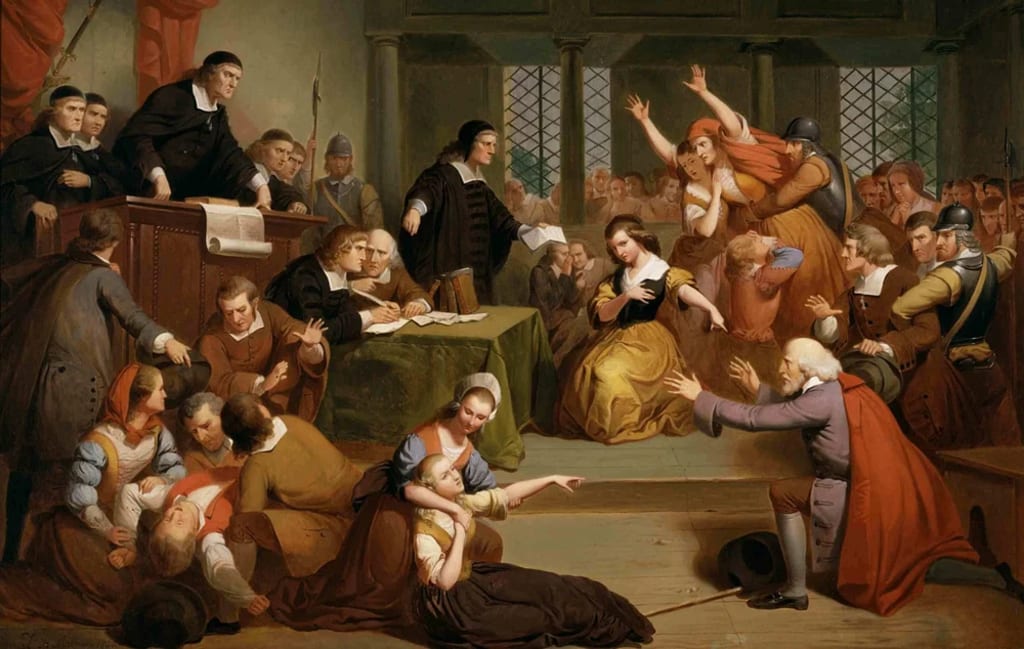
Colonial belief in witchcraft
Legal documents and testimony of the time establish that there were a number of citizens who did not believe in witchcraft, but the majority-both in the New England colonies and in the English colonies of the middle and southern colonies-certainly did. This belief was encouraged by the Bible through stories such as the Witch of Endor (I Samuel 28:3-25) and the line from the Book of Exodus mentioned above. The Bible was understood as the unequivocal word of God and made it clear that witches were as real as anything else; to question the existence of witches meant questioning the divine authority of the Bible.
Belief in witchcraft was fostered by the need to explain the seemingly inexplicable. If a pious person, a child or a young bride suddenly became ill or died, it could be attributed to the mysterious will of God, but it could also be easily explained by witchcraft and the workings of the devil. While it may seem strange and irrational to a modern audience, this belief was also supported by the colonists' interpretation of everyday experience.
However, belief in witches did not originate in the colonies, as England - and Europe in general - had been persecuting those accused of witchcraft for centuries. One of the most famous witch trials in English history was that of the Pendle witches in 1612, in Lancashire, which ended with the hanging of ten people convicted of witchcraft. The records of the trial were published in 1613 and were widely read, and the case was popularized again in 1634 when one of the accusers was herself accused of witchcraft.
Witchcraft and puritanism
Reverend Samuel Parris had moved from Boston to Salem with his children, Thomas, Elizabeth and Susannah, plus his niece Abigail Willians, who had lost her parents, killed by the Indians. With them lived a slave girl named Tituba, along with her husband, John Indian, who took care of the children. Reverend Parris was obsessed with winning the love of God and the respect of the inhabitants of Salem. But his poor ability in dealing with his family, to whom he imposed an iron discipline, and his distrustful and arrogant character, made him feel singled out and harassed by his neighbors.
In February 1692, some strange events began to occur in the small town of Salem, nestled among swamps and inhabited by Puritan workers. Disturbing accounts of profanity, curses and scandalous visions of naked girls lighting candles in a forest clearing while summoning supposed demons and lewdly rubbing their bodies against each other put all the townspeople on alert.
Tituba, the Parris family's black slave, liked to tell mysterious stories to the reverend's daughters and their friends, as well as practice old voodoo rituals. Often, these ancestral stories and rituals clashed with the puritanical morals of those children and began to spark the imaginations of teenagers Betty Parris and Abigail Williams. One day, they were caught dancing naked in a forest while Tituba performed voodoo rituals from her homeland of Barbados over a cauldron.
Indications
According to the chronicles of the time, the two girls began to suffer convulsions in public, to utter nonsensical words and phrases, to burst into sudden crying for no apparent reason, and to engage in “bestial behavior.” In fact, it is quite possible that the two girls were trying to hide their sexual games, which were soon joined by Ann Putnam, a 12-year-old daughter of one of the wealthiest families in town. In fact, Ann recounted that once while in the woods, “I fought a witch who wanted to behead me.”
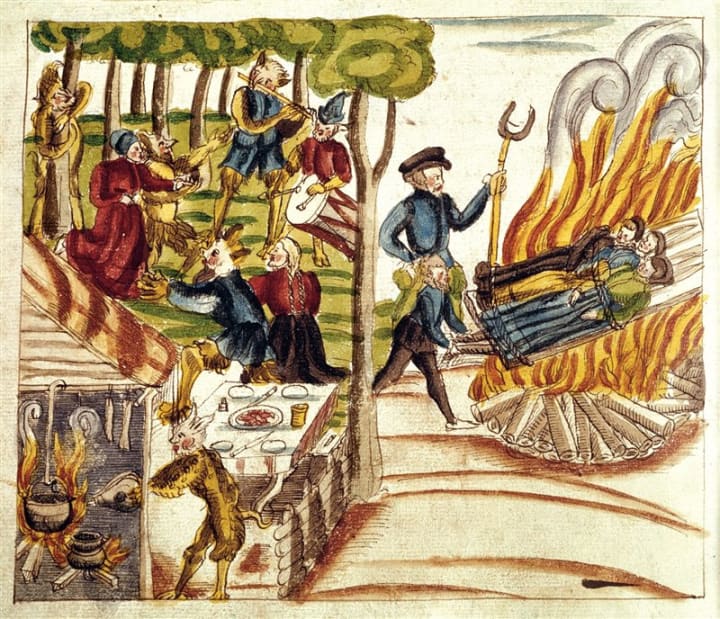
“There is no physical problem that causes that behavior. There is no doubt that it is the direct influence of the devil”. With these words William Griggs, the Salem doctor, diagnosed the girls affected by such strange “ailments”. The entire population of Salem, including Reverend Parris, believed in witches and that they were the cause of the girls' strange behavior. To avoid hanging, the girls accused Tituba of initiating them into satanic rites. It is curious that the method used to confirm the witchcraft case of the two girls was that the slave's husband, John Indian, prepared a concoction of rye flour and baby urine and gave it to a dog to drink. If the poor animal developed the same symptoms as the alleged bewitched girls, the diagnosis would be confirmed.
The Salem Witch Trials
Sarah Good was a homeless woman who often begged and had been taken in by Samuel Parris for a short time until he threw her out for “malicious conduct” and ingratitude. Sarah Osborne was a wealthy landowner who had not attended church in over three years, citing a recurring illness, making her as much an outcast as Good. Tituba was possibly an Arawak of Caribbean origin who was kidnapped, enslaved and sold to Samuel Parris in Barbados, where her family had a plantation. She was the family's domestic slave and cared for the children, whom she used to entertain with ghost stories and tales of demons and magic.
Tituba confessed (later revealing that Samuel Parris had beaten the confession out of him) and supported the girls' accusation against Good and Osborne. Good, as noted, was already despised by the Parris family and Osborne, because of his land dealings, had adversely affected the finances of Ann Putnam the Younger's father. Tituba popularized the concept of witches who rode broomsticks and conversed with “familiars” - spirits in animal form - as well as associating with demonic figures and casting malicious spells. Osborne was hanged as a witch in May and Good in July 1692, maintaining her innocence to the end; Tituba, as she had confessed, was placed in jail because Parris refused to pay the fee that would have freed her. She was finally sold for the price of the jail fees and disappeared from history.
However, the accusations against the three marginalized women in February 1692 were only the beginning, as more were charged in March. Two of them, Martha Corey and Rebecca Nurse, were members in good standing in the church. Corey had questioned the validity of the girls' accusations, implying that they were lying for personal reasons, so she was accused of being a witch for denying the existence of witches. Nurse was accused by the Putnam's, who claimed that her “specter” was harassing them. The use of “spectral evidence” was admissible in the courts, as the concept had been addressed by the respected Puritan theologian Cotton Mather (1663-1728), whose works were especially popular among Massachusetts citizens.
Spectral evidence consisted simply of accepting the word of an accuser over that of the accused, as in the Martha Corey case, in which the girls screamed in court that their specter haunted them and that a yellow bird, invisible to all but them, fed from their hand. Nurse and Corey, both in their 70s, were hanged. Their convictions further exacerbated the hysteria, for if two elderly religious women of good character could be witches, anyone could be. Corey's husband, Giles, was accused when he defended her. He refused to stand trial and was put to death under pressure - crushed to death by weights - to extract a confession of guilt. Since he never confessed and was never convicted, her last will was carried out and her lands passed to her heirs, as she intended, rather than being taken by the Putnam family who had accused her.
Although spectral evidence was admitted in court mainly because of the weight of Mather's reputation, even he began to recognize that he was going too far and wrote to one of the judges in May 1692 to give no further credence to spectral evidence of reasonableness. According to the biblical book of I John 4:1, all spirits needed to be tested to see if they were from God or the devil and it was possible that evil spirits were influencing the accusers to condemn innocent Christians. Many of the accused confessed to being witches in the hope of obtaining clemency according to James 5:16, “Confess your sins to one another, and pray for one another, that you may be healed,” but those who were not hanged or did not die in prison later recanted, explaining that they had only confessed for this purpose and had never really been witches. Levack points out:
Once the spectral testimony began to be attacked and the confessors began to recant, the court found itself in an extremely awkward position.... As the court's eagerness to convict collided with a growing chorus of opposition to its proceedings, the governor felt he had no choice but to suspend the trials and reevaluate the situation.
In May 1693, trials were suspended and pardons were granted to those still in jail. Although it is well documented that 19 people were hanged and Giles Corey was crushed to death, others died in jail awaiting trial, and more than 200 had their reputations damaged, if not irreparably ruined. The accusers were never held accountable because no one doubted the reality of the witches and their power to harm, nor of Satan and his ability to deceive in order to destroy. When the hysteria died down, the accusers went on with their lives as before.
the damage
As noted, those who had been accused and pardoned were not so lucky and continued to live with the stigma of the event or moved elsewhere. Three years later, in 1696, the General Court decreed a day of fasting and repentance for the trials on January 14, 1697. The judges who had participated in the trials publicly repented and asked for forgiveness from the community. Beginning in 1700, family members petitioned the Massachusetts colonial government to overturn the convictions and, in 1711, 22 people were exonerated and financial compensation was authorized. This pattern continued for the next ten years, but even then not all of the convicts were exonerated. In fact, the names of all those convicted were not made clear until 2001.
The Salem Witch Trials, the most infamous event of its kind, have spawned a number of myths from the time they began to be written about around 1700 to the present day. One of the most persistent is that “witches” were burned at Salem, although there is no evidence to prove it. No “witches” were burned in Salem; they were all hanged. Until recently, it was thought that the condemned were hanged on Gallows Hill, evoking images of a grim death march down the hill to the execution site, but the 2017 Gallows Hill Project debunked this myth, establishing that the hangings took place at the bottom of the hill in the much less dramatic area known as Proctor's Ledge.
It has also been claimed that most of the accused were poor and marginalized women, but this too has been questioned and discredited. People from all walks of life were accused and convicted, women and men - and, indeed, two dogs - for whatever reason. George Burroughs, the second minister to resign in Salem Village, was accused and convicted because he appeared to possess unnatural strength, another woman was convicted because she was able to walk the dusty streets of Salem Village without soiling her clothes, and Martha Corey, as noted above, was executed as a witch for denying the existence of witchcraft.
Over the years, many theories have been suggested to explain the Salem witch hysteria and trials. One theory, popularized in the 1970s, is that the colonists were poisoned by ergot fungus in their rye crop in 1692, which caused them to hallucinate, but this does not explain the continuing hysteria throughout 1693 or the fact that there were many who still believed in the witches and the justice of the later trials. Witchcraft trials had been held before 1692 and would continue to be held thereafter throughout the colonies. Class friction between Salem Village and Salem Town has also been cited as a possible cause, but, although these added to the tensions of the time, they did not actually cause the hysteria. Of the first persons charged, only Osborne had Salem Town connections, the other two were from Salem Village
The most likely cause of the witch hysteria of 1692-1693 in Salem was religious belief coupled with social tensions. No one will ever know what led the girls to make the accusations that sparked the panic, but once made, they confirmed what the colonists already believed. The play The Crucible, by American playwright Arthur Miller, presents the Salem witch trials as an allegory for the McCarthy hearings of the 1950s, which were intended to eradicate communism in the United States. In this work, Miller called attention to the dangers of ideologies that rely on confirmation bias to thrive. In both cases, the accusers relied on the belief that there were threatening agents in their midst from whom they must defend themselves. Massachusetts residents already believed in witches because the religion of colonial America encouraged it; they did not need ergot or anything else; all they needed was a physical manifestation of what they feared to confirm what they already knew to be true and act accordingly.
About the Creator
diego michel
I am a writer and I love writing
Reader insights
Nice work
Very well written. Keep up the good work!
Top insights
Compelling and original writing
Creative use of language & vocab
Eye opening
Niche topic & fresh perspectives
Keep reading
More stories from diego michel and writers in FYI and other communities.
The Dark Fascination of Ilse Koch: The Story of the Witch of Buchenwald
The woman, who unleashed all her cruelty in that place where some 56,000 prisoners were murdered - according to figures provided by the Holocaust Museum - was indicted for war crimes at the end of the world conflict and sentenced to life imprisonment. In 1967, she committed suicide in prison. She would go down in history as one of the most bloodthirsty and ferocious women in the already terrifying Nazi criminal machine.
By diego michel2 years ago in FYI


Comments (1)
Thanks for this piece and historical!