
The Past Life of Jewish Immigration to the United States
This article talks in detail about the history of Jewish immigration to the United States and the current state of Jewish-American life.

An overview of Jewish ancestry
Because the Jews have been migrating for 2,000 years and are now scattered all over the world, after a long period of mixing and intermarrying with local peoples, the Jewish people now have a biologically diverse lineage. They have divided centuries ago into Sephardic Jews, German Jews, and Eastern European Jews.
Jews mixed in Europe for more than 1,000 years, and then with the great wave of European immigration to the Americas, a large number of them immigrated to the United States, a significant portion of which was persecuted because of World War II, which in short gave birth to American Jews again. On the other hand, the Israeli population continued to grow from the 19th century with the rise of the Restoration Movement until the successful restoration of Israel in 1948. The global return of Jews to the Palestinian areas led to a new mix in the lineage of Jews in present-day Israel. If one looks at the Jewish people as a race with a global perspective, they are already diverse in their lineage.
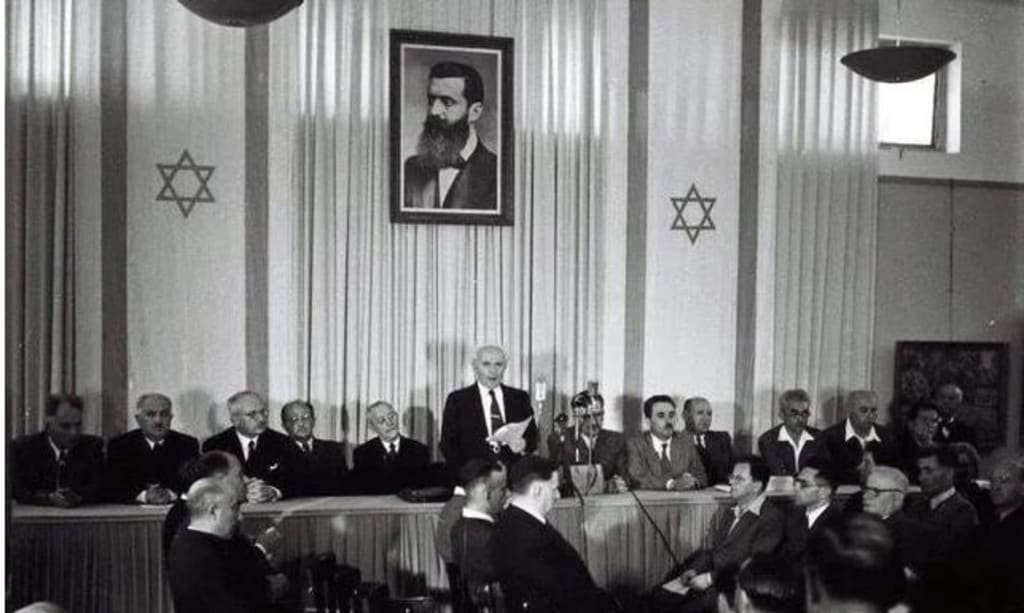
On May 14, 1948, David Ben-Gurion proclaimed the State of Israel
Even then, the Jewish people had their way of defining themselves within the nation; according to traditional Judaism, a person who holds the Jewish faith and whose mother is Jewish can be called a Jew. Of course, there is also a broader way of identifying a person who is of Jewish ancestry or who has converted to Judaism. So the concept of Jewishness in the broadest sense is not only the inheritance of lineage, but also the sharing of beliefs, racial and spiritual identity, and similar habits of life.
The infamous Nuremberg Act (an anti-Semitic law enacted by Nazi Germany in 1935) defines a person as "legally Jewish if all or three of his four grandparents are Jews. If only two or one of a person's grandparents are Jewish, that person is of mixed race." It is anti-humane and disapproved of.
So there is a reason why the Jewish identity of Chinese Kaifeng Jews is not recognized by Israel because the Israeli Law of Return judges Jewish identity according to the traditional method of defining Jewish identity by matrilineal succession. The Kaifeng Jews, on the other hand, are deeply influenced by Han Chinese culture, and their bloodline is determined by patrilineal transmission.
In fact, there are controversies within the Jewish community regarding the criteria for the identification of Jews, such as
1. Orthodox Judaism and Conservative Judaism define whether a person is Jewish or not by the criterion of whether his mother is Jewish or not, and if his mother is Jewish whether her children are Jewish or Christian or atheist her children are also recognized as Jews. This criterion was adopted by the Israeli Law of Return.
2. The Karaite minority of Judaism is defined oppositely, as the Karaite considers the children of a Jewish father to be Jewish. Because the number of Karaite Jews is so small, the Karaite view is often ignored by outsiders.
3. The liberal and Reform view is that the children of a Jewish mother or father are Jews as long as they are raised according to Jewish customs.
The Karaite faction is not mentioned, but the group of Jews who immigrated from Germany to the United States was the Reform faction, which is described in more detail below.
So what happened to the Jews who immigrated to America?
Although almost all of the ancestors of present-day American Jews came from Europe, they did not come from the same period, nor the same place, and there was even a great exclusion within them.
Jewish immigration to the United States can be roughly divided, chronologically, into three broad phases.
The first phase of Sephardic Jewish immigration.
The second phase of German Jewish immigration.
The third phase of Eastern European Jewry.
Sephardic Jews who immigrated to the United States
The earliest Jews to arrive in the North American colonies were the Sephardic Jews, a branch of the Jewish people that made up about 20% of the Jewish population. They historically settled for a long time in the Iberian Peninsula.
Spain and Portugal on the Iberian Peninsula are the home of Sephardic Jews
Sephardic Jews differ from other European Ashkenazi Jews not only in their religious practices but also in their language. They speak Ladino, a Jewish variant of the old Castilian Spanish, which is related to the fact that Sephardic Jews were expelled from the Spanish crown in 1492.
Ashkenazi Jews, on the other hand, refer to the descendants of Jews who originated in medieval Germany around the Rhineland, with Ashkenazi referring to Germany in modern times. Many of them migrated to Eastern Europe from the 10th century to the 19th century. From the Middle Ages to the mid-20th century, they generally adopted Yiddish or Slavic languages as their lingua franca, and their cultural and religious practices were influenced by the surrounding countries. German Jews and Eastern European Jews, to be mentioned later, are descendants of this group of Jews.
In the same year that the Sephardic Jews were expelled from Spain, Columbus discovered the New World of America. Of course, they did not go directly to America, but after being expelled by the Spanish crown, they first settled in neighboring Portugal, where the Portuguese also began a policy of exclusion for a long time. Some went to Holland, France, Algeria and even England. The Sephardic Jewish community of Amsterdam, Netherlands, once helped make the Netherlands a top international financial center at one point in its history.
In the late 15th and 16th centuries, with the impact of Columbus' discovery of the New World, Europeans flocked to the Americas, and some of these ships bound for the Americas were Jews forced to convert to Christianity to escape persecution.
By the 17th century, Sephardic Jews, who had the advantage in technology, knowledge, and wealth, became the first inhabitants of the Americas with the Dutch colonists. With the recapture of Brazil from the Dutch by the Portuguese, Jews here had to migrate to North America.
This was even though medieval England was the first country in Europe to implement a policy of complete exclusion of Jews. After the restoration of the Stuart dynasty in 1660, Charles II continued Cromwell's policy of "acquiescence" to Jewish immigration. This period saw the first immigration of Sephardic Jews, who were persecuted by the Spanish religion. After the Glorious Revolution, Ashkenazi Jews from Central and Eastern Europe also began to arrive in England.
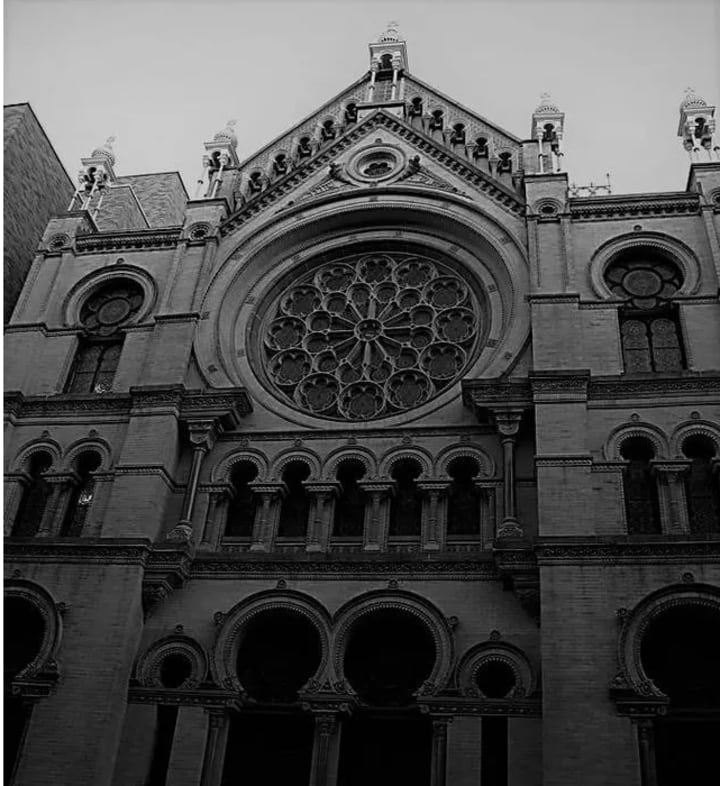
The relatively liberal policies of the British colonies in North America and the long-standing rejection of Sephardic Jews in the Iberian Peninsula led to a small number of Sephardic Jews choosing to settle in North America. In 1695, they built the first synagogue in North America in New York.
During the American Revolution in the latter half of the 18th century, Sephardic Jews were wealthier, and at that time they looked down on the Ashkenazi Jews in America and did not want their descendants to intermarry with Ashkenazi Jews. This stemmed from the cultural differences between their places of residence for thousands of years and the slight differences in religious rituals that made the two groups even more at odds in Europe.
Sephardic Jews were good businessmen, but their average IQ was not as good as that of Ashkenazi Jews, and their academic and scientific achievements were not as good as those of Ashkenazi Jews, both in what is now the United States and in Israel. It is as if descendants of those who have been baptized by the culture of the Iberian Peninsula become a bit more foolish, no matter what race, as you can see by looking at the overall gap between South America and North America today.
Coming to North America after the Sephardic Jews were Jews from Germany, who, along with those from Eastern Europe, were Ashkenazi Jews.
They differed from the Sephardic Jews in their religious prayers, although they followed the prayers of the Sephardic Jews for a time when they first arrived in America because they were so few at that time.
As the number of German Jewish immigrants to the United States increased and they gradually formed their own communities, they began to do back to Ashkenazi prayer services.
These Jewish immigrants from Germany differed considerably in social status from their Sephardic predecessors, who were by then well-established and relatively affluent in America.
In any case, however, Jewish immigration from Germany greatly expanded the number and structure of Jews in America.
Jews went from over 2,000 in number at the time of the War of Independence to over 500,000 in the late 19th century, largely contributed by Jewish immigrants from Germany.
German Jews did not prefer to live in groups as did Sephardic Jews and later Eastern European Jews. They were more scattered throughout the United States, working primarily in retail and professional and technical jobs, preferring to settle in German communities everywhere they chose.
There were also German Jews who followed the caravans to conquer the American West, including Levi Strauss, who in 1853 took advantage of the California gold rush to go to San Francisco and subsequently founded Levi's, a famous brand of jeans.
Many German Jews, like Levi Strauss, liked to go into business selling small goods. Many Jewish gentries started in this way, such as the Guggenheim family.
By the middle of the 19th century, the Jewish community had become an integral part of American society, and most of them were German Jews. By the time of the American Civil War, more than 50 synagogues had been built in New York.
By the end of the 19th century, there were several thousand Jewish business firms of some size in the United States. Companies like the famous Macy's and the New York Times were acquired by German Jews in their early years.
In the mid-19th century, 40% of German Jewish households employed at least one servant. By this time, only 1% of Jews were engaged in small second-hand businesses, and less than 1% were doing manual labor.
But the largest migration of Jews to the United States began in the late 19th century with the Eastern European Jewish immigrants who are the ancestors of most American Jews today.
In the 18th century, Poland and other parts of Eastern Europe were occupied by Russia, and for the next century or so Jews were treated coldly and ostracized here. The only czar who treated Jews well was Alexander II, but unfortunately, he was assassinated in 1881, and after his death, his son repeated the same mistake and intensified his oppression of Jews.
In the 40 years between the end of the 18th century and the beginning of the 19th century, one-third of Eastern European Jews immigrated to the United States, numbering as many as 2 million. Almost all of the Jews who immigrated to the United States during these 40 years came from Russia, but of course, they were driven to America by the Russians. This group of Eastern European Jews had the lowest return rate of any ethnic group to the United States, meaning that almost all of them stayed and settled in the United States.
The same history will repeat itself, in a country of rising immigrants, the old immigrants who arrived first and got a firm foothold always seem to look down on the new immigrants who just set foot here, even if they are the same kind of people, not only the Jews will do so?
The German Jews who had established themselves, like their Sephardic predecessors, looked down on the Eastern European Jews who had arrived at the beginning.
For, from Eastern Europe, there was a tidal wave of Jewish immigrants to those communities founded by German Jews. They were heavily concentrated in New York. At that time, New York was the city with the highest concentration of Jews after the Jews were driven out of the Palestinian area by the Romans in the 1st century AD.
The German Jews were ashamed of these large, poor, poorly educated Eastern European Jews, who wore long mane horns, beanies, beards, and old-fashioned Russian clothing, and the women wore wrapped headscarves. Their every action showed backwardness.
German Jews also despised the Yiddish language spoken by Eastern European Jews, believing that educated Jews could at least speak English or Hebrew.
In terms of prayer services, German Jews considered Eastern European Jews to be too pedantic, still using traditional Jewish prayer services and retaining the ancient processes intact, while German Reform Judaism had long since simplified and innovated.
For a time, German Jews believed that this large, highly gregarious, "coarse" group of Eastern European Jews would affect Jewish social status in the United States and feared a resurgence of anti-Semitic sentiment. There was indeed such momentum after 1880 when Eastern European Jews first arrived.
So, German Jews took it upon themselves to start the public criticism of their brethren in the media they controlled. But German Jews were well aware that they were always fellow countrymen, so privately they offered full assistance to Eastern European Jews in all aspects to help them integrate into American society as quickly as possible. German Jews built schools, libraries, hospitals, and community centers for the newly arrived Eastern European Jews.
Nevertheless, there was a longstanding status gap between German Jews and Eastern European Jews. Until the middle of the last century, there was little intermarriage between German and Eastern European Jews.
In the 1930s, the percentage of intermarriages between Jews and gentiles slowly began to rise, to 5-9% overall. By the middle of the last century, the percentage of intermarriage between Jews and gentiles was around 8% in New York, 37% in California, and over 50% in Iowa, and has been gradually increasing ever since.
Today, with a relatively smaller average family size, the median household income of American Jews is around $110,000, nearly twice the U.S. average.
And the Jewish elite even controls the U.S. financial industry, entertainment, and media. Most of the major financial firms and investment banks on Wall Street are controlled by Jewish consortia, and half of the elites working here are Jewish.
Half of the 400 richest people in the United States are Jewish year-round, and half of the top 40 on Forbes' list of America's richest people are Jewish year-round. Three consecutive Federal Reserve chairmen before him were Jewish: Alan Greenspan, Ben Bernanke, and Yellen. Hollywood is the world of Jews, the six major movie studios are almost all under Jewish control, the five major U.S. military industry is also mostly controlled by Jews.
About the Creator
Cindy Dory
When you think, act like a wise man; but when you speak, act like a common man.
Keep reading
More stories from Cindy Dory and writers in FYI and other communities.
The Visionary Behind Modern Chhattisgarh
When Chhattisgarh was carved out as a separate state on 1 November 2000, the announcement marked only the beginning of a far more demanding journey. Creating a new state is not merely a political decision; it is an administrative test of the highest order. Systems must be built, institutions must be established, and continuity of governance must be ensured often under intense time pressure and public scrutiny.
By Muddasar Rasheed4 days ago in FYI



Comments
There are no comments for this story
Be the first to respond and start the conversation.