
The Mysterious Beast that Terrorized French Farmers and Royalty
Who was it - a wolf, a hyena, or a man

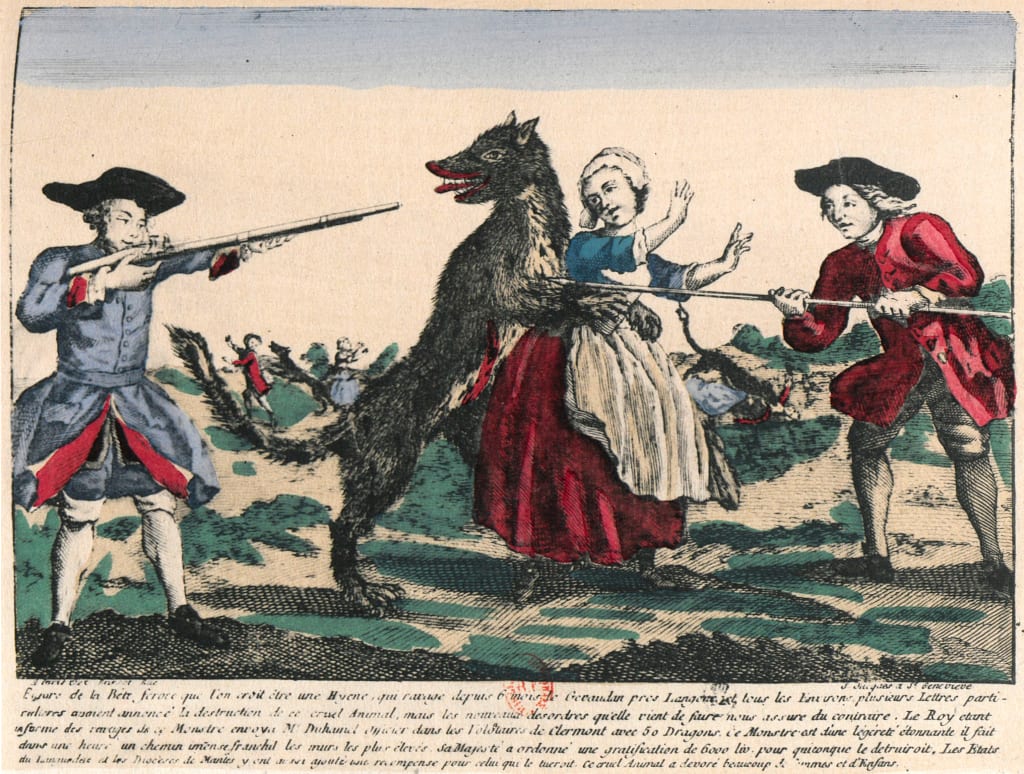
The Beast of Gévaudan claimed nearly one hundred lives, but to this day, the creature that inspired folk tales and modern fiction remains an enigma. Which is a mystery on its own, as the animal had been caught and killed not once but twice.
How It All Began
It was the summer of 1764 in southern France, and a young woman Marie Jeanne was looking after her cattle. With no warning or time for her to escape, a wolf-like beast leaped out of the woods and attacked. Luckily for her, the bulls of the cattle managed to fight the animal off and scare it back into the woods.
This is one story that is circulating. Another one takes place an entire year later, and there are no cattle, just Marie Jeanne and her teenage sister Therese walking home. In this version, Marie Jeanne is carrying a spear with her (for whatever reason). And with it, she manages to stab the animal that she later described as the largest wolf she had ever seen.
Which story is true is hard to tell. With all the stories and rumors that spanned over two hundred years, either one could be the truth or neither of them. Most likely, both girls just shared a pretty common name, and, with time, their stories got tangled into one. But still, both accounts agree on something - the young woman survived and became the town's hero.
Fourteen-year-old Jeanne was not so lucky. The girl was tending her sheep when the mysterious creature struck again. Sheep being sheep, they were of no help when the animal pounced, ripping Jeanne's throat and claiming the teenager as its first official victim.
After the first taste of human blood, the animal became unstoppable. The number of victims kept rising each week as if the beast was on a mission to claim as many lives as possible.
At the time, wolf attacks were quite a common occurrence, especially in the parts of France where the industrial revolution was not yet winning over nature. Animals had plenty of hideouts and even more chances to ambush someone wandering too close to the woods. And so they did, but never has one wolf (and according to descriptions, it was the same animal) attacked so many people.
It is believed that over the three years of the killing spree, the Beast of Gévaudan claimed over one hundred lives, most of which were children ages six to fifteen and women.
How the King Got Involved
Rumors of the attacks spread wider and grew louder, but they would have never reached Paris were it not for the press.
Yes, you read correctly. Once a regional newspaper started publishing stories of the attacks in the local crime section, it caught the attention of the bored national press.
Why bored? Well, not much else was going on since the end of the seven-year war, and the story of a mysterious beast terrorizing poor villagers seemed like the perfect money maker.
With each article, the attacks grew more gruesome. The descriptions of the animal took a full swing from a large wolf to a mythical creature that looked like a lion, leopard, and a "divine scourge" nonetheless.
And the French peasants were the true heroes battling the murderous monster with no help from the outside.
This is when King Louis XV stepped in. But why would a monarch care about animal attacks across the country from Versailles?
Again, the press.
How can this king win a war if he fails to protect his people from animal attacks... They asked.
King Louis XV's reputation was tainted after he miserably lost the war to England and its allies. The monarch and the advisors desperately needed to prove the newspapers wrong and regain the support and trust of the nation.
How Army Failed
Louis ordered his dragoons to the region with a solemn task - to catch and kill the wolf. The job should have been a piece of cake for skilled and trained men, and yet, days went by with no results. Weeks passed, but nothing happened. At some point, tens of thousands of men participated in the organized hunts. And still nothing.
All Captain Duhamel and his battalion achieved was alienating the locals and becoming the subject of ridicule. Despite baits, hunts, and even dressing the soldiers as women to attract the animal, they failed to find it.
Once the battalion shamefully retreated, two hunters, father and son d'Ennevals, set out to complete the task.
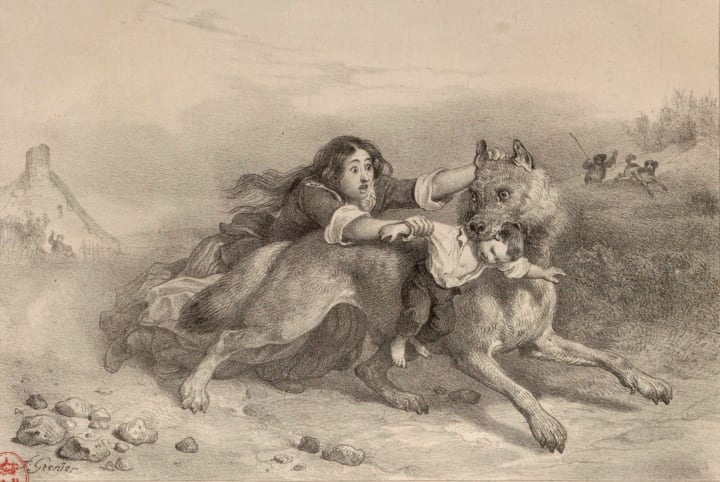
They bragged left and right about having killed over a thousand wolves already, and the villagers believed the terror would finally end. Yet, the beast evaded any capture.
The king, losing trust in his troops, offered a reward worth more than the one-year salary of a worker. Groups of men raided forests and hills, killing hundreds of wolves on their way, yet nobody could catch the monster ripping people's throats nearly every week.
Suspicions arose that the beast might not be an animal but a man in a wolf's costume. Most of the victims were women and children, after all. What if a sadistic person was assaulting them, and then mutilating their bodies to hide the evidence of his crimes?
Church had its own theory. The beast was sent to punish people for their lack of faith and loose morals. Again, especially the women who, in the eyes of the clergy, were becoming less and less compliant and were losing their virtues.
Numerous newspapers now eagerly published survivors' accounts, embellishing whatever they could. The animal was fast turning into a werewolf-like creature that could walk on its back legs, had a fire in its eyes, and was bullet-proof.
Amid this chaos, local kids emerged as heroes. Some village boys successfully chased away the beast with no more than sticks, stones, and group effort. Lous XV was so impressed, or at least he pretended to be, that he rewarded the kids and granted them free education.
How The Beast Died
Tired of all the failures, the king sent his personal gunbearer Francois Antoine to do the job. More than a year after the attacks began, in September 1795, Antoine ambushed, shot, and killed a giant wolf. It was 80 cm (31 in) high, 1.7 m (5 ft 7 in) long, and weighed 60 kg (130 lb). Antoine was convinced that the beast was the one responsible for all the attacks, and then, so was the king.
The animal was stuffed and sent to Versailles for Louis to see, while Antoine stayed behind to hunt down the wolf's female companion and their two pups.
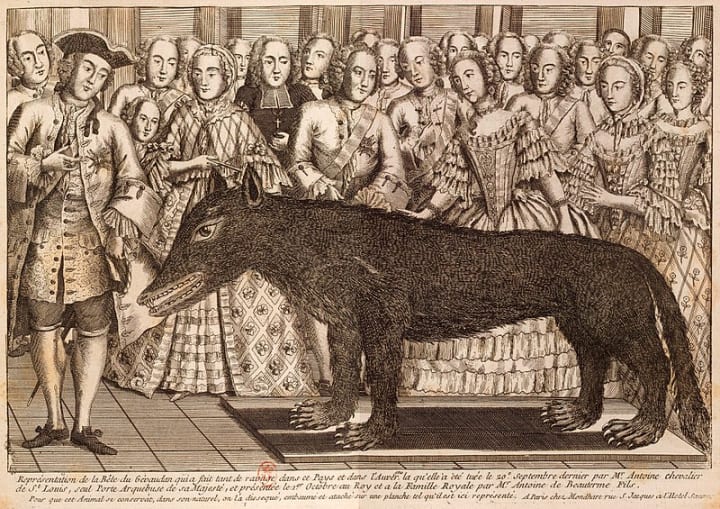
Antoine got his reward money and his fame. The king got approval from the nation and the media. And the Gévaudan people got back their peace.
Or so it seemed. Until it didn't.
How the Beast Returned
Two months after the slaying of the wolf family, the attacks resumed. The beast took over a dozen more lives during the following eighteen months, but the king and the court remained silent. In their eyes, the beast was dead, and their work was done.
Villagers were left alone to fight whatever new creature was terrorizing them. And so they did.
How The Beast Died Again
In 1767, a local farmer Jean Chastel took matters into his own hands. He loaded his gun with silver bullets (or so stories say) and went out to look for the beast he had spotted earlier that day.
Surprisingly enough, Jean shot and killed the animal, and after that, no other life was lost.
Now here is where the story takes an even stranger turn. Some sources claim that the farmer then took the beast's body to Versailles and that the king ordered it to be burned. Thus, nobody to this day knows what the creature that Jean shot looked like or where the body was buried.
Another rumor had it, that Jean himself trained the dog or the wolf he later killed. This stemmed from the fact that he was so uncooperative during the first organized hunts he even ended up in jail for obstruction.
Some people speculated that Jean was up to no good and he used the animal as a distraction to hide his other crimes. To others, he was a true hero who rid Gévaudan of the blood-thirsty monster.
How the Beast Lived in Popular Culture
Whatever the truth was, we will never know. Most likely, the attacks were carried out by different wolves rather than one beast, but thanks to the press, the legend of the Beast of Gévaudan was born, and it lives to this day.
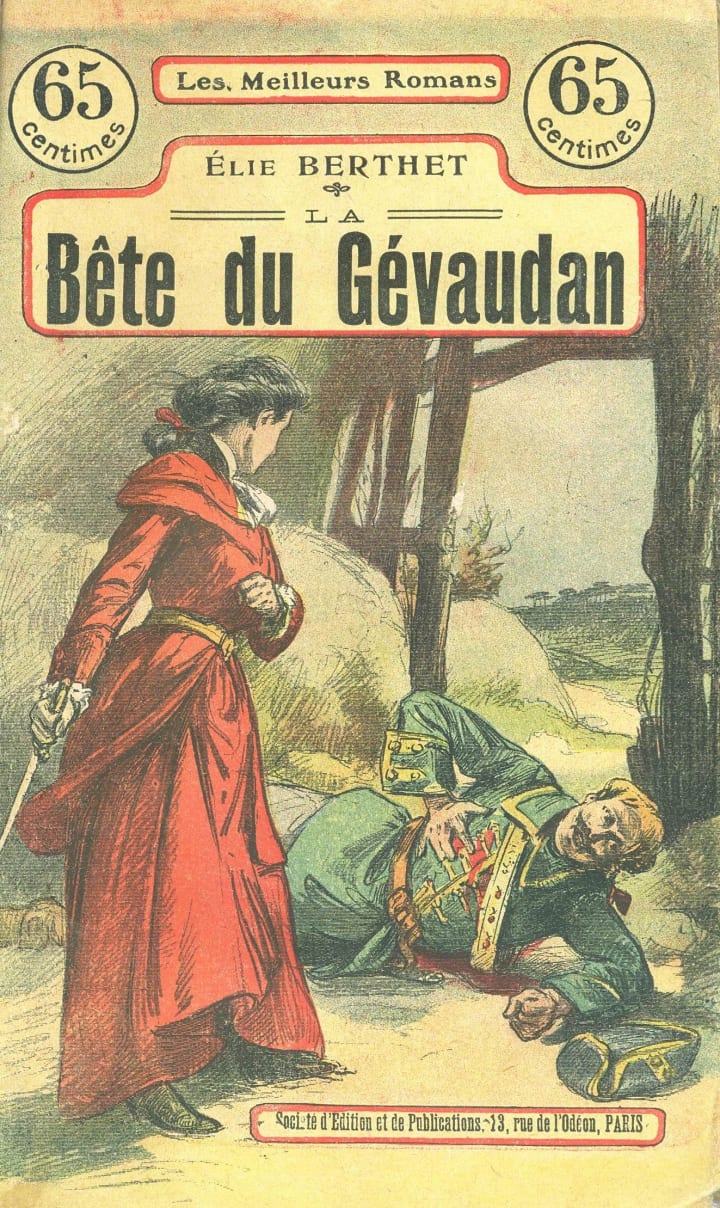
The Beast of Gévaudan was featured in different books, documentaries, movies, and television. A couple of metal bands created songs about it. The story was also featured in podcasts and documentaries.
The series Teen Wolf had an episode dedicated to the killing of the animal who was, of course, a werewolf. The creature returned in the fifth season alongside the character inspired by Marie-Jeanne Vallet, the young woman who bravely fought off the wolf with a spear.
Maybe it's good that we still don't know what the Beast of Gévaudan was. After all, who doesn't like a good mystery that offers multiple scenarios and speculations?
About the Creator
GD Madsen
A historian by education, a former journalist by profession, now living in the French countryside writing books and articles.



Comments
There are no comments for this story
Be the first to respond and start the conversation.