
The Long Road Home
An emotional reflection wrapped in a quiet journey. Inspired by real events.
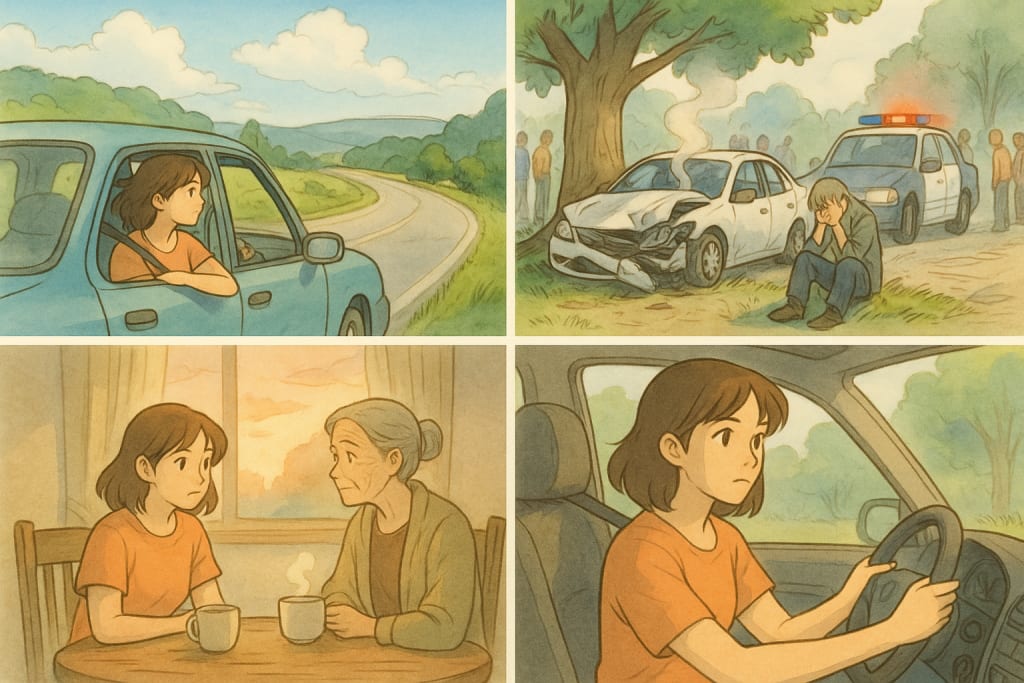
It was the beginning of summer when Emi packed up her little blue car and headed out of the city. The sky was a soft blue, the kind you only see after a night of rain. The trees lining the streets shimmered with morning dew, and the scent of blooming jasmine drifted in the air. She was on her way to her grandmother’s house in the countryside—a trip she hadn’t made in years.
Her playlist was ready. Her favorite snacks sat beside her in the passenger seat. And the road? It stretched out like a painting, inviting and open.
She loved driving. Not for the destination—but for the in-between moments: the rhythm of the tires on the asphalt, the way the wind played with her hair, the quiet peace that came from being just a little removed from everything. For Emi, the car was a kind of cocoon. A place where she could think. Breathe. Let go.
But that morning, something in the air felt different.
Cars zoomed past more aggressively than usual. A horn blared behind her even though she hadn’t done anything wrong. And when she stopped at a red light, she saw a man in the car next to her yelling at someone on speakerphone. The world seemed louder. Harsher.
Still, she pressed on.
About an hour into her drive, she took the backroads like her grandmother always told her to. “Avoid the highway if you can,” she used to say. “It’s not worth the stress.” Emi smiled at the thought.
She was winding through a narrow stretch near the hills when she saw them—flashing lights, red and blue, pulsing like a heartbeat in distress. She slowed down. A crowd of cars had begun to gather, pulling over or simply creeping past. Some drivers leaned out of their windows. Others took photos.
That’s when she saw it.
A white sedan had veered off the road and hit a tree. Its front end was crushed, steam hissing from beneath the hood. Shattered glass sparkled in the sunlight like broken stars. An older man sat on the roadside, knees drawn up, face hidden in his hands. His shirt was stained with dust and tears.
Most drivers didn’t stop. They stared. Some shook their heads and moved on. But something inside Emi—maybe her heart, maybe her instinct—told her to pull over.
She turned off her engine and walked toward the scene, her footsteps soft and hesitant. A paramedic glanced up as she approached. “You a relative?” he asked gently.
“No,” she said. “I just… wanted to help.”
The man, it turned out, had been driving alone. A deer had run across the road, and he swerved too hard to avoid it. He wasn’t seriously hurt—just shaken. But his eyes looked lost, like someone who had wandered far from home and didn’t know how to return.
Emi sat with him while they waited for the tow truck. He didn’t speak much, but he held her hand. And that felt like something.
Later, back in her car, she stared at the steering wheel, hands still trembling. The road was clear again. The world had moved on. But she couldn’t. Not yet.
The paramedic’s words echoed in her head: “These happen more often than you’d think. Rubberneckers. Kids on their phones. Drunk drivers. A second of distraction, and everything changes.”
She thought of the people who’d passed by without stopping. She thought of the way she herself had checked her phone that morning at a red light. Just for a second.
It could have been her.
It could have been someone she loved.
At her grandmother’s house that evening, the sunset cast long golden shadows over the porch. The house smelled like warm bread and old books. Her grandmother hugged her tightly, and for a long time, neither of them said anything.
Later, over tea, Emi shared what she’d seen. Her grandmother listened quietly, nodding.
“When I was younger,” she said softly, “a friend of mine died in a car crash. Her boyfriend was driving too fast, just trying to impress someone. You never forget that kind of thing. You never stop thinking—what if they'd just slowed down?”
That night, Emi couldn’t sleep.
She thought about how much she’d taken for granted. The freedom of driving. The fragility of life. The invisible thread that connected all of us—drivers, passengers, pedestrians—sharing the road in our own little worlds, yet always just one moment away from colliding.
In the days that followed, Emi made some quiet changes.
She took her car in for a full check-up. She bought new tires and fixed her brake lights. She downloaded a “no-phone” driving app that locked her screen while the engine was running. She started leaving five minutes earlier so she wouldn’t be tempted to speed.
But more than that, she became present. Truly present. Every time she slid into the driver’s seat, she took a breath, placed both hands on the wheel, and reminded herself: This is not just a drive. This is a life.
And slowly, others began to notice.
She shared her story on social media—not to go viral, but because it felt too important not to. The post was simple. Honest. It read:
“I saw a man cry on the side of the road. I saw what one second of distraction can do. And I realized: my choices behind the wheel don’t just affect me. They ripple outward, like waves.
So now I drive like someone I love is in every car I pass. Maybe you will too.”
The comments poured in. Friends messaged her, saying they’d deleted driving distractions. Her cousin—who used to race from work to home every day—started taking backroads. One woman said it reminded her to finally talk to her teenager about drinking and driving.
Emi hadn’t set out to change lives. She just wanted to feel less powerless. But maybe, in choosing to be more careful, more aware, she’d created a little ripple after all.
And sometimes, ripples become waves.
Your Road Is a Story. Drive It Like It Matters.
The journey isn’t just about where you’re going. It’s about how you get there. Be mindful. Be kind. Be present. Because the smallest choice can carry the greatest weight.
https://januszjankra.systeme.io/vyb
About the Creator
Janusz Krawczak
https://januszjankra.systeme.io/vyb
Keep reading
More stories from Janusz Krawczak and writers in FYI and other communities.
Is your self-esteem, on the rocky side
In a picturesque land hidden behind the misty peaks of the Izera Mountains, in a quiet valley where streams sang old songs and the wind whispered secrets through the crowns of ancient oaks, lived a young girl named Hania. Her eyes were the color of morning dew on a spiderweb, and her hair resembled wildflowers in the summer sun. Hania felt a longing in her heart, a vague desire for something more, though she couldn't quite name the feeling. Sometimes she would gaze at the distant, sunlit peaks and dream of traveling, of discovering her place in the grand tapestry of life.
By Janusz Krawczak9 months ago in Psyche
The algorithm behind Instagram reels is explained in detail, along with how to make it work for you.
The algorithm behind Instagram reels is explained in detail, along with how to make it work for you. Instagram Reels did not suddenly become popular. The Instagram Reels algorithm is the driving force behind every viral Reel, every sudden increase in views, and every creator who blew up overnight.
By Farida Kabira day ago in FYI


Comments
There are no comments for this story
Be the first to respond and start the conversation.