
The Light of Truth: Why Islam Shines as One of the World’s Greatest Religions
A Journey Through Faith, Peace, and Universal Values That Make Islam a Guiding Light for Humanity

By Azmat Roman ✨Published 7 months ago • 4 min read
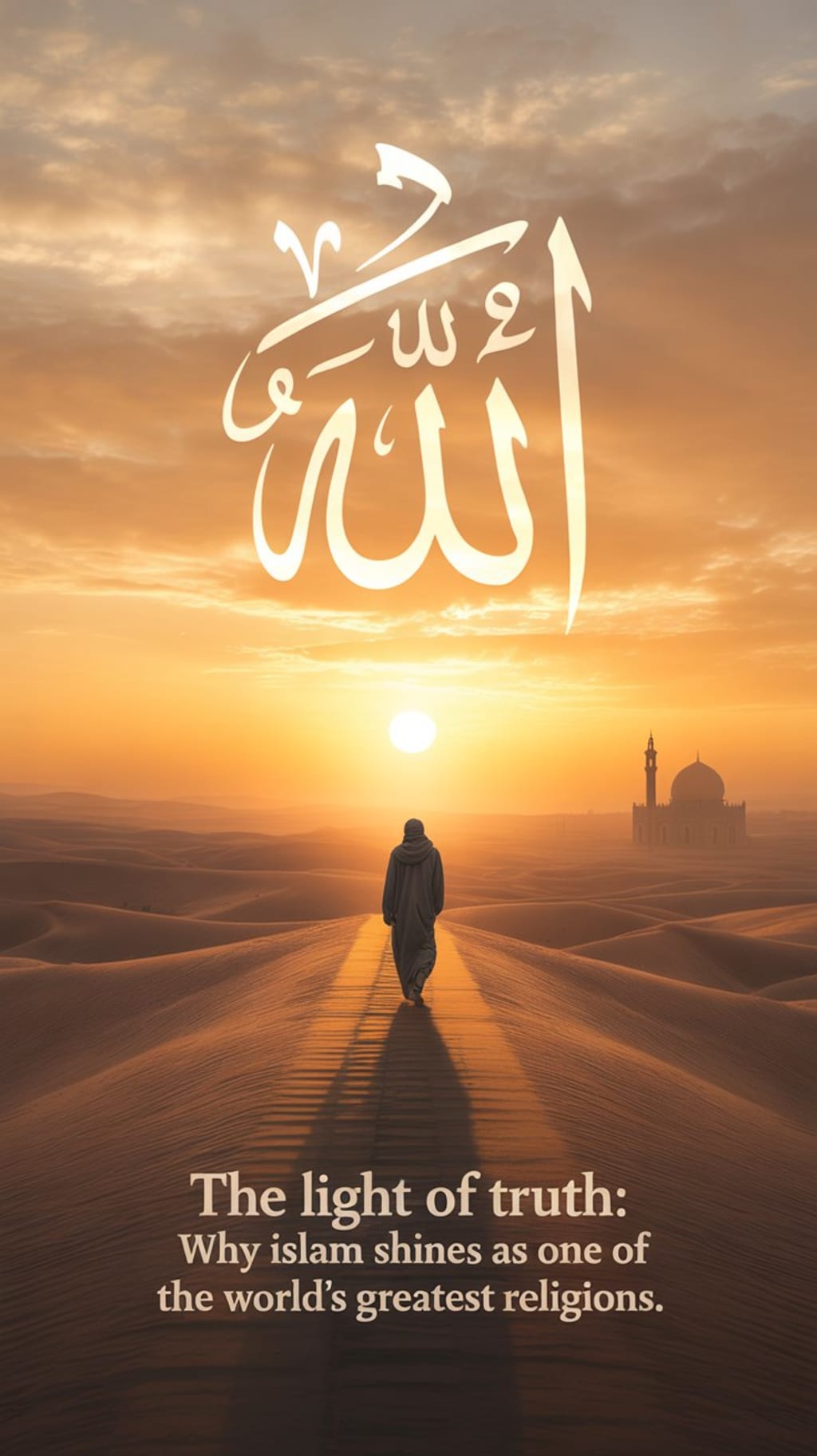
The Light of Truth: Why Islam Shines as One of the World’s Greatest Religions
In a world increasingly divided by politics, misinformation, and fear, religion often becomes misunderstood or misrepresented. Among the most misunderstood is Islam — a religion followed by over 1.9 billion people, yet often subjected to stereotypes and misjudgments. But if one ventures beyond headlines and into its essence, one uncovers a profound truth: Islam is not only one of the most practiced religions in the world, but also one of the most beautiful, rational, and transformative faiths.
This is not just a claim—it is a lived experience, proven through centuries of guidance, wisdom, and real-world impact.
A Faith Founded on Peace and Mercy
The word Islam itself comes from the Arabic root word “Salaam” which means peace. Islam, at its core, means submission to the will of God and is deeply connected to the concept of inner peace through alignment with divine purpose. The common Muslim greeting, “As-Salamu Alaikum” (Peace be upon you), is not just a phrase—it is a reflection of the faith’s mission.
The first example of Islam’s peaceful nature is in the character of Prophet Muhammad (peace be upon him). Known as Al-Amin (the trustworthy) even before his prophethood, he forgave the very people who persecuted him for years. When he re-entered Mecca after years in exile, he had every reason to seek revenge—but instead, he offered forgiveness, saying, “No blame will there be upon you today. Go, for you are free.”
That is the soul of Islam: mercy over vengeance, peace over conflict.
Intellectual Brilliance and the Golden Age
One of the lesser-known truths in modern discourse is the enormous contribution Islam has made to human civilization. During the Islamic Golden Age (8th to 13th century), the Muslim world was the hub of knowledge, science, medicine, and philosophy. While Europe remained in the Dark Ages, Muslims were building libraries, hospitals, and universities.
Great thinkers like Ibn Sina (Avicenna) revolutionized medicine. Al-Khwarizmi, a Persian mathematician, invented algebra. The very word algorithm is derived from his name. Muslims preserved and translated Greek, Roman, and Persian knowledge, and then expanded upon it.
Islam did not merely tolerate science—it encouraged it. The Quran itself says:
"Are those who know equal to those who do not know?" (Surah Az-Zumar 39:9)
This emphasis on education and understanding is what made Islam one of the most intellectually progressive religions of its time—and it continues to promote knowledge as a form of worship.
A Religion That Honors All Prophets
Islam is also unique in that it does not reject or denounce other Abrahamic faiths. In fact, Muslims are required to believe in all prophets, including Moses, Abraham, and Jesus (peace be upon them all). The Quran says:
"Say: We believe in Allah, and in what has been sent down to us and what has been sent down to Abraham, Ishmael, Isaac, Jacob, and the Tribes, and in what was given to Moses and Jesus, and in what was given to the prophets from their Lord. We make no distinction between any of them..." (Surah Al-Baqarah 2:136)
This universal respect fosters interfaith dialogue and understanding, proving that Islam is not exclusive or divisive, but rather inclusive and respectful of other traditions.
Social Justice and Equality
One of Islam’s most admirable qualities is its strong stance on social justice and equality. Long before modern human rights movements, Islam established rights for women, the poor, and even animals.
Islam gave women the right to own property, earn money, and choose their husbands at a time when most societies did not. Prophet Muhammad (peace be upon him) declared, “The best of you are those who are best to their women.” (Tirmidhi)
Zakat (charity), one of the Five Pillars of Islam, requires Muslims to give a portion of their wealth to those in need, directly addressing poverty and inequality.
The Prophet also said, “None of you truly believes until he loves for his brother what he loves for himself.” (Bukhari and Muslim) — a principle that, if universally applied, would transform society.
The Quran: A Timeless Miracle
Unlike other scriptures that have been edited or rewritten over time, the Quran has remained unchanged since it was revealed over 1400 years ago. Millions of Muslims have memorized the entire book—a feat unmatched in any other religion.
More than its preservation, the Quran is a literary and spiritual masterpiece. Its verses touch the soul, inspire reflection, and resonate with both heart and intellect. The Quran repeatedly calls for reflection:
"Do they not reflect upon the Quran, or are there locks upon [their] hearts?" (Surah Muhammad 47:24)
Whether it's the complexity of embryology mentioned in the Quran (Surah Al-Mu’minun 23:12-14) or the formation of the universe (Surah Al-Anbiya 21:30), many modern scientists have marveled at the alignment between the Quran and scientific discovery.
Real-Life Transformations
Islam's greatness is not only in theory—it is in its impact on people’s lives.
Take the story of Malcolm X. A man once known for his anger and militancy transformed after performing Hajj (pilgrimage to Mecca). Witnessing the racial unity among Muslims of all colors, he wrote:
"In the past, yes, I have made sweeping indictments of all white people... But in the pilgrimage, what I have seen has forced me to re-arrange much of my thought patterns previously held... Islam has the power to remove the cancer of racism from the society."
Even today, millions of people convert to Islam each year, often citing the religion’s clarity, spirituality, and logic. Converts speak of the inner peace they discover, the discipline Islam teaches, and the sense of purpose it provides.
A Final Word: Not Just a Religion, But a Way of Life
Islam is more than rituals and rules—it is a complete way of life. It governs not only how to worship but how to treat others, earn money ethically, raise a family, and live with purpose. Its teachings span every part of life—spiritual, intellectual, emotional, and social.
To call Islam one of the best religions in the world is not an exaggeration—it is a recognition of its deep spiritual legacy, its rational foundations, and its unmatched contribution to human progress and moral clarity.
Whether you are a seeker, a skeptic, or simply curious, looking into Islam with an open heart may just illuminate your soul with a light you've never known before.
About the Creator
Keep reading
More stories from Azmat Roman ✨ and writers in FYI and other communities.


Comments (1)
Good work