

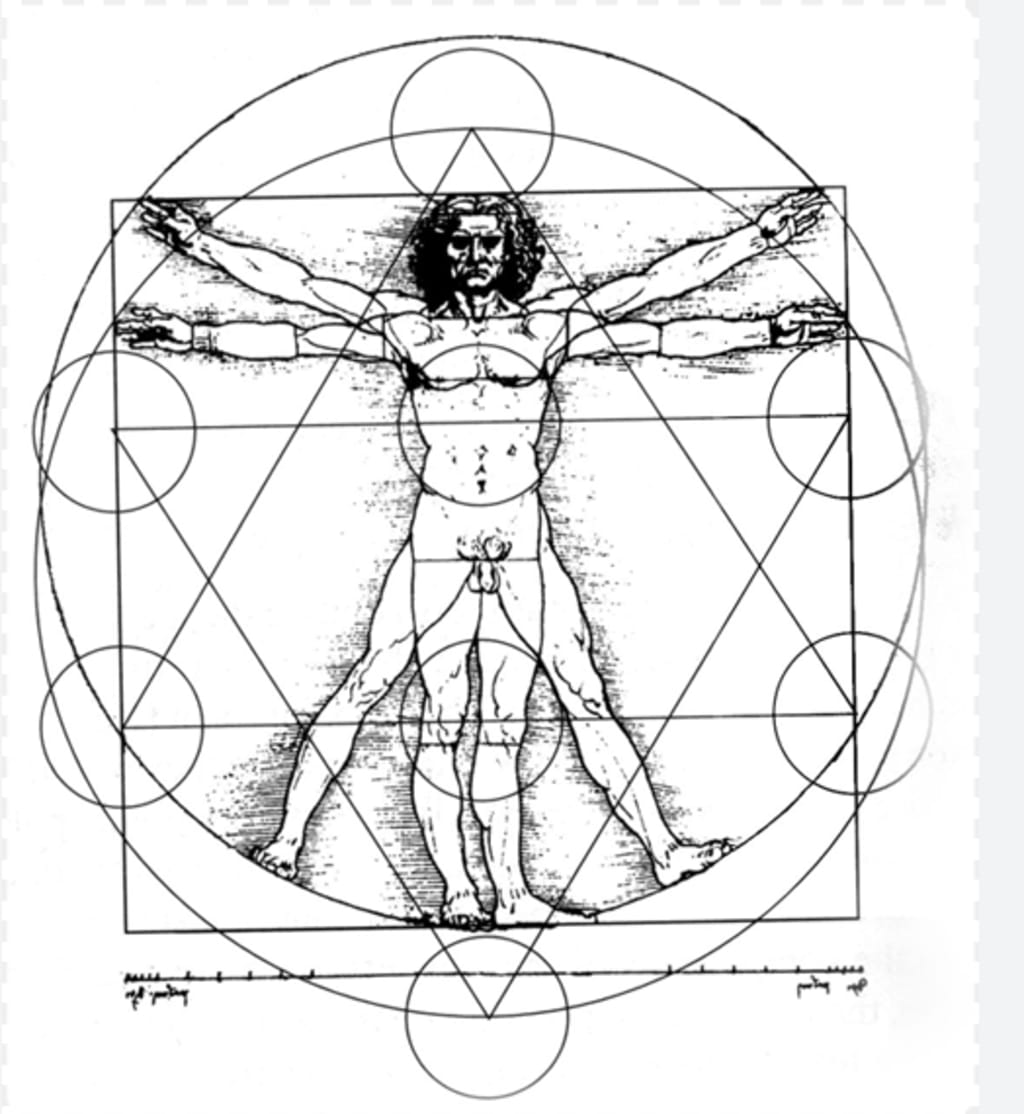
The concept of the Golden Ratio, also known as the divine proportion, is a fascinating topic that has captivated mathematicians, artists, architects, and scientists alike. It is believed to be the most perfect number, found everywhere in nature, and closely linked to beauty and harmony.
This concept is deeply rooted in sacred geometry, which refers to the use of geometric shapes and ratios in religious and spiritual contexts. The Golden Ratio is a mathematical property that is hardwired into nature, governing the growth patterns of everything from sunflowers to seashells, pineapples, pine cones, and even the human body.
The question that arises is whether there is really one special number that underlies everything in the universe. Is there really a number that can link beauty in art, music, and the human body, and nature's order to the rules of mathematics? Some people believe that the answer is yes, but extraordinary claims require extraordinary evidence, so let's take a closer look at what the Golden Ratio is really about.
The Golden Ratio is a proportion that is found in many aspects of the natural world, as well as in human-made objects. The ratio of its long side to its short side is exactly 1.6180339887..., which is an irrational number. This means that the decimal goes on forever without repeating, just like pi. Unlike rational numbers like 5, 3/4, and 1/3, the Golden Ratio can't be written as a simple ratio of two integers.
The ancient Greeks were among the first to notice the existence of the Golden Ratio. Around 300 BC, a mathematician named Euclid wrote a book called Elements, which was a collection of most of what was known about math at the time. Euclid noticed that there was one special way to divide a line where the ratio of the whole to the longer segment was the same as the ratio of the longer segment to the shorter one, and that ratio was the Golden Ratio. He called it the extreme and mean ratio, which sounds like what happens when someone makes a bad tweet.
The Greeks and mathematicians of that time did not think of numbers like we do today, as strings of digits from zero to nine. To them, the Golden Ratio was simply a ratio, just like pi was the ratio of a circle's circumference to its diameter. The names phi and the Golden Ratio did not show up until almost the 20th century.
The Golden Ratio has many interesting mathematical properties. For example, the ratio of the long sides of a Golden Triangle to its short side is also the Golden Ratio. This triangle has angles of 72, 72, and 36 degrees and is also known as a sublime triangle. If you divide one of the long sides according to the Golden Ratio and make a smaller triangle, it is another Golden Triangle with the same angles. The length of the sides of this triangle to the base is one over phi, and this shape is known as the Golden Gnomon. If you take one Golden Triangle and stick two Golden Gnomons on the side, you get a regular pentagon.
The Golden Ratio also shows up in the shape of a Golden Rectangle, which is believed to be the most aesthetically pleasing quadrilateral. The ratio of the long side to the short side of a Golden Rectangle is the Golden Ratio, and if you put another Golden Rectangle inside it, another inside that, and so on, and draw a curve through all these shapes, you get a shape called the Golden Spiral.
The Golden Spiral is a beautiful and intriguing shape that has been used in art, architecture, and design for centuries. It is closely linked to the Fibonacci sequence, which is a series of numbers where each number is the sum of the two preceding ones.
About the Creator
Keep reading
More stories from Tsar Banks and writers in FYI and other communities.
The Art of Reading
Introduction In this essay, we will delve into the mysterious and fascinating world of reading. At first glance, reading seems to be a straightforward process. We look at letters on a page or screen, and we instantly recognize them as words. But what is actually happening in our brains when we read? How are we able to process complex ideas and emotions from a string of letters and words?
By Tsar Banks3 years ago in FYI
Strategic Importance of Domestic Aerospace Manufacturing Capacity
Domestic aerospace manufacturing capacity plays a vital role in maintaining national security, economic stability, and technological leadership. In an era where global supply chains are increasingly complex and geopolitical uncertainties continue to grow, the ability to produce critical aerospace components within national borders has become more important than ever. For countries like the United States, maintaining a strong domestic aerospace manufacturing base ensures operational readiness, supply chain resilience, and long-term industrial competitiveness.
By Beckett Dowhan4 days ago in FYI



Comments
There are no comments for this story
Be the first to respond and start the conversation.