
The Global Consumer Electronics Repair and Maintenance Market: Powering the Circular Economy, One Device at a Time
With global market value projected to reach US$ 31.03 billion by 2033, sustainability, affordability, and the right-to-repair movement are revolutionizing how consumers handle their tech.


In a consumer world obsessed with upgrades, the global consumer electronics repair and maintenance market stands out as a quiet but powerful driver of sustainability. According to Renub Research, this market is set to climb from US$ 18.62 billion in 2024 to US$ 31.03 billion by 2033, growing at a CAGR of 5.84% between 2025 and 2033.
This growth reflects not only shifting consumer attitudes but also the global realization that the planet can no longer sustain a throwaway economy. As the price of new devices climbs and environmental regulations tighten, consumers and governments alike are turning to repair and refurbishment to extend product lifecycles and cut down on e-waste.
Market Overview
Consumer electronics repair and maintenance includes the inspection, diagnosis, servicing, and restoration of devices ranging from smartphones and laptops to TVs, gaming consoles, and kitchen appliances. The intention is clear: prolong device functionality while saving consumers money and reducing waste.
In a digitally dependent society, repair services are indispensable. They bridge financial barriers, enable greater tech access, and sustain product usability far beyond warranty periods. The sector thrives on convenience and environmental stewardship—both key priorities in the era of sustainability legislation and conscious consumption.
Key Growth Drivers
Rising Electronic Waste and Sustainability Consciousness
The world generated 62 million tonnes of e-waste in 2022, projected to surge to 82 million tonnes by 2030. Yet only a fraction of that waste—less than 20%—is formally recycled, leaving the remainder to pollute ecosystems. Repair services have thus emerged as environmental heroes, providing sustainable alternatives that lengthen product life.
As national governments highlight circular economy initiatives, repair and refurbishment are becoming mainstream solutions. This shift benefits both ecosystems and job markets, spurring a new wave of certified repair technicians and local service entrepreneurs. Sustainability is no longer just a moral imperative—it’s good business.
Cost-Efficiency over Replacement
Consumers facing hefty price tags for smartphones, laptops, and major appliances are increasingly opting to repair instead of replace. This is particularly true in developing economies, where financial pragmatism meets environmental necessity.
Affordable spare parts, independent technicians, and extended warranties have made repair services more accessible and appealing. As inflation and living costs rise, this cost-based advantage will remain one of the strongest market stimulators across both developed and emerging regions.
Government & “Right-to-Repair” Momentum
Public policy now actively fuels the industry’s growth. Governments in the U.S., EU, and India are implementing “Right to Repair” laws that grant consumers and independent technicians access to manuals, diagnostic tools, and original components.
The European Commission’s 2023 Directive on the Right to Repair included household electronics and mobile phones in its scope. It supports reusable parts, mandates the availability of repair documentation, and encourages manufacturers to design easily fixable products. These legal frameworks signify a structural turning point for the industry, empowering consumers and diversifying the repair landscape.
Major Challenges
Limited Access to Spare Parts and Technical Data
Still, not all manufacturers are on board. Restricted access to proprietary components and digital repair guides stifles market growth and frustrates independent service providers. Without the right parts or software updates, third-party repair technicians face delays and rising costs—a challenge that underscores the ongoing need for regulatory enforcement and open repair ecosystems.
Rapid Product Complexity and Technological Evolution
Today’s high-tech electronics, loaded with AI processors, IoT connections, and compact sealed designs, are remarkably difficult to service. These ultra-integrated devices require precision tools, diagnostic software, and highly trained technicians, all of which drive up operational costs.
Small repair businesses must constantly invest in new training and equipment to stay competitive—making skill development a critical area of focus for sustaining market growth.
Sectoral Breakdown
Home Appliance Repair Market
The home appliances segment—spanning refrigerators, washing machines, microwaves, and air conditioners—represents a substantial share of global repair activity. As households face long product lifecycles and expensive replacements, repair services provide both convenience and cost savings. The growing focus on energy-efficient appliances also fosters continuous demand for certified technicians capable of meeting quality and environmental standards.
Authorized Service Centers
Authorized service centers serve as an essential pillar of trust within the repair ecosystem. Offering original components, brand-backed expertise, and warranty protections, these centers remain preferred by consumers seeking guaranteed quality and safety. Manufacturers are increasingly partnering with certified service providers to expand regional coverage, reduce counterfeit risks, and reinforce customer loyalty through transparent and reliable repair practices.
Residential Repair Market
Residential demand dominates the global landscape due to the high volume of consumer electronics in daily use. The surge in remote work and e-learning has amplified dependency on personal devices, heightening sensitivity to downtime. With smart home adoption rising, more households are turning to professional technicians to maintain network-integrated electronics and hybrid systems.
Commercial Repair Market
In the commercial segment, device maintenance is essential for uninterrupted business operations. Corporate environments—ranging from hospitals to universities—depend heavily on service contracts and regular calibration schedules to minimize downtime. As offices adopt hybrid work models, maintaining connected infrastructure, such as printers and communication systems, keeps commercial demand steady and recurring.
Regional Highlights
United States
The U.S. leads the repair movement, empowered by state-level right-to-repair regulations and a mature network of independent and authorized repair shops. With mounting concerns about sustainability, Americans increasingly prefer to fix rather than discard electronics. The New York Digital Fair Repair Act—effective July 2023—set a national precedent by guaranteeing consumer access to repair manuals and parts. Combined with tech-savvy labor pools and eco-conscious consumers, the U.S. remains a major force in market innovation.
France
France’s forward-looking Repairability Index, which scores devices based on their ease of repair, has drastically reshaped consumer behavior. Government investments in local repair education and repair-friendly policies have fostered a thriving repair culture. Social and environmental awareness, along with high living costs, continues to fuel steady growth in this sector.
India
India’s booming electronics usage and large technician base make it one of the most dynamic markets worldwide. The government’s 2024 repairability rating for smartphones and appliances is an ambitious bid to curb rising e-waste and guide consumer purchasing. Informal neighborhood repair hubs coexist alongside growing networks of branded and independent service providers, ensuring affordability while supporting circular economy goals.
Saudi Arabia
Propelled by Vision 2030, Saudi Arabia’s market reflects rapid technological modernization. Rising consumer spending, an expanding middle class, and the region’s climatic conditions—all contribute to frequent maintenance needs. As sustainability awareness grows, both domestic and international service providers are investing in advanced repair training and infrastructure to capture this growing demand.
Market Segmentation
By Product
Home Appliances
Personal Devices
Entertainment Devices
By Service Provider
Authorized Service Centers
Independent Repair Shops
By End User
Residential
Commercial
By Region
North America: United States, Canada
Europe: France, Germany, Italy, Spain, United Kingdom, Netherlands, Belgium, Turkey
Asia-Pacific: China, Japan, India, South Korea, Thailand, Malaysia, Indonesia, Australia, New Zealand
Latin America: Brazil, Mexico, Argentina
Middle East & Africa: Saudi Arabia, UAE, South Africa
Key Players and Competitive Insights
Prominent players in the global repair and maintenance industry include:
The Cableshoppe
Redington Services
Electronix Services
B2X Care Solutions
Encompass Parts
uBreakiFix
Asurion, LLC
Best Buy Co. Inc.
Across these companies, strategic imperatives focus on expanding service networks, integrating AI-assisted diagnostics, and developing sustainability-driven service models. Partnerships with retailers and OEMs strengthen brand ecosystems and enable rapid scaling across regions.
Final Thoughts
The global consumer electronics repair and maintenance market is not just a business—it’s a sustainability mission. Driven by rising e-waste awareness, economic constraints, and supportive legislation, the next decade will see repair evolve from a secondary service to a mainstream industry cornerstone of the circular economy.
As devices grow smarter and more complex, the repair sector must evolve in tandem—balancing high-tech diagnostics with affordability and accessibility. In the race to a greener future, each repaired device is more than a transaction; it is an act of responsibility, innovation, and resilience in a connected world.
About the Creator
Sushant. Renub Research
I’m Sushanta Halder, Digital Marketing Manager at Renub Research with 15+ years in SEO, content, PPC & lead generation. Passionate about data-driven growth strategies.
Keep reading
More stories from Sushant. Renub Research and writers in FYI and other communities.
Global Tilt Sensor Market Soars Toward $635 Million by 2033
According to Renub Research Latest Report global tilt sensor market, valued at USD 255 million in 2024, is set for outstanding expansion, reaching approximately USD 635 million by 2033 — growing steadily at a CAGR of 12.25% from 2025 to 2033, according to Renub Research. The industry’s rapid rise comes on the back of increasing technological sophistication in automotive safety systems, construction machinery, advanced IoT devices, and high-precision aerospace instruments.
By Sushant. Renub Research3 months ago in FYI
Europe Commercial Greenhouse Market Size and Forecast 2025–2033
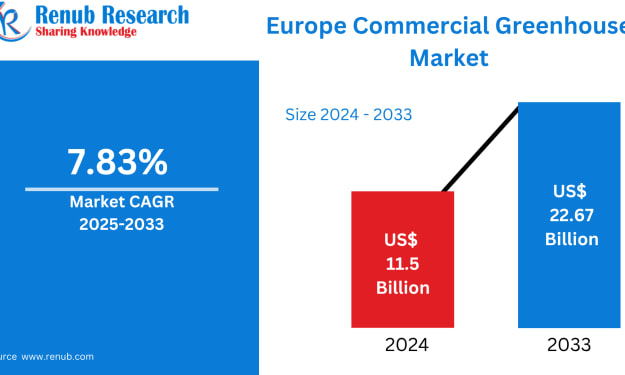
The Europe Commercial Greenhouse Market is set for dynamic expansion over the coming decade, reflecting the region’s accelerating transition toward sustainable, technology-driven agriculture. According to Renub Research, the market is projected to reach US$ 22.67 billion by 2033, rising from US$ 11.5 billion in 2024, at a robust CAGR of 7.83% during 2025–2033. This growth is being driven by increasing demand for year-round crop production, the rapid adoption of Controlled Environment Agriculture (CEA), and a strong policy push toward climate-resilient and resource-efficient farming.
By Renub Research3 days ago in FYI



Comments
There are no comments for this story
Be the first to respond and start the conversation.