
The Eye of Sauron Has Been Found
When Sauron's Gaze Turns Cosmic
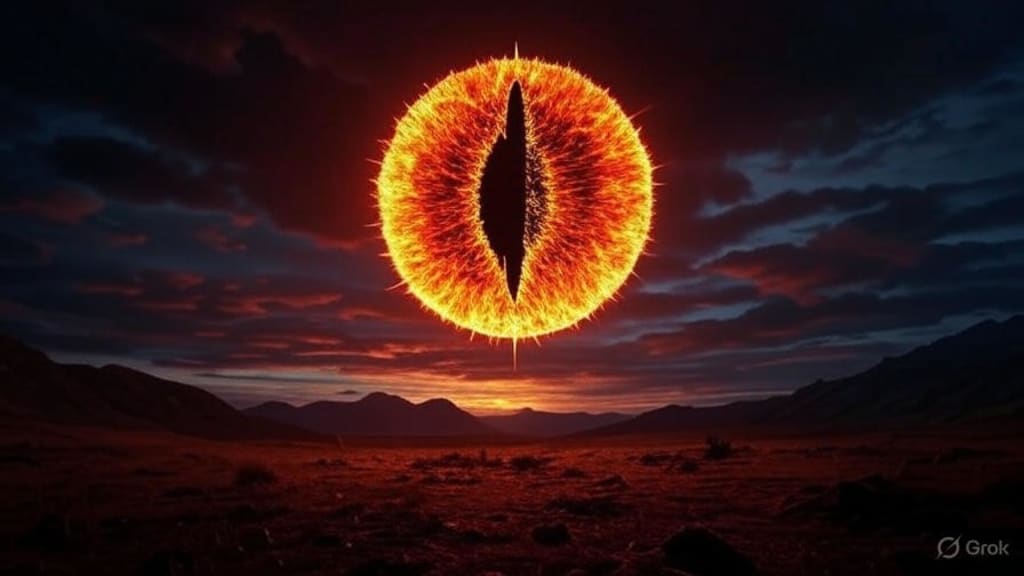
The Eye of Sauron: From Myth to the Cosmos
In J.R.R. Tolkien’s The Lord of the Rings, the Eye of Sauron is more than just a symbol—it is an ever-watchful presence, a flaming orb wreathed in shadow, representing absolute power, surveillance, and the inescapable pull of destiny. Perched atop the dark towers of Mordor, this malevolent gaze sweeps across Middle-earth, unblinking and omniscient, striking fear into all who sense its attention. It is not merely a physical eye, but a manifestation of evil consciousness—an unrelenting force that sees all, senses all, and demands obedience.
Yet, as it turns out, this haunting image from fantasy finds a surprising echo in the depths of the real universe. Astronomers, inspired by the evocative power of myth, have begun to name distant celestial objects with eerie visual similarities to Tolkien’s infamous eye. These are not vessels of malice, but rather natural wonders: glowing rings of gas, swirling accretion disks, and relativistic jets that, when viewed from Earth, bear an uncanny resemblance to the Lidless Eye. Far from fiction, these "cosmic Saurons" offer profound insights into the life and death of stars, the nature of black holes, and the violent beauty of the cosmos.
What links these diverse phenomena is not just their appearance, but the sense of awe and mystery they inspire—much like the original Eye of Sauron. And so, as we turn our telescopes skyward, we find that the boundary between myth and science blurs. The gaze once feared in legend now guides us toward discovery, inviting us to explore the universe’s most extreme realms. Just as Frodo felt the weight of Sauron’s stare, we too feel a shiver when we look upon these distant eyes—reminders that the universe, in all its wonder, is watching back.
Gazing into the abyss, Nietzsche reminds us, risks the abyss gazing back. But what if that gaze wasn't a philosophical metaphor, but a fiery, cosmic stare emanating from the inky blackness of deep space?
It turns out that the iconic Eye of Sauron, that symbol of dread and omnipresent surveillance from Tolkien's The Lord of the Rings, isn't confined to Middle-earth. Astronomers, with a touch of whimsy and a keen eye for pattern recognition, have bestowed this moniker on several celestial objects, each a window into the universe's most extreme and captivating phenomena.
We're not talking about a single, solitary eye, mind you, but a collection of cosmic doppelgangers, from the death throes of stars to the ravenous appetites of supermassive black holes. These aren't mere visual coincidences; they're clues, beckoning us to decipher the universe's grand narrative. So, let's embark on a journey through these fiery orbs, exploring their history, current mysteries, and the tantalizing promise of future discoveries.
The Original Gaze: Nebulae and Stellar Eyes
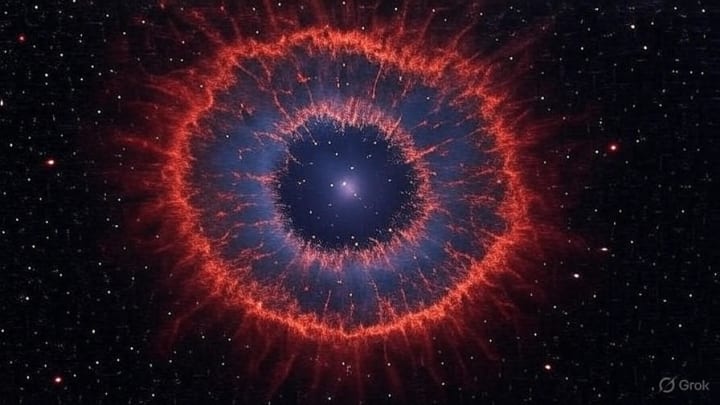
Our journey begins with the "classic" Eye: the Helix Nebula (NGC 7293). Often dubbed the "Eye of God," this object isn't a galaxy, but a planetary nebula. This is the beautiful, expanding shell of gas ejected by a dying star – a cosmic exhalation. Located a relatively close 655 light-years away, it's a smoke ring writ large across the heavens, with a white dwarf star glowing faintly at its heart – the dying ember of a once-mighty furnace.
But the Helix isn't alone in its ocular resemblance. Consider M 1-42, another planetary nebula lurking 10,000 light-years distant in Sagittarius, also bearing the "Eye of Sauron" tag. Or HR 4796, a binary star system whose "debris disk," seen edge-on, mimics that familiar fiery gaze.
And then there's WOH G64, the new kid on the block (relatively speaking, of course, since it came to our attention in November 2024). This colossal red supergiant, residing in the Large Magellanic Cloud, is a star on its deathbed. Recent images reveal an "egg-shaped cocoon" enveloping the star, giving it an undeniable Sauron-esque quality.
The Galaxy's Watch: NGC 4151 – The Cosmic Ruler
Venturing beyond individual stars, we encounter NGC 4151, a spiral galaxy some 52 million light-years away. This isn't just any galaxy; it's a Seyfert galaxy, meaning it possesses an intensely active nucleus, powered by a supermassive black hole. The "Eye" in this case isn't the black hole itself (which, being a black hole, is invisible), but a glowing, hot dust ring swirling around it.
Discovered in 1787 by William Herschel, NGC 4151 has become something of a "cosmic ruler." In 2014, scientists ingeniously used its hot dust ring to develop a precise method for measuring distances to far-off galaxies – a sort of cosmic land surveying technique. This method refined NGC 4151's distance, impacting our calculations of black hole masses (suggesting previous estimates were off by as much as 40%). Intriguingly, the question of whether a binary black hole system resides at its heart remains a subject of debate.
The Blazar's Stare: PKS 1424+240 – The Solved Mystery
Now, for something truly epic: PKS 1424+240, a blazar. Blazars are active galaxies with a supermassive black hole at their core, blasting out a powerful jet of particles and energy. In this case, that jet is pointed almost directly at Earth.
For over a decade, PKS 1424+240 was an enigma. It was a bright source of high-energy gamma rays and neutrinos, yet its jet appeared to move slowly. The puzzle has been solved today, August 13, 2025. Fifteen years of observations with the Very Long Baseline Array (VLBA) revealed that the jet is aligned almost perfectly with our line of sight – less than 0.6 degrees off! This direct alignment, amplified by special relativity, dramatically increases its brightness (making it 30 times brighter!) and makes its rapid motion appear slow. The observations also revealed a doughnut-shaped magnetic field that accelerates particles to extreme energies. This discovery confirms that supermassive black holes are not just electron accelerators, but also proton accelerators, solving the mystery of high-energy neutrino origins. As one scientist put it, "We had never seen anything quite like it."
Emerging Eyes: Other Intriguing "Saurons"
The cosmos, it seems, is replete with ocular phenomena. Consider PDS 70c, a circumstellar disk around a planet forming a moon (observed in July 2021), resembling the "Eye of Sauron" in the process of creation. Or Fomalhaut's "Dusty Eye," recently imaged by the James Webb Space Telescope, revealing concentric dust rings, potentially the building blocks of planets. There's even speculation about a "zombie planet" lurking in this system.
The Future Gaze: What's Next for Sauron's Cosmic Eyes?
As we peer into the future, new telescopes and missions promise even deeper insights into these cosmic eyes. Upcoming MeV gamma-ray missions, advanced neutrino telescopes (like IceCube-Gen2 and GRAND), and ongoing programs like MOJAVE will undoubtedly unveil new secrets.
For NGC 4151, further refining cosmic distance measurements will impact our understanding of the universe's expansion. For PKS 1424+240, we can expect deeper insights into relativistic beaming, blazar physics, and multi-messenger astrophysics (combining light, neutrinos, and gravitational waves!). WOH G64 offers a chance to witness a massive star's death throes in real-time, while PDS 70c and Fomalhaut provide direct observations of planet and moon formation. The future also holds the promise of probing even dimmer blazars and confirming elusive structures like WOH G64's dusty torus.
Conclusion: A Universe Full of Wonders (and Eyes!)
From dying stars to active galaxies, the "Eye of Sauron" isn't just a catchy nickname; it's a pointer to some of the most dynamic and mysterious objects in our cosmos. It's a reminder of how human imagination can connect with the scientific wonders of the universe. As astronomers continue to peer into these cosmic eyes, unraveling the universe's secrets, one fiery gaze at a time, we should remember to keep looking up – who knows what familiar shapes we'll spot next? The universe, after all, is full of surprises.
About the Creator
Francisco Navarro
A passionate reader with a deep love for science and technology. I am captivated by the intricate mechanisms of the natural world and the endless possibilities that technological advancements offer.
Keep reading
More stories from Francisco Navarro and writers in FYI and other communities.
Say Goodbye to Reading Glasses?
Squinting No More? A New Hope for Your Aging Eyes Ah, the indignity! The dreaded reach for reading glasses, the strategic arm extension when faced with a restaurant menu, the familiar lament – "my arms are just not long enough anymore!" If this resonates, you're likely acquainted with presbyopia, that near-universal rite of passage into the over-40 club. It’s that gradual blurring of near vision, a frustrating reminder that time, indeed, marches on. But what if I told you there's a new contender in the fight against blurry close-ups? Enter VIZZ, the recently FDA-approved eye drop poised to potentially redefine how we manage age-related vision changes. Could it be a future free from the tyranny of spectacles? A simple drop, and presto, clear vision? Intriguing, isn't it?
By Francisco Navarro7 months ago in FYI
Becca
"Everything is so... flat." Denille said stupidly as she looked around her new neighborhood. She looked around at the muted desert where even the smallest sign of life seemed to have given up. The plant life was shrubs that were half cooked by the heat and where there should have been a lawn, a mess of white rocks laid glistening in the sun. Even the sky looked stretched thin, like the sun had ironed it smooth. She’d moved from Riverside, where at least there were hills, but here in Barstow, everything felt baked and brittle.
By Sara Wilson7 days ago in Fiction


Comments
There are no comments for this story
Be the first to respond and start the conversation.