
Say Goodbye to Reading Glasses?
All About VIZZ for Presbyopia!
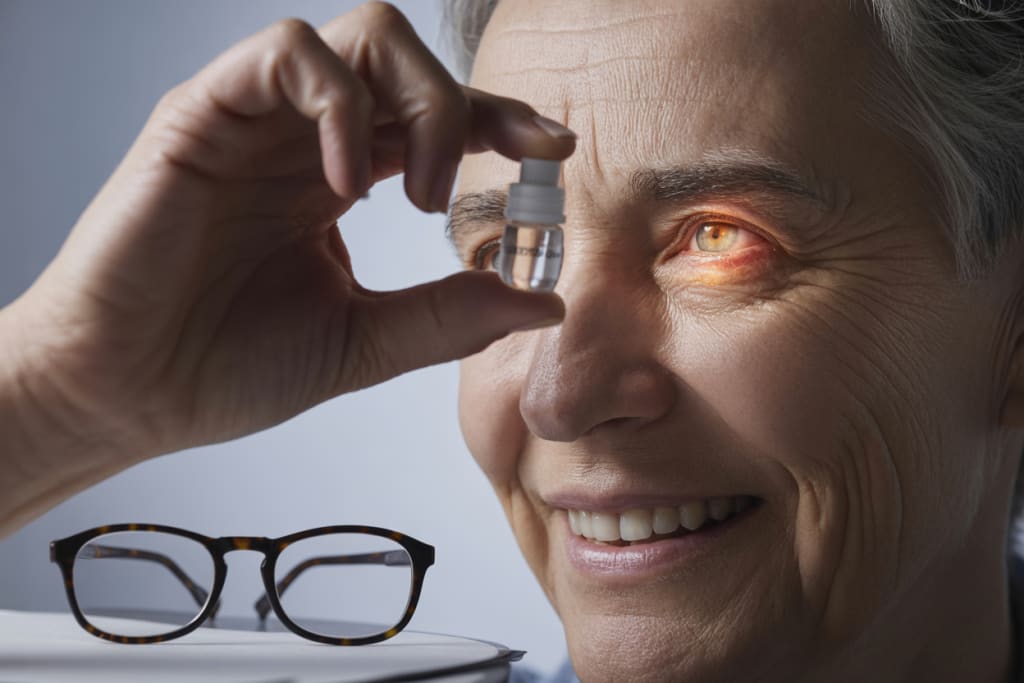
Squinting No More? A New Hope for Your Aging Eyes
Ah, the indignity! The dreaded reach for reading glasses, the strategic arm extension when faced with a restaurant menu, the familiar lament – "my arms are just not long enough anymore!" If this resonates, you're likely acquainted with presbyopia, that near-universal rite of passage into the over-40 club. It’s that gradual blurring of near vision, a frustrating reminder that time, indeed, marches on. But what if I told you there's a new contender in the fight against blurry close-ups? Enter VIZZ, the recently FDA-approved eye drop poised to potentially redefine how we manage age-related vision changes. Could it be a future free from the tyranny of spectacles? A simple drop, and presto, clear vision? Intriguing, isn't it?
Presbyopia: The Ultimate Age-Defying Challenge (for Your Eyes)
Let's demystify this ubiquitous visual gremlin. Presbyopia isn't a disease, mind you. It's simply your eye's lens, once supple and accommodating, becoming a bit… shall we say… less enthusiastic about flexing. The lens loses elasticity, making it harder to focus on nearby objects. And who does it affect? Well, pretty much everyone. Seriously. Estimates suggest that millions upon millions in the US alone grapple with this daily. Traditionally, we’ve resorted to the trusty trio: reading glasses (those ubiquitous "cheaters"), bifocals, and multifocal contact lenses. And for the more adventurous, surgical options exist. But are these the only paths?
A Peek Back in Time: How Far Have We Come?
Humankind has been battling the blurry close-up for millennia. Even Aristotle, that granddaddy of philosophical inquiry, likely squinted at his scrolls. The invention of convex lenses – spectacles! – towards the end of the first millennium was a monumental leap. Can you imagine the sheer relief? For centuries, lenses reigned supreme. More recently, eye drops emerged as a possible alternative. Pilocarpine, for instance (remember Vuity?), worked by constricting the pupil. But alas, these earlier iterations often came with a caveat: side effects that ranged from mildly annoying to downright uncomfortable. A better mousetrap, as they say, was needed.
VIZZ Vision: How Does This Magic Drop Work? (The "Pinhole Effect")
So, what makes VIZZ different? The star of the show is aceclidine, a relative newcomer to the US ophthalmic scene when it comes to treating presbyopia. VIZZ is categorized as a "pupil-selective miotic." Essentially, it’s more discerning in its action, primarily focusing on reducing the pupil size without excessively engaging the ciliary muscle (the culprit behind many of those unpleasant side effects associated with earlier drops).
Think of it this way: remember peering through a tiny pinhole to sharpen an image? That's the essence of VIZZ's mechanism of action, often called the "pinhole effect". By constricting the pupil to a sweet spot of under 2mm, the depth of focus extends, bringing near objects into sharper relief without significantly compromising distance vision.
And the perks? Patients typically experience noticeable improvements in near vision within about 30 minutes. The effects can last for up to 10 hours with a single daily dose. Moreover, the reduced ciliary muscle stimulation often translates to fewer headaches, less brow ache, and less of that disconcerting "zoomed-in" sensation. And the cherry on top? VIZZ is preservative-free and generally well-tolerated, making it a gentler option for many.
The Buzz: What Are Doctors & Patients Saying?
The response from both medical professionals and patients has been notably enthusiastic. Some experts have hailed VIZZ as a "disruptive paradigm shift" and a "transformative improvement" in presbyopia management. The prospect of a non-surgical alternative that could potentially become a new standard of care is generating considerable excitement.
Real-life experiences shared by patients in clinical trials paint a compelling picture. Many have described VIZZ as "life-changing," enabling them to effortlessly read small print, navigate their daily routines without relying on glasses, and even drive with greater comfort. Imagine the possibilities for professionals like truck drivers or home inspectors, whose livelihoods depend on clear vision at various distances! The convenience of a once-daily application and the sustained effect further enhance its appeal, offering a newfound sense of freedom from the constant need for optical aids.
Hold Up! Any Catches or Controversies?
Now, let's inject a dose of reality. VIZZ isn't a permanent solution; you'll need to use it regularly to maintain the benefits. Some users may experience temporary dimness or darkness of vision, particularly at night, so caution is advised when driving in low-light conditions. Clinical trials have reported mild irritation, dim vision, and headaches as the most common side effects, although these are typically transient.
It's also worth noting that miotics, as a class of drugs, have been linked to retinal issues in susceptible individuals, although this wasn't specifically observed with VIZZ in clinical trials. A pre-treatment retinal examination is therefore recommended. Contact lens wearers will need to remove their lenses before applying the drops and wait 10 minutes before reinserting them.
Finally, the "controversy," if you can call it that, lies not in the drug itself but in its potential to disrupt the established market for glasses and surgical interventions. Could VIZZ signal the beginning of the end for reading glasses as we know them? Only time will tell.
Looking Ahead: The Future is Bright (and Clear!)
Looking ahead, VIZZ is poised to become a prominent non-surgical option for managing presbyopia. Its reach is expected to extend beyond the US, with agreements already in place for distribution in Canada.
Researchers are actively exploring avenues for further innovation, including the possibility of combining VIZZ with other medications to achieve even greater visual enhancement. Extended-release formulations are also being investigated to potentially prolong the duration of its effects. The ultimate goal is to develop more personalized treatment approaches that can be tailored to individual patients' unique vision needs and lifestyles. VIZZ represents a broader shift towards less invasive, more patient-centric solutions in ophthalmic care.
Clear Vision, New Horizons

In summary, VIZZ presents a compelling and non-invasive alternative for the millions who grapple with the daily frustrations of presbyopia. It offers the promise of liberation from the constant reliance on glasses, restoring a sense of visual independence. Ultimately, the choice is yours. But with the arrival of VIZZ, the future of clear near vision appears brighter, and perhaps less encumbered by spectacles, than ever before.
About the Creator
Francisco Navarro
A passionate reader with a deep love for science and technology. I am captivated by the intricate mechanisms of the natural world and the endless possibilities that technological advancements offer.
Keep reading
More stories from Francisco Navarro and writers in FYI and other communities.
Detecting Interstellar Idiots: A Field Guide for Cosmic Eavesdroppers
In the grand symphony of the cosmos—filled with ancient light and abyssal silences—we search for signs of intelligent life. But what if the true hallmark of a technological civilization isn’t a carefully modulated radio signal or a Dyson sphere, but something far more... idiotic? Say, for example, a nuclear war. Or, to put it more delicately: a flare of interplanetary stupidity detectable in ultraviolet light.
By Francisco Navarro9 months ago in FYI


Comments
There are no comments for this story
Be the first to respond and start the conversation.