
The Exact Reality in The Ukrainian War A Year Later
Russia attacked Ukraine under the cover of military training a year ago, but the truth is finally out, and Putin's true plan to conquer sections of Ukraine has been unveiled! Read today's spectacular new narrative, which illustrates how much this needless war has cost. ❕😠🆚😡❗

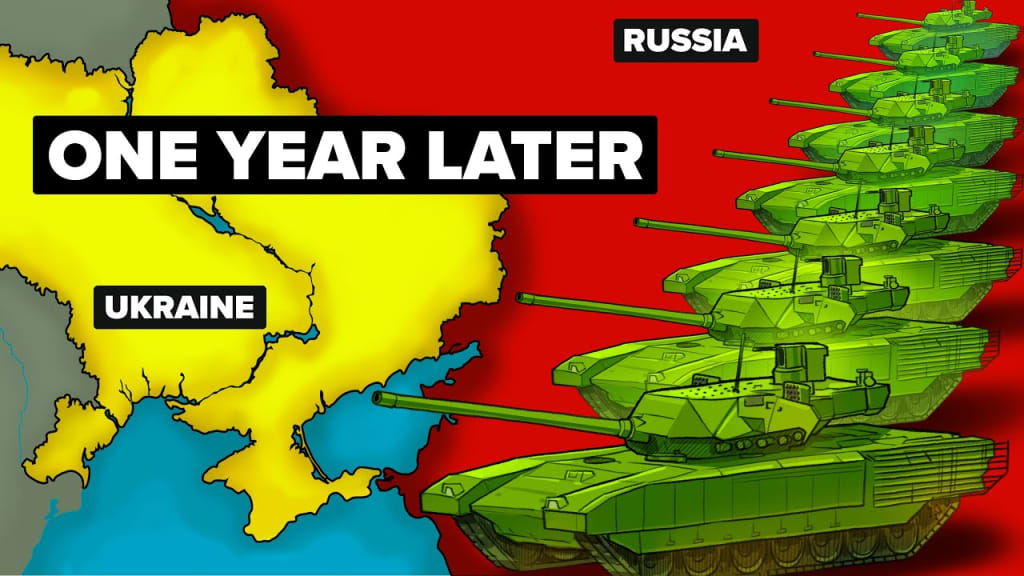
Russia attacked Ukraine under the cover of military training a year ago, but the truth is finally out, and Putin's true plan to conquer sections of Ukraine has been unveiled! Read today's spectacular new narrative, which illustrates how much this needless war has cost. ❕😠🆚😡❗
Tens of thousands of people have died. Millions of artillery shells were fired. Dollars lost in the billions. These figures merely begin to scratch the surface of the costs incurred by the war in Ukraine over the previous 12 months. Russia invaded Ukraine on February 24, 2022. The conflict is still ongoing nearly a year later. Putin and the rest of the world believed that Ukraine would fall within a few weeks of the initial attacks, but it appears that everyone underestimated the tenacity and fortitude of the Ukrainian people. As the war's one-year anniversary draws closer, some mind-boggling statistics are available for analysis, some of which will be difficult to accept. There will be casualties in every war. However, the nature of Russian warfare throughout the conflict has resulted in a significant number of deaths among soldiers, civilians, and kids.
Due to the limited number of timeouts in war, the statistics coming out of Ukraine are constantly changing. And even when cease-fires were declared in the past, Russia blatantly disregarded them and carried on killing innocent people. In order to allow the evacuation of Ukrainian citizens from front-line cities and towns, several cease-fires were agreed upon at the start of the conflict. However, they continued to fire even after Russia consented to allow for a safe exit from these areas. Unarmed civilians who merely wished to flee the carnage instead found themselves trapped in a nightmare of total war, with innocent lives lost. The best estimates place the number of civilian casualties in Ukraine between 20 and 40 thousand.
Indirect deaths from fighting in Ukraine are believed to have killed no less than 7,000 civilians. These deaths were brought on by various factors. Russian artillery, kamikaze drones, and missile attacks resulted in numerous fatalities. However, Putin's hired mercenaries and Russian soldiers, like those of the Wagner Group, have also been accountable for the murder of Ukrainian civilians while committing terrorist acts. As one particularly heinous example, it occurred during the Bucha Massacre, which occurred sometime between the initial invasion and April 2022. When Ukrainian forces began to retake territory in the Kyiv region, they discovered that Russian forces had left Bucha, a town, in a state of carnage. 458 civilian bodies were discovered here.
The remaining 419 deaths were due to natural causes; they were likely brought on by the occupation. The Bucha Massacre's most tragic aspect was the murder of nine children by the fleeing Russian soldiers and the mercenaries who were with them. What took place in Bucharest is inexcusable. Sadly, reports of Russian forces deliberately torturing and killing Ukrainian civilians in order to instill fear in the populace have surfaced on several occasions. This has been done with the intention of weakening their resolve and making the battle easier. The strategy has failed, and the Ukrainian people have stood strong and resiliently in their defense of their nation against Russia. Because the war is being fought on Ukrainian soil, almost all civilian deaths have been reported.
When we look at what's happening in Russia, though, some shocking statistics become apparent. Putin is not universally supported in Russia. Additionally, bad things can happen when you express opposition to a leader's decisions under an authoritarian regime. During Ukrainian forces' sabotage missions, a few Russian civilians were hurt or killed, but their numbers pale in comparison to the number of people who died at the hands of Vladimir Putin and his allies. According to reports, thousands of people have died as a result of the brutal repression of antiwar demonstrations. To protest the invasion of Ukraine at the outset of the conflict, Russian citizens took to the streets. Other protests against the forced conscription of Russians and the war crimes committed in Ukraine erupted as the conflict wore on.
Putin dispatched his riot police once more. Additionally, things never go well when armed soldiers confront unarmed protesters. Thousands of Russians were also detained. One of two things happened to those who were taken into custody: they were either thrown in a Russian prison to rot or sent to the front lines. Therefore, civilians are being killed in Ukraine by Russian soldiers. In Russia, Russian soldiers are killing civilians. Vladimir Putin, regardless of how wealthy or influential they are, is killing anyone who speaks out against him. Since Putin came to power, wealthy oligarchs have been mysteriously dying, but the number of these murders has increased as more successful businessmen have denounced Putin's actions in Ukraine.
In light of this, as the first year of the war draws to a close, the number of civilian deaths in Ukraine and Russia has probably increased into the tens of thousands. Furthermore, 40,000 Russians committed suicide by alcohol in a single year, which is not even mentioned in this figure. Alcoholism is a major issue in the country, and the war has only made it worse. Russians are turning to alcohol as concerns about being drafted grow, poverty worsens as a result of sanctions, and life in general becomes more miserable. It's likely that the strains brought on by war are to blame for a significant portion of the civilians who died from alcohol poisoning over the past year. There are also, of course, military casualties. Again, as Russians and Ukrainians are killed by artillery, missiles, and bloody clashes, the number of soldiers dying in the conflict literally fluctuates every day.
However, estimates place the number of Russian fatalities at around 130,000. The number of soldiers who lost their lives each day was significantly higher at the beginning of the conflict, when fierce fighting occurred every day. As both sides get ready for the upcoming spring offensives, fighting in Ukraine has slowed since the start of the winter months. Long-range strikes have continued to kill soldiers and civilians, though, even as defensive positions were taken up until the next stage of the war. Most estimates place the number of Ukrainian soldiers who have died or been injured during the conflict at 100,000. The number of fatalities on both sides is staggering, though it is probably less than the number of Russian casualties.
There's a good chance that as you read through this narrative, the death toll on at least one side of this conflict has gone up. The number of artillery shells that have been fired over the past year is arguably the most absurd statistic to come out of the war in Ukraine. During the first few months of the invasion, Ukraine is thought to have fired between 4,000 and 7,000 artillery shells per day. Even conservative estimates place the total number of artillery shells fired by Ukraine so far at well over one million. This number has been scaled back due to the decrease in fighting over the winter and the diminishing supply of artillery shells. Let's now examine the quantity of artillery rounds discharged. In terms of military size at the start of the conflict, Russia had the second-largest force in the world. But as we've seen, a large military isn't always indicative of a strong military.
It simply means you have a lot of weapons and, in Russia's case, a ton of artillery and ammunition. The number of shells fired by Russia during the first few weeks of fierce fighting in Ukraine has been estimated to range between 20,000 and 30,000 per day. According to some reports, it may have reached 60,000 shells per day, while others place the number closer to 10,000. Whichever way you look at it, Russia has been firing a lot more shells than Ukraine. According to the average estimate, Russia has fired approximately 5 million artillery rounds over the past year. Additionally, the actual number might be much higher. Given this astounding figure, it should not be surprising that both Russia and Ukraine are running low on artillery shells.
The production of artillery ammunition is increasing daily because it is relatively simple to make compared to guided missiles and drones. The shortage is not limited to artillery shells, though. Many vehicles have also been lost on both sides. But it appears that Russia is winning the race to see who can lose more military hardware in the conflict. As the first year of the war draws to a close, estimates place Russia far ahead in terms of the amount of equipment destroyed or captured over the past 12 months. We are estimating that Russia lost, on average, 9,000 pieces of equipment, compared to Ukraine, which lost, on average, 3,000. From armored cars to naval ships, these are just a few examples of the diverse equipment types. It will soon become clear that Ukrainian forces are incredibly effective at destroying Russian machinery.
Even if Ukraine loses military assets in the trade against Russia, they still manage to destroy numerous additional important targets. Putin's forces are losing a lot of battles, regardless of what he says. The Ukrainian military is not being routed by them. And as we get closer to the invasion's one-year anniversary, they are most definitely not in any position to win the war. Around 3,300 tanks were said to be in readiness for combat when the war first started in Europe. Around 12,000 tanks were thought to be in reserve. Ukraine, on the other hand, had a total of fewer than 2,000 tanks. This is one of the reasons why, when Russian forces invaded Ukraine, the rest of the world believed they had no chance. However, the destruction or capture of hundreds of tanks is one of the biggest setbacks Ukraine has dealt Russia over the past year.
Over 1,600 tanks have reportedly been lost by Russia in the conflict so far. Due to the fact that these tanks are even simpler to destroy, they have dusted off their outdated Soviet-era tanks. Russian tank numbers have been drastically reduced by Ukrainian forces using Javelins and other anti-tank weapons supplied by the West. But due to Russian incompetence, hundreds of tanks have also been abandoned because of mechanical issues, fuel shortages, or simple stuckness. When this occurs, Ukrainian forces are only too happy to repurpose the Russian tanks from their adversaries for their own use. There have reportedly been less than 500 tanks lost by Ukraine. The stark contrast in tank losses highlights how disastrous the first year of the war in Ukraine has been for Russia.
There will be more losses for Russia as a result of the United States' recent pledge to send 31 M1 Abrams, among the most advanced tanks in the world, to Ukraine. Russia seems to have suffered fewer losses in the war in the area of air and naval craft than Ukraine. This is one of the arguments Ukraine has made to the West in an effort to get more anti-aircraft defense systems and surface-to-air missiles sent over. Russia has lost about 200 aircraft so far, compared to about 210 lost by Ukraine. Although there isn't much of a difference, Ukraine is likely to feel the losses much more severely because the Russian air force is much larger than the Ukrainian air force. The number of aircraft lost by Russia, however, is closer to 600 if we take into account the number of drones that Ukraine has shot down. Therefore, it's hard to say for sure who is winning this battle.
Unfortunately, even though Ukraine has succeeded in destroying Russia's aerial vessels, missiles and drones have wreaked havoc on the nation's infrastructure during the war's colder months. Additionally, it is thought that Russia bought around 1,700 Shahed-136 kamikaze drones from Iran; therefore, the number of drone losses from flying them into targets will be significant for Russia. However, given that the US sold 700 Switchblade kamikaze drones to Ukraine, the number of drones lost or lost in the future by Ukraine will also be significant. On the high seas, Ukraine has significantly harmed Russia's Black Sea Fleet. They even succeeded in sinking the Russian flagship Moskva, a guided missile cruiser that was operating off the Snake Island coast.
At least five Raptor-class patrol boats, as well as a number of landing ships and corvettes, have all been sunk by Ukraine. At least 12 ships from the Black Sea Fleet have been damaged or sunk overall by Ukrainian forces. On the other hand, about 30 Ukrainian boats have been sunk by Russia. It's crucial to remember that many of these vessels—along with a number of unmanned surface ships—were regular ships that had been modified for military purposes. Russia has thus destroyed more Ukrainian ships overall, but the ships themselves are very different. This indicates that, overall, the Russian Navy has been significantly more negatively impacted by Ukraine than the other way around. This brings us to yet another enormous number. Both sides have spent enormous sums of money on purchasing weapons, ammunition, and, in the case of Russia, paying mercenaries because war is expensive.
How much money has been lost in the war in terms of vehicles, ammunition, and soldiers? According to some estimates, Russia has lost around 18 billion dollars in equipment-related losses. This is an incredible amount. However, the lost equipment comes from all walks of life. Everything from Cold War technology to contemporary weapons is being used by Russia. But the 18 billion dollars in equipment losses in just one year really puts the cost of the war into perspective. Although Ukraine has suffered significant equipment losses of its own, it is unquestionably receiving more foreign assistance than Russia. Over the past year, the US has sent Ukraine more money than any other country. Just fewer than 25 billion dollars have been sent by the Biden administration alone. However, even before the war started, the U.S. was supplying Ukraine with aid so that it could safeguard itself from the exact circumstance that exists right now.
Unfortunately, it wasn't enough and obviously came a little too late. Nearly 48 percent of U.S. assistance has gone to Ukraine for military uses like buying supplies and equipment. Nearly 10 billion dollars have been spent on logistics for weapons and training, and another 15 billion have been sent for financial assistance. Humanitarian aid totaling $10 billion has also been sent, but this is hardly enough to support all of the people who have lost everything as a result of the war. And speaking of money, as the first year of the war draws to a close, Russia's economy is at a critical point. Even though severe sanctions created problems with supply and cash flow, Russia was still able to survive at the start of the war. Its continued ability to sell oil and other fossil fuels to nations like China, India, and much of Europe allowed it to continue funding its war effort.
It seems that there aren't enough cash reserves as the war's anniversary approaches. Russia's ability to finance its military activities during the conflict is not yet clear. Despite the abundance of available economic data, Russia's GDP had decreased by about 4% over the previous year, and it appears that this decline will continue and get significantly worse in the months to come. Ukraine has a lot more support than Russia does, despite the fact that their economy is also in turmoil. After a year, there has been a slight change in the number of countries that support each side in the conflict. NATO countries were hesitant to publicly support Ukraine when the invasion first began. Sure, they denounced the invasion and eventually imposed economic sanctions on Russia, but many nations were wary of Russia when it became apparent that Ukraine wouldn't be able to stop the invasion.
They reasoned that there was a chance Putin wouldn't stop expanding there if he could claim Ukraine. As the massacre of Ukrainians began in the early weeks of the war, some nations around the world and in Europe remained silent. More countries came out of hiding to support Ukraine, though, once the tides turned and it became clear that Ukraine would not only stop the invasion but also have a good chance of winning the war. Forty nations openly support Ukraine after a year of fighting.
Certified. You're definitely going to miss out.
Make sure to always be updated. Possibly Daily. 😁
About the Creator
Building a New Era: Inside the Indonesia Commercial Construction Boom
Market Overview: The Construction Engine of Southeast Asia Indonesia is currently undergoing one of the most significant infrastructure transformations in its history. As the largest economy in Southeast Asia, the archipelago is moving beyond basic infrastructure development and stepping into a new era of sophisticated commercial construction.
By Sam walter5 days ago in FYI


Comments
There are no comments for this story
Be the first to respond and start the conversation.