
The Enduring Mystery of the Roanoke Colony
Exploring the Theories and Discoveries Surrounding America's Lost Settlers

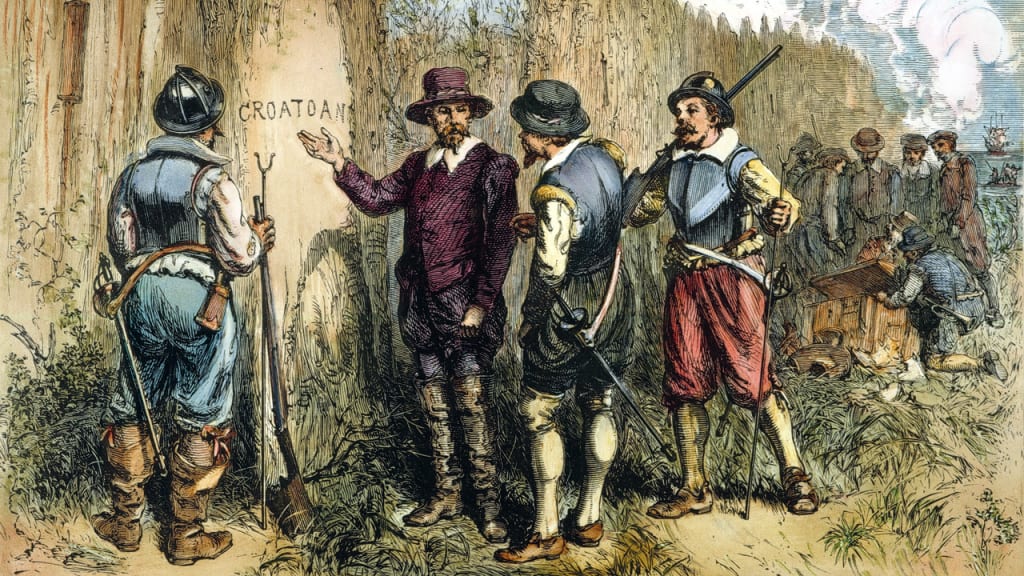
The mystery of the Roanoke colony has fascinated historians and amateur sleuths alike for centuries. The settlement was established in 1587 by Sir Walter Raleigh, with the aim of creating a permanent English presence in the New World. However, when a supply ship arrived at the colony in 1590, it was deserted, with no sign of the colonists or their belongings. The only clue was the word "Croatoan" carved into a post.
Over the years, many theories have been put forward to explain the fate of the colonists. One popular theory is that they were killed by hostile Native Americans. At the time, tensions were high between the English and the local tribes, and there were reports of clashes between the two groups. It is possible that the colonists were attacked and killed, and their bodies hidden or disposed of.
Another theory is that the colonists succumbed to disease or starvation. The settlement was established in a difficult environment, and the colonists may have struggled to find enough food and clean water. It is also possible that they were hit by a deadly epidemic, which wiped out the entire settlement.
A third theory is that the colonists were absorbed into local tribes. The Croatoan were a friendly tribe that had previously traded with the English, and it is possible that the colonists decided to integrate with them rather than face an uncertain future in the settlement.
Despite these theories, no definitive explanation for the colony's disappearance has ever been found. The lack of evidence has led some to speculate that the colonists may have attempted to sail back to England, but were lost at sea. Others have suggested that they may have been taken captive by the Spanish or Portuguese, who were active in the region at the time.
The mystery of the Roanoke colony has captured the public imagination for centuries, and has inspired countless works of literature, film, and television. In recent years, a renewed interest in the mystery has led to new investigations and discoveries.
In 2015, archaeologists uncovered a tantalizing clue in the form of a small lead tablet. The tablet was found near the site of the Roanoke settlement, and contained a curious inscription. The inscription read "Ananias and Virginia went hence unto heaven 1591". Ananias Dare and Virginia Dare were two of the colonists who had disappeared from the settlement, and the inscription suggested that they had died the year after the settlement was established.
However, the tablet has also been the subject of controversy, with some experts questioning its authenticity. The mystery of the Roanoke colony remains unsolved, and may never be fully explained. However, the continued fascination with the mystery ensures that the Roanoke colony will remain one of history's enduring enigmas.
The Pre-History Of The Lost Roanoke Colony
The year is 1587. Under the rule of Queen Elizabeth I, England is strong and prosperous. Shakespeare writes in London’s taverns, Sir Francis Drake leads daring raids against the Spanish, and an increasingly literate and urban population turns its eyes to a new frontier: the Americas.
Among those attracted to the promise of the New World was John White, a gentleman artist and mapmaker with a passion for new lands. He had already been to North America once — though the experience was so harrowing that many were astonished he wanted to return.
Three years before the voyage of the famous Lost Colony of Roanoke, White had been the artist for the ill-fated 1585 expedition of Sir Ralph Lane, a mission so badly executed that it was a miracle anyone returned.
White had been aboard the Tiger when it ran aground on a rocky North Carolina sandbar and destroyed most of its food supplies in the process.
Instead of making friends with the area’s well-provisioned natives, the mission’s admiral looted and burned an Algonquian village in search of a misplaced silver drinking cup he believed had been stolen.
The admiral then departed for other ventures, leaving Lane, White, and roughly 100 other men stationed on nearby Roanoke Island with the understanding he would return to resupply them shortly.
It was a disastrous move. The aggrieved Native Americans attacked the Roanoke settlement, and though the colonists managed to defend themselves, it was the final straw for many.
When Francis Drake miraculously showed up and offered them a ride home, a significant number took him up on the offer. The rest — all but a small detachment of 15 left behind to maintain England’s claim — hopped on the supply ships that appeared the following week and never looked back.
But White was different. Though he returned to England, he remained enthusiastic about the New World’s promise — so enthusiastic that when a second voyage to the area was proposed, he was asked to join, this time as the colony’s prospective governor.
And he didn’t just say yes. He convinced his own family, including his pregnant daughter and her husband, to join the perilous expedition along with 115 other hopefuls looking for adventure and a home in the New World.It was a very different group that set out for North Carolina the second time around. The 1587 expedition, unlike the previous one, included women and children, and its members were more interested in settlement and a fresh start than exploration.
Like the 1585 colonists, however, they found themselves plagued with troubles almost from the moment their feet touched the ground.
For one, their new life was starting about 100 miles off course. Home was supposed to be a fertile site in the Chesapeake Bay area. But the ship’s navigator, forced to stop at Roanoke Island to check on the 15 men White’s last expedition had left behind, reportedly refused to continue on.
The colonists could stay at Roanoke, he said — it had been good enough for the last group, and he had Spanish ships to plunder.
So the colonists, eying their new home warily, forged inland to track down what was left of the old settlement.
The answer was unnerving: bones.
About the Creator
Santosh Belbase
I Write Blog, who enjoys technology, YouTube Tips & Tricks, SEO, Travel Cities knowledge, Fitness courses,poem and fictions,True Crime Stories and helping people access information that they need.
Keep reading
More stories from Santosh Belbase and writers in FYI and other communities.
How should I start learning Python?
Python is a popular programming language known for its simplicity, versatility, and ease of use. Whether you're a beginner or an experienced programmer, learning Python can be a valuable skill that opens up a world of possibilities for you. In this article, we'll guide you through the steps of getting started with Python and help you develop a solid foundation for your learning journey.
By Santosh Belbase3 years ago in Education
3 Impossible Planets That Defy the Laws of Astronomy
For as long as humans have looked up at the stars, we’ve tried to make sense of our place in the universe. We’ve found thousands of exoplanets orbiting distant suns, and we thought we had a pretty good handle on how they formed.
By Areeba Umaira day ago in FYI
How to Succeed at the Benson Directory®
Congratulations and welcome to the Benson Directory® employee #22391! As our newest call handler, you will have the privilege of speaking with dozens of unique and interesting people on a daily basis as well as the opportunity to earn bonuses for high performance. Contained within this handbook you will find a set of ease to follow instructions designed to help you settle in to your new role and begin paving the way to success.
By S. A. Crawfordabout 19 hours ago in Fiction




Comments
There are no comments for this story
Be the first to respond and start the conversation.