
3 Impossible Planets That Defy the Laws of Astronomy
According to our theories, these worlds shouldn't exist, but NASA found them anyway.

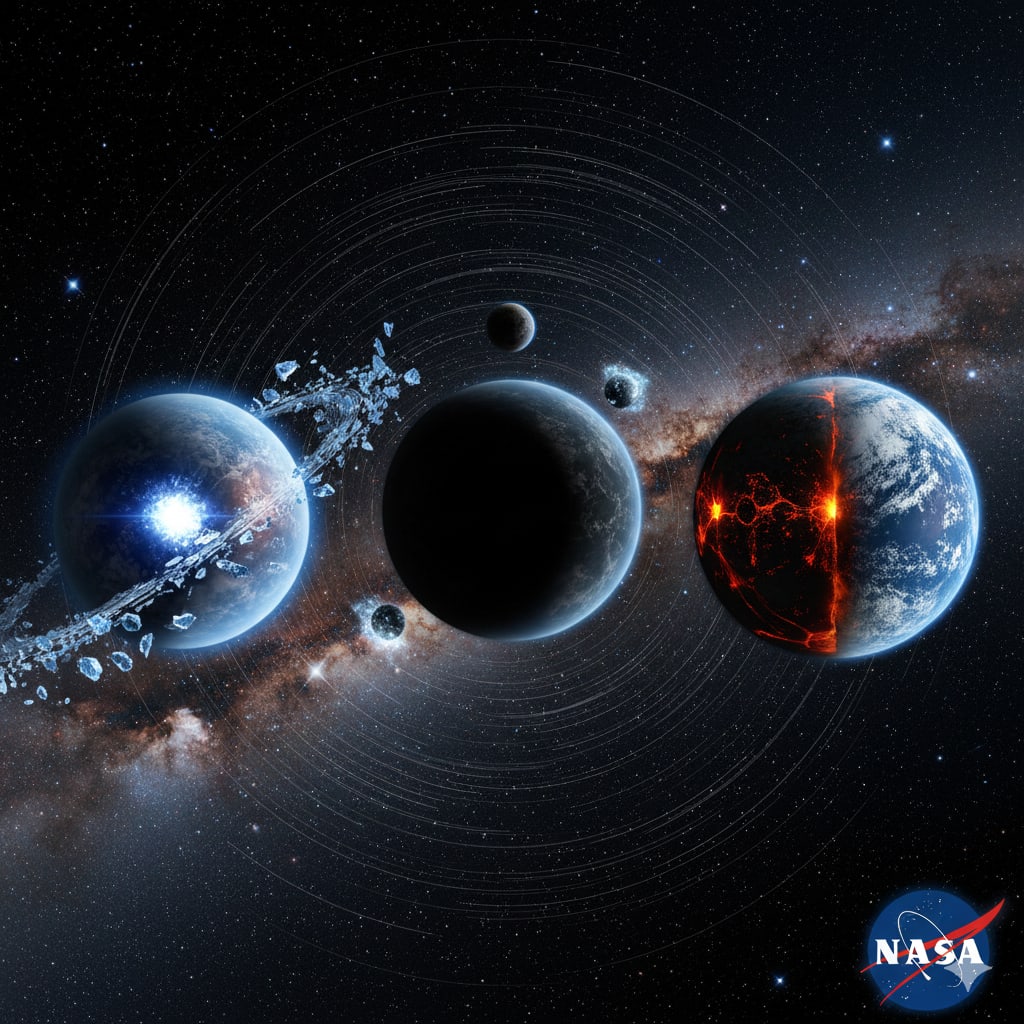
For as long as humans have looked up at the stars, we’ve tried to make sense of our place in the universe. We’ve found thousands of exoplanets orbiting distant suns, and we thought we had a pretty good handle on how they formed.
But every once in a while, the universe throws us a curveball. Astronomers have recently discovered three planets that are so strange they’ve been dubbed "impossible." According to everything we know about physics and planetary formation, these three worlds simply shouldn't be there.
1. Kepler-78b: The Inferno with an 8.5-Hour Year
Imagine a planet that is roughly the same size and mass as Earth, made of rock and iron just like our home. Sounds cozy, right? Well, not exactly.
Kepler-78b orbits a star about 400 light-years away, but it is 100 times closer to its host star than Earth is to the Sun. Because it’s so close, the surface temperature is a blistering 3,100 Kelvin. It’s essentially a blazing inferno where a "year" (one full trip around the star) lasts only eight and a half hours.
The Mystery: Why shouldn't it exist? When this star system was forming, the star itself was much larger than it is now. Based on its current position, Kepler-78b would have actually been inside the star during its formation. That’s physically impossible. Scientists are still scratching their heads over how it got there without being swallowed up or spiraling into the sun.
2. Kepler-10c: The "Mega-Earth" That Refused to Grow Up
When astronomers first spotted Kepler-10c, they figured they knew exactly what it was. At 2.3 times the radius of Earth, it looked like a "mini-Neptune", a planet with a small rocky core and a massive, thick atmosphere of gas.
But when they measured its mass, they were stunned. Kepler-10c is 17 times more massive than Earth. This suggests it isn’t a gas giant at all, but a solid, incredibly dense rock.
The Mystery: A planet that heavy has a massive amount of gravity. According to our current understanding of how planets form, gravity should have sucked in all the nearby hydrogen and helium, turning the planet into a gas giant like Jupiter. Instead, it stayed a "Mega-Earth." It’s a giant rock that defies the rules of planetary growth.
3. HD 106906 b: The Lonely Giant
Finally, we have HD 106906 b, a gas giant that makes Jupiter look like a toy. It’s 11 times as massive as our Solar System's largest planet, but that isn’t even the weirdest part.
This planet orbits its star at a distance of 650 Astronomical Units (AU). To put that in perspective, that is 20 times further away than Neptune is from our Sun.
The Mystery: Out that far from a star, there shouldn't be enough gas or dust to create a planet, let alone a massive giant like this one. Even more confusing? The star system is only 13 million years old, hardly a blink of an eye in cosmic terms. There simply wasn't enough time for a planet to grow that big that far away. Some think it was "kicked out" from the center of the system, but for now, it remains a total enigma.
Why These Mysteries Matter
These three planets are more than just cosmic oddities. They remind us that our "laws" of astronomy are really just our best guesses based on what we’ve seen so far. Every time we find a "Mega-Earth" or a "Hell-World" that shouldn't be there, we are forced to rewrite the textbooks.
It’s the strangest discoveries that make space so cool. Just when we think we’ve figured out how the universe works, a new planet shows up to tell us we’ve still got a lot to learn.
About the Creator
Areeba Umair
Writing stories that blend fiction and history, exploring the past with a touch of imagination.
Keep reading
More stories from Areeba Umair and writers in FYI and other communities.
Wild Card Weekend Recap: What Happens Now?
I think I figured out why I love Wild Card Weekend so much. It's because it's the first playoff anything of the calendar year. The NFL season starts in the fall, and once upon a time, the champion was crowned either on or slightly before New Year's. The evolution of the NFL schedule has resulted in the playoffs starting just into the New Year, and currently, the final week of the season falls on the first weekend of the New Year, with Wild Card Weekend coming a week after that. So yes, chronologically, the NFL's Wild Card Weekend serves as the first playoff anything of the calendar year.
By Clyde E. Dawkins4 days ago in Unbalanced



Comments
There are no comments for this story
Be the first to respond and start the conversation.